

Syllabus: GS3/Infrastructure
Context
- PM GatiShakti National Master Plan for multi-modal connectivity has completed four years.
PM GatiShakti National Master Plan (PMGS-NMP)
- It was launched in 2021 for providing multimodal connectivity infrastructure to various economic zones and improving logistics efficiency across India.
- It is not under a single ministry but is coordinated by the Department for Promotion of Industry and Internal Trade (DPIIT) under the Ministry of Commerce and Industry.
- Aim: To provide seamless and efficient connectivity for the movement of people, goods, and services across various modes of transport, thereby enhancing last-mile connectivity and reducing travel time.
- PM GatiShakti is driven by seven engines: Railways, Roads, Ports, Waterways, Airports, Mass Transport and Logistics Infrastructure.
- 57 Central Ministries/Departments including 8 Infrastructure, 22 Social and 27 Economic & other Ministries/Departments have been onboarded on PMGS NMP.
Key Achievements of PM GatiShakti in Past Four Years
- State and UT Integration: All 36 States/UTs have developed State Master Plan (SMP) Portals aligned with the National Master Plan (NMP).
- Over 600 projects planned and mapped on the PM GatiShakti portal, streamlining capital investment and execution.
- Expansion to Social and Economic Sectors: PM GatiShakti extended to social infrastructure — education, health, and welfare.
- Identified infrastructure gaps in schools, hospitals, anganwadis etc.
- Enhanced planning for primary healthcare, education, postal services, and tribal development, ensuring coverage of remote and underserved areas.
- District-Level Planning: The PM GatiShakti District Master Plan (DMP) portal, developed with technical support from BISAG-N, facilitates collaborative district-level planning for 28 Aspirational Districts.
- Capacity Building and Training: DPIIT conducted 20,000+ official training through iGOT modules, workshops, and interactive sessions.
- International Collaboration: Engagement with Nepal, Bangladesh, Sri Lanka, Madagascar, Senegal, and Gambia to promote geospatial technology and integrated infrastructure planning through the PM GatiShakti framework.
Overview of the Logistics Landscape in India
- India’s logistics sector was valued at USD 215 billion in 2021. It is well-positioned for strong growth with an expected compound annual growth rate (CAGR) of 10.7% till 2026.
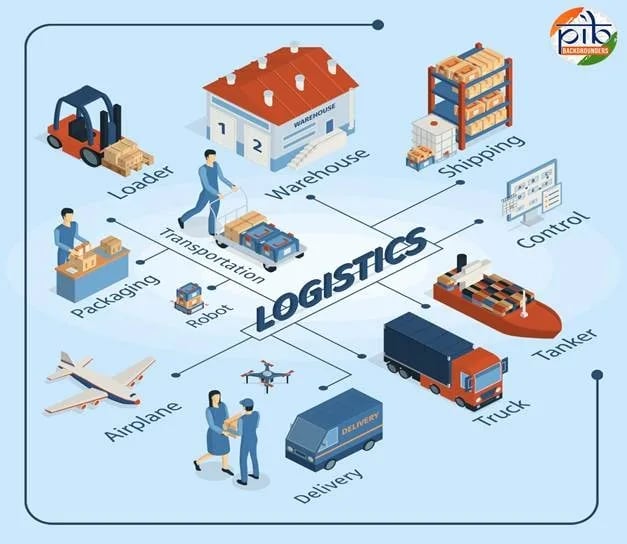
- In 2017, a separate logistics unit was created under the Department of Commerce to oversee the Integrated Development of Logistics Sector.
- The Logistics Industry supports manufacturing, retail, e-commerce, and services by managing inventory, transportation, storage, warehousing, and distribution, linking producers to consumers, both domestically and internationally.
Challenges
- High Logistics Cost: India’s logistics cost is very high at around 13–14% of GDP, making Indian exports less competitive compared to global peers.
- Infrastructure Gaps: The sector suffers from infrastructure gaps in warehousing, cold storage, and last-mile connectivity.
- Multimodal Transport Issues: The low share of railways and inland waterways in freight transport hampers the development of an efficient multimodal system.
- Environmental Concerns: Heavy dependence on diesel-based trucking increases carbon emissions and contributes to environmental pollution.
Key Government Initiatives in Logistics
- Maritime Amrit Kaal Vision 2047: It is aligned with blue economy principles, lays out a long-term roadmap to transform India’s maritime sector.
- The vision also aims to boost coastal tourism, strengthen maritime skill development, and position India as a global hub for shipbuilding and repair.
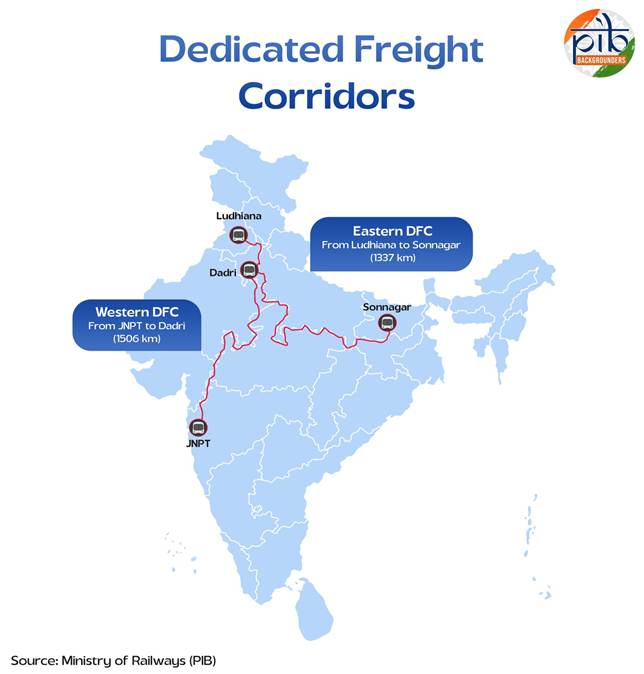
- Dedicated Freight Corridors: The Ministry of Railways is currently developing two Dedicated Freight Corridors (DFCs).
- The objectives of these specialized railway lines are to ease congestion on existing passenger routes, lower transportation costs, and improve energy efficiency.
- Multi-Modal Logistics Park: 35 key locations such as Chennai, Bengaluru, Nagpur, Indore, and others have been approved through both private and public sector efforts for the development of MMLPs. Out of these, 5 are expected to be operational by 2027.
- Unified Logistics Interface Platform (ULIP): It is a digital platform that brings together data from various logistics-related ministries and departments on a single interface; it has recorded 100 crore API transactions in 2025.
- Gati Shakti Vishwavidyalaya (GSV): The GSV is India’s first university dedicated to transport and logistics education.
- GSV plays a key role in preparing skilled professionals to support this national goal.
- Gati Shakti Vishwavidyalaya has signed Memoranda of Understanding (MoUs) with about 40 different industrial and academic institutions.
- Sustainability:The Freight Greenhouse Gas (GHG) Calculator has been developed for calculating and comparing the total cost of transportation and GHG emissions to build awareness and support sustainable development.
- The Indian Railways has launched Rail Green Points for freight customers, allowing them to see potential carbon emission savings.
Source: AIR
Previous article
India and Saudi Arabia to Deepen Trade Relations
Next article
Draft Electricity (Amendment) Bill 2025
