

Rajasthan Assembly Passes ‘Anti-Conversion’ Bill
Syllabus: GS2/ Polity and Governance
Context
- The Rajasthan Legislative Assembly passed the “Rajasthan Prohibition of Unlawful Religious Conversion Bill, 2025”.
Background
- As of 2025, 11 states have passed laws to regulate religious conversion on the ground of public order.
- Article 25 of the Constitution provides for the fundamental right to freedom of conscience and free profession, practice and propagation of religion.
- The Supreme Court, 1977 ruled that this fundamental right does not include the right to convert another person to one’s own religion, but to transmit or spread one’s religion by an exposition of its tenets.
Key Features
- The Bill prohibits religious conversions by force, coercion, misrepresentation, undue influence, allurement, marriage, or any fraudulent means.
- The person undergoing conversion and the converter must make declarations before the DM.
- The DM will conduct inquiry and invite objections.
- Persons who can lodge an FIR against a forced conversion include the victim, parents, brother, sister, or anyone related by blood, marriage, or by adoption.
- General offences: Unlawful conversions will invite imprisonment of seven to fourteen years and a minimum fine of ₹5 lakh.
- Vulnerable groups: If the converted person is a minor, woman, differently abled, or from SC/ST communities, the punishment will be ten to twenty years of imprisonment and a fine of ₹10 lakh.
- Mass conversions: In cases of mass conversions, guilty parties face twenty years to life imprisonment along with a minimum fine of ₹25 lakh.
Key Issues
- Details of conversion and personal details of the person converting will be put on public notice. This may violate a person’s right to privacy.
- Re-conversion to a person’s previous religion will not be considered as conversion. This may violate the right to equality.
Source: IE
Langkhon Festival
Syllabus: GS1/ Culture
Context
- The Tiwa tribesmen celebrated the Langkhon (Langkhun) Festival in Umsowai village of Karbi Anglong district, Assam.
About
- The festival involves the worship of bamboo over four days, symbolizing fertility, resilience, and the close bond between nature and human life.
- It is primarily celebrated in the Karbi Anglong district of Assam, but also holds importance in other Tiwa-inhabited regions.
- The tribe celebrates the annual harvest festival to offer their sacrament to Ramsa Devota and other Gods seeking wellbeing of their paddy from pests and a good yield.
Source: TH
National Scheduled Tribe Finance and Development Corporation (NSTFDC)
Syllabus: GS2/ Governance
In News
- Coal India Limited (CIL) and the National Scheduled Tribe Finance and Development Corporation (NSTFDC) have signed a Memorandum of Understanding (MoU) aimed at empowering tribal students enrolled in Eklavya Model Residential Schools (EMRSs).
About NSTFDC
- Established: NSTFDC was set up in 2001 under the Union Ministry of Tribal Affairs, Government of India.
- Objective: Its core goal is the socio-economic and educational upliftment of Scheduled Tribes (STs) by providing better self-employment opportunities to help them become economically independent and self-reliant.
- Role in Training: NSTFDC also provides grants for conducting skill development and training programs aimed specifically at tribal youth.
Source: TH
Scope of Social Security to Expand with SPREE-2025 and AMNESTY Scheme
Syllabus:GS2/Governance
In News
- The Employees’ State Insurance Corporation (ESIC) has launched two key initiatives — SPREE-2025 and the AMNESTY Scheme-2025 — to expand social security coverage and ease compliance for industries.
SPREE-2025
- SPREE-2025 (Scheme for Promoting Registration of Employers and Employees) will be active until 31st December 2025.
- It allows unregistered industries and employees to enroll with ESIC via the ESI Portal, Shram Suvidha Portal, or Company Affairs Portal without paying past dues.
- Registered employers will be covered from their chosen date, and employees will receive ESIC benefits from the registration date.
- The scheme promotes voluntary compliance over punishment, aiming to reduce litigation and build trust between employers and employees.
AMNESTY Scheme-2025
- It is a one-time dispute resolution initiative by ESIC, effective from 1st October 2025 to 30th September 2026.
- It aims to reduce the backlog of court cases and promote compliance under the ESI Act by allowing employers to settle legal disputes with ESIC through out-of-court settlements.
Source :PIB
Ethiopia Opens Africa’s Largest Dam Across Nile
Syllabus: GS1/ Geography
Context
- Ethiopia has inaugurated the Grand Ethiopian Renaissance Dam (GERD), Africa’s largest hydro power project.
About the GERD
- Location: Guba, Ethiopia, on the Blue Nile (a major tributary of the Nile).
- Installed capacity: 6,450 MW, placing it among the world’s top 20 hydroelectric dams.
- The dam remains contentious among downstream nations including Egypt and Sudan.
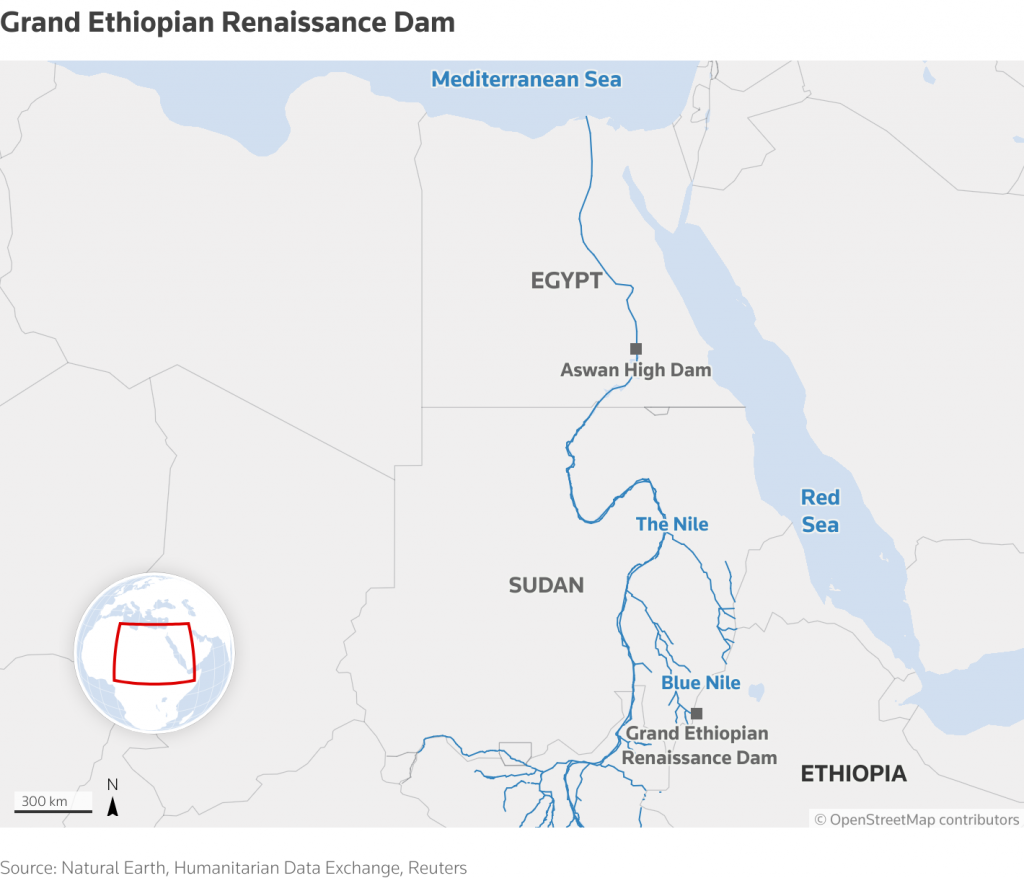
| About the Blue Nile – The Blue Nile originates in Lake Tana, located in the Ethiopian Highlands of eastern Africa. – It joins the White Nile at Al-Muqrin in Khartoum (the capital of Sudan). From this confluence, the river flows north through Sudan and Egypt, eventually emptying into the Mediterranean Sea as the Nile. – The Nile River is the longest river in the world, flowing through 11 countries: Democratic Republic of the Congo, Burundi, Uganda, Kenya, South Sudan, Ethiopia, Eritrea, Rwanda, Tanzania, Sudan and Egypt. |
Source: BBC
Vembanad Lake
Syllabus: GS3/ Environment
In News
- Vembanad Lake of Kerala is facing a severe ecological crisis.
About Vembanad Lake
- It is the longest lake in India and the largest in Kerala.
- It is a Ramsar site and a wetland of international importance.
- It is fed by 10 rivers including Pamba, Meenachil, Achankovil, Manimala, and Periyar and eventually opens into the Arabian Sea.
Source: DTE
EXERCISE ZAPAD 2025
Syllabus: GS3/Defence
Context
- An Indian Armed Forces contingent departed for Russia to take part in the multilateral joint military exercise ZAPAD 2025.
About the Exercise
- More than 20 countries, including China, are participating in the exercise. Notably, for the first time since Operation Sindoor, the Indian and Pakistani armies will take part in the same military drill.
- The exercise aimed at enhancing military cooperation, improving interoperability, and providing a platform for participating armies to exchange tactics, techniques and procedures in the domains of conventional warfare and counter-terrorism operations.
Source: PIB
Previous article
India Need to Build Climate-Resilient Cities
