


Syllabus: GS3/Energy Infrastructure
Context
- India’s power sector, long characterized by fragmented regulation, mounting debts, and inefficient distribution, is undergoing vital reforms to meet modern energy needs and ensure sustainable, reliable access for all.
India’s Power Sector
- Installed Generation Capacity: India is the third-largest producer and consumer of electricity worldwide, with an installed power capacity of 466.24 GW as of January 31, 2025.
- India’s Coal Based Energy: It contributes nearly 55% to the national energy mix and fuels over 70% of total power generation.
- It has the fifth-largest coal reserves and is the second-largest consumer.
- Sulphur Dioxide (SO₂), a harmful pollutant associated with respiratory and ecosystem damage, remains a major concern.
- Renewable Energy Growth: India is among the top nations globally for solar and wind capacity, aiming for 500 GW of non-fossil fuel capacity by 2030.
- Total Installed Capacity (renewable energy sources, including large hydropower): 209.45 GW (As of December 2024).
- Wind Power (48.16 GW); Solar Power (97.87 GW); Biomass/Co-generation (10.73 GW); Small Hydro (5.10 GW); Waste To Energy (0.62 GW), and Large Hydro (46.97 GW).
- Total Installed Capacity (renewable energy sources, including large hydropower): 209.45 GW (As of December 2024).
- Transmission Infrastructure: The country boasts one of the world’s largest synchronized power grids, enabling electricity transfer across regions.
- India has achieved near-universal electricity access, with over 99% of villages electrified.
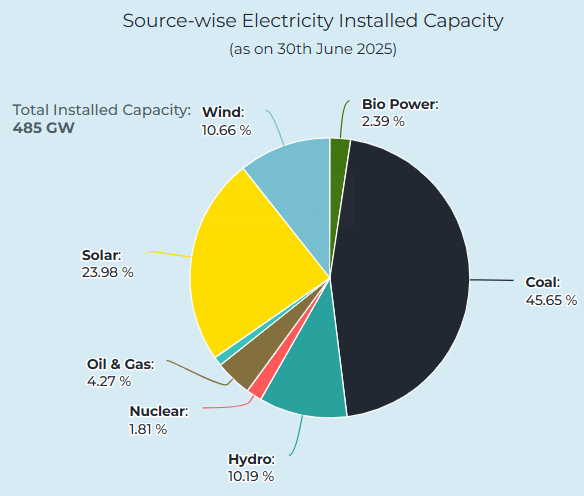
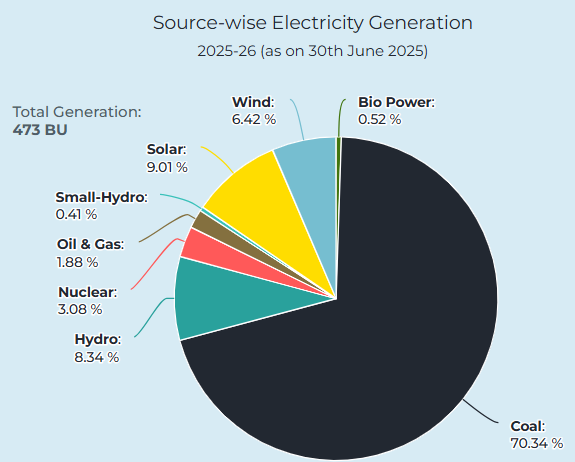
| Flue Gas Desulphurisation (FGD) – MoEFCC mandated the installation of Flue Gas Desulphurisation (FGD) systems to curb SO₂ emissions. 1. In 2015, India introduced revised emission norms, requiring mandatory FGD installation across thermal plants by 2017. – It is a set of technologies used to remove SO₂ from exhaust flue gases of fossil fuel plants. – The most common method in India is wet limestone scrubbing, where SO₂ reacts with limestone slurry to form gypsum. |
Key Concerns & Challenges
- Coal Dependency: Thermal power remains dominant in India, raising concerns about environmental sustainability and supply fluctuations.
- Economic Burden on Consumers: Installing FGD systems entails high capital expenditure, especially for older plants.
- Estimates suggested a cost increase of ₹0.25 – ₹0.30 per kilowatt-hour (kWh), which would ultimately affect power tariffs.
- Technology Gaps: Many aging plants were not designed for retrofits.
- Lack of Indigenous Supply Chains: Dependence on imports slowed progress.
- Mixed Compliance: Less than 15% of coal-based capacity had installed FGD by early 2024.
- Low Sulphur Content in Indian Coal: Indian coal naturally has low sulphur content.
Scientific Re-Evaluation of the SO2 Norms
- IIT Delhi and Ministry of Power Study: It stressed the need for a more comprehensive analysis of SO₂ emissions across the country.
- It recommended reevaluating the need for FGDs based on empirical data rather than blanket policy mandates.
- NEERI-NITI Aayog Report:
- Ambient SO₂ levels at all monitoring stations were well below the prescribed limit of 80 µg/m³, despite limited FGD implementation.
- India’s geographical and climatic conditions — including higher solar radiation, stronger vertical convection, and greater ventilation — naturally reduce ground-level SO₂ concentrations.
- The carbon footprint of FGD systems due to limestone mining, transport, and water usage posed additional environmental concerns.
- CO₂, a long-lived greenhouse gas, has a greater atmospheric impact than SO₂, calling into question the net environmental benefit of mass FGD deployment.
Policy Revision: A Targeted and Balanced Approach
- Based on scientific analysis, the government revised its notification. Key changes include:
- Power plants are now categorized into three groups:
- Located near large cities;
- Situated in heavily polluted zones;
- All other plants
- Only plants in the first two categories are required to install FGDs.
- Around 78% of thermal power plants are exempt, significantly reducing unnecessary capital expenditure.
- Power plants are now categorized into three groups:
Implications for Power Sector and Energy Policy
- Financial Relief: The revised guidelines help avoid avoidable investments in FGD systems, freeing up resources for other critical infrastructure, particularly renewable energy.
- Tariff Stability: Consumers and power distribution companies benefit from stable tariffs, shielding them from unnecessary cost escalations.
- Balanced Energy Transition: India’s energy transition roadmap emphasizes renewables. However, domestic coal will remain essential for ensuring energy security in the near to medium term. The new notification supports this balanced transition strategy.
Way Forward: Rethinking Implementation
- Phased Implementation: Prioritize high-polluting regions for early adoption.
- Hybrid Solutions: Combine FGD with other NOx and particulate control mechanisms.
- Updated Deadlines With Accountability: Tie non-compliance to financial penalties.
- Funding Innovations: Use green bonds or international aid to support retrofits.
- Dynamic Norms: Encourage transition to low-sulphur coal or renewables where feasible.
Conclusion
- The revised SO₂ emission norms mark a science-led and economically pragmatic shift in India’s environmental regulation. By aligning policy with empirical research and ground realities, the government has optimized public spending, reduced environmental trade-offs, and created a more sustainable pathway for the energy sector.
| Daily Mains Practice Question [Q] Critically examine how the adoption of Flue Gas Desulphurisation (FGD) technology in India’s thermal power sector reflects the country’s approach to balancing energy security with environmental responsibility. |
Previous article
India’s Criminal Justice System: Key Concerns & Road Ahead
Next article
Critical Mineral As Strategic Asset For India
