


Syllabus: GS3/ Economy
In Context
- With the United Nations declaring 2025 as the International Year of Cooperatives (IYC) under the theme “Cooperatives Build a Better World”, India’s cooperative sector has gained renewed global attention.
About
- The cooperative idea in India is deeply rooted in the civilisational philosophy of Vasudhaiva Kutumbakam, the world as one family emphasising mutual help, shared responsibility & collective prosperity.
- According to the International Cooperative Alliance, cooperatives are member-owned and member-governed enterprises that pursue economic, social and cultural objectives through democratic decision-making.
Historical Evolution
The Indian cooperative movement has transitioned through four major phases, evolving from simple credit providers to multi-sectoral economic engines.
- Experimental Phase (1904–1911): Initiated by the Cooperative Credit Societies Act, 1904, primarily to rescue farmers from the debt traps of moneylenders.
- Expansion Phase (1912–1947): The 1912 Act allowed for non-credit societies (marketing, housing, etc.). The 1919 Reforms made “Cooperation” a provincial subject, allowing states to tailor laws to local needs.
- State-Led Growth (1947–2020): Cooperatives were integrated into Five-Year Plans. Landmarks included the birth of Amul (1946), the establishment of NCDC (1963) for development, and NABARD (1982) for refinancing rural credit.
- Structural Transformation (2021–Present): The creation of the Ministry of Cooperation (July 6, 2021) shifted the focus toward professionalization and “Ease of Doing Business.”
Importance of Cooperatives in India
- Economic Impact:
- GDP Contribution: Cooperatives drive a significant portion of the rural economy, aiming to contribute significantly to India’s goal of a $5 trillion economy.
- Market Leadership: Major players like IFFCO and Amul dominate their sectors, providing high-quality fertilizers and dairy products while competing globally.
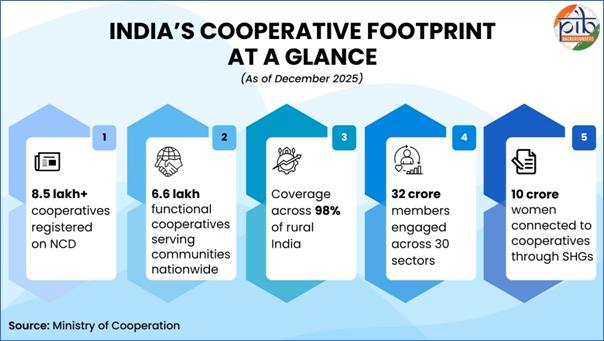
- Employment: They provide direct and indirect livelihoods to over 30 crore (300 million) people, particularly in rural areas.
- Financial Inclusion:
- Affordable Credit: PACS (Primary Agricultural Credit Societies) provide low-interest loans to small farmers, protecting them from informal moneylenders.
- Three-Tier Banking: A robust network of state, district, and primary levels ensures that financial services reach the “last mile” where commercial banks often do not operate.
- Agricultural Support:
- Input Supply: Cooperatives ensure the timely distribution of seeds, fertilizers, and pesticides at fair prices.
- Bargaining Power: By aggregating produce, small farmers gain the scale needed to negotiate better prices with large buyers.
- Storage Solutions: The “World’s Largest Grain Storage Plan” is creating local godowns at the PACS level to reduce post-harvest losses.
- Social Development:
- Democratic Governance: Operated on the principle of “one member, one vote,” ensuring that decision-making power remains with the community rather than shareholders.
- Women’s Empowerment: Cooperatives like Lijjat Papad and women-led dairy societies have provided millions of women with financial independence.
- Fair Pricing: They act as a market stabilizer, ensuring consumers get fair prices while producers receive a majority share of the profit.
- Modernization & Innovation:
- Digital Transformation: Over 63,000 PACS are being computerized to ensure transparency and real-time auditing.
- Diversification: Beyond farming, cooperatives are now entering organic exports, seed production, and renewable energy (biogas).
- Multi-Service Hubs: Village cooperatives are being converted into Common Service Centers (CSCs) and Janaushadhi Kendras to provide digital services and low-cost medicines.
Major Initiatives Taken For Cooperatives
- Strengthening Primary Agricultural Credit Societies (PACS):
- Model Bye-laws: New bye-laws have been adopted by 32 States/UTs, allowing PACS to expand from simple credit providers to multipurpose entities involved in over 25 business activities, including fisheries, dairy, and storage.
- Nationwide Computerization: A ₹2,925 crore project is digitizing 79,630 PACS. Currently, 59,261 PACS are using a common national ERP software in 14 languages, ensuring transparency and real-time auditing.
- e-PACS Integration: Over 32,119 PACS are now enabled as “e-PACS,” digitally linked to NABARD through State and District Cooperative Banks for seamless credit flow.
- Diversification as Multi-Service Hubs:
- Healthcare Access: 812 PACS are now operational as Pradhan Mantri Bhartiya Janaushadhi Kendras, providing low-cost medicines to rural areas.
- Digital Service Centers: More than 51,836 PACS now function as Common Service Centres (CSCs), delivering over 300 e-services (like Aadhaar and bill payments) to villagers.
- Global Scaling & Specialized Apex Bodies:
- NCOL (Organics): Markets certified organic produce under the “Bharat Organics” brand, featuring 28 pesticides-tested products.
- BBSSL (Seeds): An apex society for the production and branding of high-quality “Bharat Beej” seeds.
- Major Livelihood & Storage Projects:
- World’s Largest Grain Storage Plan: A pilot project has already created 68,702 MT of storage capacity in 112 PACS, reducing post-harvest losses and improving food security.
- White Revolution 2.0: A 5-year plan to increase milk procurement by 50%. So far, 20,070 new Dairy Cooperative Societies have been registered.
- Atmanirbharta Abhiyan: Ensures assured procurement of pulses and maize at MSP through digital platforms like e-Samyukti and e-Samridhi.
- Financial & Legislative Reforms:
- Tax Relief: The cooperative surcharge was reduced from 12% to 7%, and the Minimum Alternate Tax (MAT) was lowered to 15%.
- Sugar Sector Revival: Provided tax relief of over ₹46,000 crore to cooperative sugar mills and disbursed ₹10,005 crore for ethanol and cogeneration units.
- Banking Support: Launched the “Sahkar Sarathi” shared service entity to support Rural Cooperative Banks with digital and audit services.
- Education & Mobility:
- Tribhuvan Sahkari University (TSU): Established in April 2025 as India’s first national university for the cooperative sector to build a professional workforce.
- Sahkar Taxi: Launched India’s first cooperative-led mobility platform (supported by Amul and IFFCO), currently trial-running with 1.5 lakh drivers.
Challenges Facing the Cooperative Sector
- Regional Imbalance: Western India dominates and North-East and eastern states lag.
- Governance Deficits: Politicisation, nepotism (“Uncle Judge Syndrome”), weak accountability.
- Infrastructure Gaps: Storage, logistics and processing still inadequate at scale.
- Financial Stress: NPAs in cooperative banks; limited access to long-term capital.
Way Ahead
- Balanced regional expansion: Replicate successful models of Gujarat and Maharashtra in lagging regions
- Technology deepening: Use AI, data analytics and blockchain for audits, traceability and fraud prevention
- Credit-plus model: Convert PACS into sustainable multi-service business centres
- Global branding: Scale “Bharat” brands in seeds, organics and agri-exports to access high-value global markets
Conclusion
- India’s cooperative movement has evolved from a narrow rural credit mechanism into a multi-sectoral pillar of inclusive growth. Backed by digital reforms, institutional innovation and policy support, cooperatives today play a vital role in strengthening rural livelihoods, deepening democracy and promoting sustainable development.
| Daily Mains Practice Question [Q] Digitisation and professionalisation are critical to the sustainability of the cooperative sector in India. |
Source: IE
Previous article
Improving Diversity of Subsea Cables
