


Syllabus: GS2/ Governance
Context
- Good Governance Day is observed on 25th December every year to commemorate the birth anniversary of former Prime Minister Atal Bihari Vajpayee.
About Good Governance Day
- According to the United Nations, Good governance is participatory, consensus oriented, accountable, transparent, responsive, effective and efficient, equitable and inclusive, and follows the rule of law.
- In 2014, the government announced that December 25 would be celebrated as Good Governance Day.
Good Governance Index
- The Good Governance Index (GGI) is a diagnostic tool introduced by the Department of Administrative Reforms and Public Grievances (DARPG), on December 25, 2019 to evaluate governance performance across states and union territories and encourage improvements.
- The Index identifies 10 key sectors and assesses governance performance through 58 citizen-centric indicators.
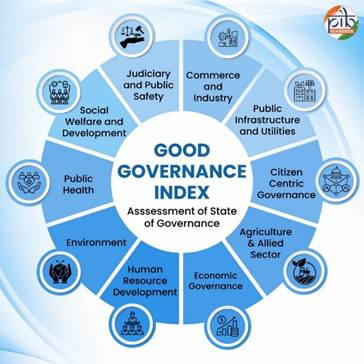
Government initiatives for Good Governance
- Government e Marketplace (GeM): Facilitates online procurement of common use Goods & Services required by various Government Departments/ Organizations/ PSUs. GeM aims to enhance transparency, efficiency and speed in public procurement.
- UMANG App: Developed by the Ministry of Electronics and Information Technology and National eGovernance Division, the UMANG App serves as a single platform to access PAN India services of the Government.
- It brings together major government services on a single mobile app so as to enable the accessibility of government services on mobile phones of citizens.
- Centralized Public Grievance Redress and Monitoring System (CPGRAMS): A 24×7 online platform for time-bound redressal and monitoring of public grievances through dashboards, enhancing transparency and accountability in service delivery.
- e-HRMS 2.0 Mobile Application: The e-HRMS 2.0 app, available on Android and iOS, was launched to provide government employees seamless access to human resource services.
Challenges to Good Governance
- Ineffective implementation of laws: Hasty and ineffective implementation of laws and policies has led to hardship for the common man and even led to a lack of trust in the government in being responsible.
- Corruption: It persists due to opaque administrative structures, weak legal frameworks, limited access to information and poor understanding of individual rights.
- Criminalisation of Politics: When individuals with criminal backgrounds become lawmakers, they prioritize personal interests over public welfare, leading to inefficient administration, and breakdown of public trust.
- Low Awareness of Rights and Duties: Limited civic awareness prevents citizens from asserting their rights and fulfilling their duties, leading to misuse of freedoms, weak participation and ineffective governance.
Way Ahead
- Governance reforms must focus on making grievance redressal and service delivery systems more responsive by fully leveraging digital platforms, real-time monitoring and data-based decision-making across all levels of administration.
- Parallel efforts are required to strengthen institutional capacity, promote citizen awareness and scale up proven best practices so that improvements in governance translate into consistent, on-ground outcomes.
| About Atal Bihari Vajpayee – He was born on December 25, 1924, in Gwalior, Madhya Pradesh. – Early involvement in politics: Joined the Quit India Movement in 1942 during his student days. – Prime Ministerial terms: Served three times as India’s Prime Minister — briefly in 1996, for 13 months in 1998-1999, and full-time from 1999 to 2004. 1. He became the first non-Congress leader to complete a full term as Prime Minister. – Nuclear achievement: Oversaw India’s declaration as a full-fledged nuclear state. – First Indian leader to address the UN General Assembly in Hindi. – Awards: He received the Padma Vibhushan in 1992 for his selfless dedication to the nation and was conferred with Bharat Ratna in 2015. |
Source: PIB
Previous article
Dowry a Cross-cultural Evil: Supreme Court judgment
Next article
100 Years of Communist Party of India (CPI)
