


Syllabus: GS2/Polity & Governance
Context
- Recently, the Constitution (130th Amendment) Bill, 2025 was introduced in the Lok Sabha and subsequently referred to a Joint Parliamentary Committee (JPC) following intense opposition protests.
- The Bill seeks to amend Articles 75, 164, and 239AA dealing with the Union Council of Ministers, State Councils of Ministers, and special provisions for Delhi.
What Does the 130th Amendment Bill Propose?
- The Bill introduces a mechanism to remove ministers who are in jail for serious offences:
- If a minister is arrested and held in custody for 30 consecutive days for an offence punishable with five years or more imprisonment, they will lose their position.
- The President, acting on the advice of the Chief Minister, must remove the minister by the 31st day of custody.
- If no advice is given, the minister automatically ceases to hold office.
- However, the Bill allows reappointment once the minister is released from custody.
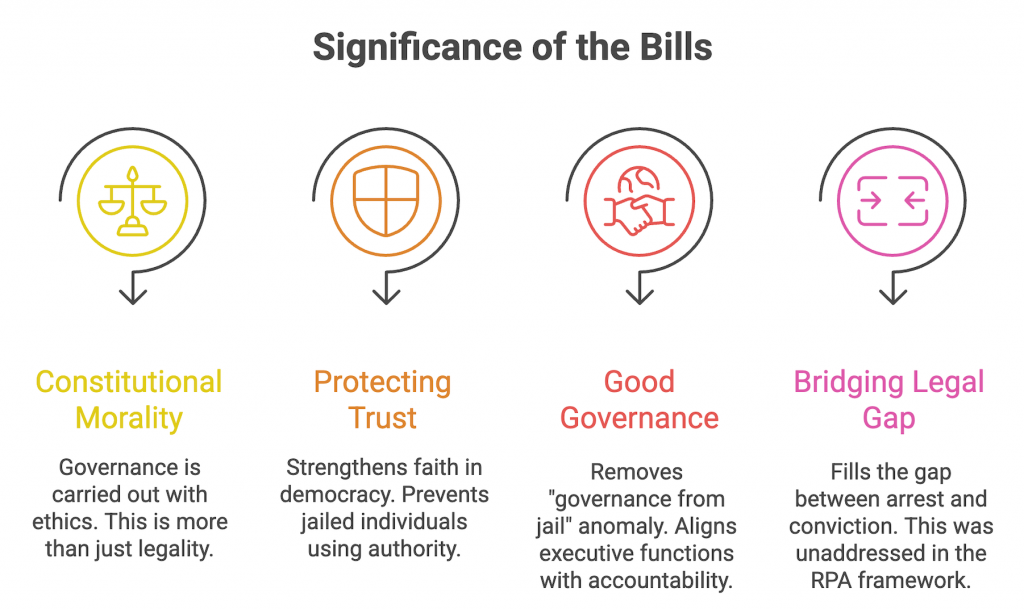
- It is expected that ministers accused of serious criminal offences may compromise constitutional morality, good governance, and public trust.
Related Concerns & Challenges
- Presumption of Innocence Undermined: The Bill allows removal based on detention, not conviction, which contradicts the principle of ‘innocent until proven guilty’.
- It is argued that the Bill could violate Article 14 (Right to Equality) and Article 21 (Right to Life and Liberty).
- Scope for Political Misuse: Opposition argue the provision could be weaponized by the Union government through investigative agencies like the CBI and ED.
- Threat to Federalism: Bill centralizes power and weakens the autonomy of state governments.
- Judicial Challenges Likely: The Bill may face scrutiny under the Basic Structure Doctrine, especially regarding the independence of the executive and separation of powers.
- Ethical Governance vs. Democratic Safeguards: Some argue that the Bill promotes integrity and aligns with Supreme Court observations in cases like Lily Thomas and Manoj Narula, along with eroding democratic norms by allowing executive removal without judicial verdicts.
| Existing Framework and Its Limitations – Section 8 of RPA, 1951: Legislators are disqualified only upon conviction and sentence of at least two years. – Law Commission’s 170th Report: Recommended disqualification from the stage of framing of charges for offences with punishment of five years or more. – Limitation: Neither provision addresses the period of pre-conviction custody, enabling ministers to remain in office despite being in jail. What Is a Constitution Amendment Bill? – It is a legislative proposal, introduced under Article 368, to modify provisions of the Indian Constitution, like changes in the structure of government, electoral processes, or fundamental rights. – It requires a special majority: two-thirds of members present and voting in each House of Parliament. – Some amendments require ratification by half of the state legislatures if they affect federal provisions (e.g., distribution of powers between Centre and States). What Is a Joint Parliamentary Committee (JPC)? – It is an ad hoc body formed to examine complex or controversial legislation and dissolve after submitting their report. – It is composed of members from both Lok Sabha and Rajya Sabha. 1. Typically includes 31 members (21 from Lok Sabha, 10 from Rajya Sabha), though size may vary. – It is tasked with scrutinizing bills clause-by-clause, gathering expert opinions, and submitting a report to Parliament. – While its recommendations are influential, they are not binding on the government. |
Previous article
News In Short 20-August-2025
