


Syllabus: GS3/Science and Technology
In News
- India has evolved from experimental drone pilots to a robust regulated ecosystem, with over 38,500 drones registered via Unique Identification Numbers (UIN) as of February 2026.
Evolution of Drone Ecosystem
- Over the past two decades, drone technology has evolved from experimental use to a structured ecosystem in India, transforming public service delivery, infrastructure management, agriculture, and national security.
- Drone technology has become a key enabler of efficient and responsive public service delivery in India.
- They are enhancing agility, precision, and transparency in governance.
India’s Approach
- The Government of India has accelerated adoption through progressive policies, including the Liberalised Drone Rules, the Digital Sky platform, skill development programs, and manufacturing incentives, making drones integral to government schemes and public services.
- Drones are Integrated into flagship government schemes such as Survey of Villages and Mapping with Improvised Technology in Village Areas (SVAMITVA) and Pradhan Mantri Fasal Bima Yojana (PMFBY).
Applications
- Agriculture and Farmer Services: Drones are used in land surveys, precision agriculture, infrastructure inspection, disaster management, transportation monitoring, and defence.
- The Namo Drone Didi Scheme, launched in November 2023, is a flagship initiative of the Government of India. The scheme aims to provide drones to Women Self Help Groups (SHGs) to support modern farming practices.
- Land Mapping: Drone technology is central to the Survey of Villages and Mapping with Improvised Technology in Village Areas (SVAMITVA) Scheme. The scheme was launched in April 2020, and implemented by the Ministry of Panchayati Raj, State Governments, and the Survey of India.
- The scheme is intended for drone-based mapping for survey of rural abadi areas to settle land dispute cases and to improve access to bank credit.
- Aerial Mapping for Highway Development: The National Highways Authority of India (NHAI) mandates monthly drone-video recordings for all highway projects.
- Use of Drones in Disaster Management and Emergency Response: Drones are helping India respond better during natural disasters. The North East Centre for Technology Application and Reach (NECTAR) has developed a special drone system for disaster situations.
- Railway Drone Monitoring: The Ministry of Railways has directed all its zones and divisions to deploy UAVs/drones for enhanced monitoring and maintenance of railway tracks, bridges, and other infrastructure.
- The Railway Protection Force (RPF) has adopted drones for security surveillance in rail yards, station premises, and along railway tracks.
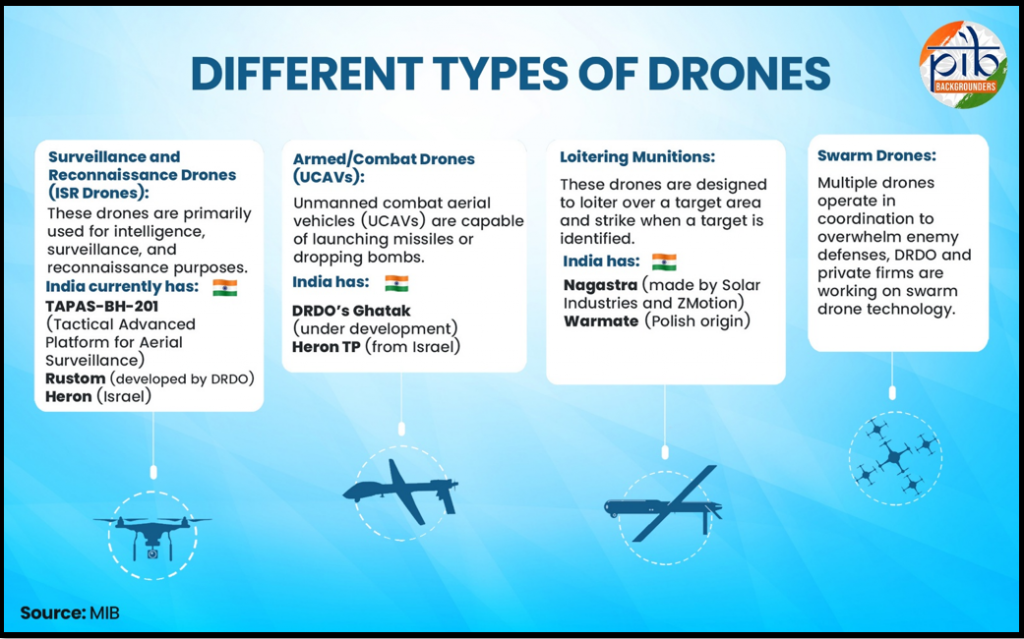
- Drones in Defence: Drones play a key role in India’s defence, helping the armed forces watch borders, gather intelligence, and carry out precise strikes.
- During Operation SINDOOR, Indian drones and loitering munitions destroyed enemy targets safely and accurately.
- Drones work together with air defence systems, radar networks, and command centres to protect critical infrastructure and respond quickly to threats.
- Benefits for Governance: They enhance agility, precision, and transparency in public service delivery.
Governments steps and Policies
- The Government of India has simplified and liberalised drone regulations through the Drone Rules, 2021 and subsequent 2022–2023 amendments.
- Key amendments include reducing approval forms from 25 to 5, rationalising fees, designating 90% of airspace as Green Zones, replacing pilot licences with Remote Pilot Certificates, and removing passport requirements.
- Civilian drone operations were permitted for drones weighing up to 500 kg, thereby expanding commercial and industrial applications.
- Production Linked Incentive (PLI): PLI scheme for drones and drone components has an approved outlay of ₹120 crore. It aims to promote high-value domestic manufacturing by encouraging local production.
- GST on drones: GST on drones was reduced to a uniform 5% in September 2025. Earlier tax rates of 18% and 28% were removed. This simplified taxation supports wider commercial and personal use of drones.
- The NextGen GST reform also applies to flight and motion simulators used for drone pilot training.
- Digital Sky, 2018 and eGCA: The regulatory services such as drone registration, remote pilot certification, Type certification and RPTO authorisation have been migrated from Digital Sky platform to eGCA.
- Further, the operational services such as flight plan and airspace map continue to be integrated with the Digital Sky Platform.
- Platforms such as Bharat Drone Shakti, Bharat Drone Mahotsav and the Drone International Expo promote Drone-as-a-Service (DaaS) start-ups and new business models.
- They showcase indigenous technologies and encourage collaboration among start-ups, MSMEs, industry, and research institutions.
- DGCA-approved training programmes & Remote Pilot Training Organisations (RPTOs) are also expanding the national pool of certified drone pilots.
- SwaYaan is a Capacity Building programme for Human Resource Development in Unmanned Aircraft Systems supports training and talent creation.
- National Innovation Challenge for Drone Application and Research (NIDAR) engages students and researchers. It promotes autonomous drones for disaster management and precision agriculture.
- The programme offers a ₹40 lakh prize pool and supports start-up incubation.
Conclusion and Way Forward
- Drones in India are driving socio-economic development across agriculture, infrastructure, disaster management, and national security by improving efficiency, transparency, and resilience.
- Supported by progressive policies, financial incentives, and skill development initiatives, the sector is expanding rapidly.
- Emphasis on indigenous manufacturing and government integration positions India as a future global leader in unmanned aerial systems.
Source :PIB
Previous article
Military AI and the Urgency of Guardrails
Next article
News In Short 19-02-2026
