


Syllabus: GS2/Polity and Governance
Context
- India’s rural development trajectory over the past decade indicates a structural transition from fragmented welfare provision towards an integrated, decentralised, and community-led development paradigm.
Decentralisation in Governance
- The 73rd Constitutional Amendment (1992) institutionalised Panchayati Raj Institutions (PRIs) as vehicles of grassroots democracy, enabling communities to participate directly in the planning, implementation, and monitoring of development initiatives.
- Participation is increasingly supported through capacity building, technology-enabled engagement, strengthened community institutions, and participatory planning and budgeting processes.
- Direct fiscal transfers to panchayats have been increased from around ₹2.36 lakh crore under the 15th Finance Commission (2021-2026) to nearly ₹4.35 lakh crore under the 16th Finance Commission (2026-2031).
Need for Decentralisation
- Deepening Grassroot Democracy: Strengthens participatory democracy by empowering village-level institutions like the Gram Sabha to take decisions on local development.
- Need-Based Local Planning: Local bodies better understand region-specific issues related to agriculture, irrigation, drinking water, sanitation, and rural infrastructure.
- Improved Service Delivery: Enhances last-mile delivery and monitoring of schemes like Mahatma Gandhi National Rural Employment Guarantee Act.
- Greater Accountability and Transparency: Proximity of elected representatives to citizens improves answerability and strengthens mechanisms like social audits.
- Strengthening Cooperative Federalism: Supports fiscal decentralisation through State Finance Commissions and grants recommended by the Finance Commission.
Challenges
- Incomplete Devolution: Many States have not fully devolved Functions, Funds, and Functionaries to Panchayati Raj Institutions despite the 73rd Constitutional Amendment Act.
- Financial Dependence on Higher Governments: PRIs rely heavily on grants recommended by the Finance Commission and State governments, with limited own-source revenue generation.
- Capacity Constraints: Lack of trained personnel, technical expertise, and administrative capacity hampers effective planning and implementation.
- Elite Capture and Proxy Representation: Local elites sometimes dominate decision-making; in some cases, women representatives face proxy control by male family members.
- Weak Gram Sabha Functioning: The Gram Sabha often suffers from low participation, irregular meetings, and limited awareness among citizens.
- Poor Accountability and Transparency Mechanisms: Weak auditing, irregular social audits, and limited digital governance increase risks of corruption and fund misutilisation.
Achievements in Rural Development
- Poverty has declined significantly, with extreme poverty at 5.3% (2022-23), which is less than the global average, and multidimensional poverty has reduced to 11.28%.
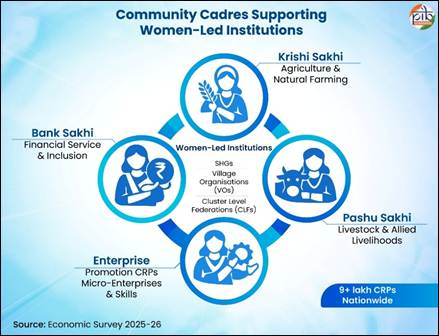
- Women-led collectives anchor last-mile delivery, mobilizing 10.05 crore women across 90.09 lakh SHGs, supported by 9 lakh community cadres.
- Rural connectivity is near-universal, with budgetary allocations for Pradhan Mantri Gram Sadak Yojana increasing from ₹12,581 crore in 2016-17 to ₹19,000 crore in 2026–27 (an increase of 51%).
- Housing-led security has expanded at scale, with 3.70 crore rural homes built over 11 years, budgetary allocations for PMAY-G (Pradhan Mantri Awas Yojana-Grameen) increased by 266.1%.
Government Initiatives
- Rural Development Budget allocations rose over 211% from ₹87,765 crore (2016-17) to ₹2.73 lakh crore (2026-27).
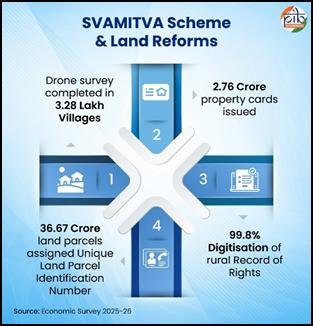
- Land Reforms:
- The Model Youth Gram Sabha (MYGS) promotes democratic engagement and civic awareness by familiarising students with grassroots governance through simulated Gram Sabha processes in schools.
- Revamped Rashtriya Gram Swaraj Abhiyan (RGSA) strengthens decentralised governance by enhancing the institutional capacity of Panchayati Raj Institutions through leadership development, e-governance, and deeper constitutional devolution.
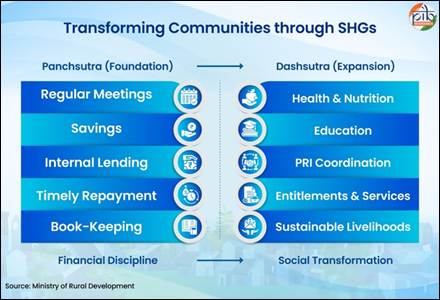
- Women-Led Institutions as Drivers of Rural Transformation: Women-led institutions are central to the Deendayal Antyodaya Yojana–National Rural Livelihoods Mission (DAY-NRLM), positioning women as key drivers of rural transformation.
- Community Resource Persons (CRPs), including Bank Sakhis, Krishi Sakhis, Pashu Sakhis, and Enterprise Promotion CRPs, facilitate the smooth functioning of women-led community institutions.
Conclusion
- India’s rural development trajectory over the past decade indicates a structural transition from fragmented welfare provision towards an integrated, decentralised, and community-led development paradigm.
- Collectively, these reforms position rural India not merely as a recipient of development interventions but as a pivotal driver of inclusive growth, democratic governance, and long-term socio-economic sustainability.
Source: PIB
