


Sawalkote Hydroelectric Project
Syllabus: GS1/Geography
In News
- Recently, an apex committee of the Environment Ministry has accorded a fresh environmental clearance to the Sawalkote hydroelectric project.
Sawalkote Hydroelectric Project
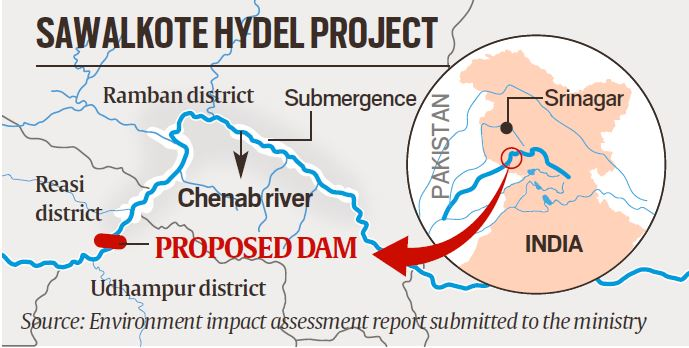
- Origin: First proposed 1984, Sawalkote Hydroelectric Project is a run-of-the-river hydroelectric initiative located on the Chenab River in Jammu and Kashmir.
- Developed by the National Hydroelectric Power Corporation (NHPC), it is poised to become one of India’s largest hydroelectric projects in the Indus basin, with a proposed capacity of 1,856 MW.
- Initial Clearance: The project received environmental clearance in 2017 under the Jammu and Kashmir Power Development Corporation (JKPDC).
- In 2021, JKPDC handed over its execution and control to NHPC Ltd, which will manage it until 2061.
- Features: The Sawalkote project will consist of a 192.5-m high Roller Compacted Concrete (RCC) gravity dam with six power generator units of 225 MW capacity and one unit of 56MW capacity in the first stage and two units of 225 MW capacity in the second stage of development.
Source :TH
Bharat Taxi
Syllabus: GS2/ Governance
In News
- India is going to launch Bharat Taxi, a cooperative-driven national ride-hailing platform, with strategic and technical support from the National e-Governance Division (NeGD).
About
- The National e-Governance Division (NeGD), under the Ministry of Electronics & Information Technology (MeitY), has signed an MoU with Sahakar Taxi Cooperative Limited (brand name: Bharat Taxi) to provide strategic and technical advisory support.
- The initiative is promoted by leading cooperative and development institutions such as NCDC, IFFCO, AMUL, KRIBHCO, NAFED, NABARD, NDDB, and NCEL.
- The collaboration will link Bharat Taxi with DigiLocker, UMANG, and API Setu for seamless digital services.
Significance
- Cooperative Model of Digital Governance: Embodies the ‘Sahakar se Samriddhi’ vision by combining cooperative ownership with digital innovation.
- Atmanirbhar Bharat in Mobility: Reduces dependence on foreign ride-hailing apps by creating an indigenous, interoperable ecosystem.
- Citizen Empowerment: Ensures fair pricing, driver dignity, and data privacy, moving toward a public digital infrastructure approach.
- Synergy with Digital India: Reinforces India’s vision of open, inclusive, and secure digital public goods.
Source: PIB
CCRAS Launches SPARK 4.0
Syllabus: GS2/ Governance
In News
- The Central Council for Research in Ayurvedic Sciences (CCRAS), under the Ministry of Ayush, announced the fourth edition of its flagship Studentship Program for Ayurveda Research Ken (SPARK) for 2025–26.
About
- It aims to promote scientific curiosity and research skills among undergraduate Ayurveda students across the country.
- Under SPARK–4.0, 300 Bachelor of Ayurvedic Medicine and Surgery (BAMS) students from colleges recognised by the National Commission for Indian System of Medicine (NCISM) would be receiving a studentship of ₹50,000, disbursed as ₹25,000 per month over two months.
- The student would get short-term independent research projects and a certificate on completion.
Significance
- Strengthens Ayurveda’s research ecosystem.
- Builds a pipeline of trained researchers to integrate traditional medicine into public health.
Source: PIB
China Tightens Export Controls on Rare-earth Metals
Syllabus: GS3/Economy
Context
- China outlined new curbs on exports of rare earths and related technologies.
About
- Foreign companies will need approval to export products containing even trace Chinese rare earths.
- The rules extend to processing technologies, equipment, and intellectual property for the first time.
- The move could complicate India’s efforts to secure inputs for its EV, renewable energy and defence sectors.
- China’s Dominance in Rare Earths:
- Production dominance: Mines ~60% and processes ~90% of global rare earths.
- Controls much of the downstream value chain — refining, separation, and permanent magnet manufacturing.
Rare Earth Elements
- Rare earth elements are a series of seventeen substances that are present in the earth’s crust.
- Unlike what the name may indicate, rare earths occur plentifully in nature, but the rarity comes from the ability to isolate them chemically and make them usable in industrial applications.
- Demand for rare earth metals such as neodymium, dysprosium, praseodymium and yttrium is increasing alongside technological advancements.
- Heavy and light rare earths occur naturally in several countries, such as India, China, Myanmar, Japan, Australia and North Korea.
- China is the world’s largest producer of rare earths followed by the USA.
- Significance:
- They are used in everyday technologies like a cellphone and computer.
- They are also used in advanced medical technologies like MRIs, laser scalpels and even some cancer drugs.
- In defense applications, they are used in satellite communications, guidance systems and aircraft structures.
- They are critical in a number of green technologies, especially those that are going to support net zero carbon emissions goals, like wind turbines and electric vehicles.
Source: DTE
Three Major Ports Recognised as Green Hydrogen Hubs Under The National Green Hydrogen Mission
Syllabus:GS3/Environment
In News
- The Ministry of New and Renewable Energy has designated Deendayal, V.O. Chidambaranar, and Paradip ports as Green Hydrogen Hubs under the National Green Hydrogen Mission.
The National Green Hydrogen Mission
- The Union Cabinet approved the National Green Hydrogen Mission in 2023, with an outlay of ₹ 19,744 crore.
- It aims to make India a Global Hub for production, usage and export of Green Hydrogen and its derivatives, by targeting production of 5 MMT per annum of Green Hydrogen by 2030.
- It will lead to significant decarbonization of the economy, reduced dependence on fossil fuel imports, and enable India to assume technology and market leadership in Green Hydrogen
Latest guidelines
- The guidelines issued in June 2025, allow the Ministry of New and Renewable Energy (MNRE) to recognize Green Hydrogen Hubs without direct financial aid, enabling these locations to access incentives under various central and state schemes.
- These hubs will serve as key centers for hydrogen production and consumption, supporting a sustainable and competitive hydrogen economy.
Impacts
- Designating ports as Green Hydrogen Hubs will drive clean energy innovation and leverage India’s strategic maritime positions to promote sustainable logistics.
- Projects will benefit from supportive policies and incentives, expected to boost industrial participation, attract green investments, and foster innovation in clean fuel technologies.
- It aligns with India’s broader goal of achieving energy self-reliance and net-zero emissions by 2070.
Source :PIB
Biomedical Research Career Programme
Syllabus: GS3/Science and Technology
Context
- The Union Cabinet has approved Phase III of the Biomedical Research Career Programme (BRCP).
About
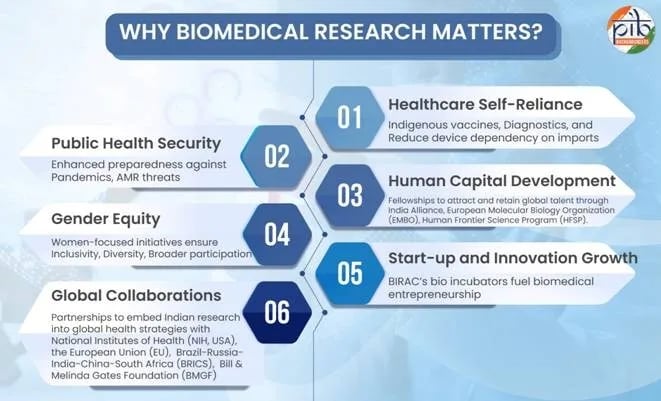
- The Biomedical Research Career Programme (BRCP) is a strategic investment in India’s health and innovation landscape, supported by a ₹1,500 crore Indo-UK partnership that aligns global expertise with national priorities.
- Aim: To build a world-class research ecosystem in biomedical sciences, clinical, and public health research
- 2025–26 to 2030–31: Active implementation period during which new research fellowships, collaborative grants, and capacity-building initiatives will be rolled out.
- 2031–32 to 2037–38: Servicing period for continuing support of fellowships and grants already awarded ensuring long-term continuity and completion of projects.
- Expected Outcomes: The initiative targets training 2,000+ researchers, high-impact publications, patentable discoveries, and peer recognition.
- Aims for 10–15% more support for women scientists, pushing 25–30% projects reaching Technology Readiness Level (TRL-4) and above, and wider Tier-2/3 outreach.
Source: PIB
THE World University Rankings 2026
Syllabus: Miscellaneous
Context
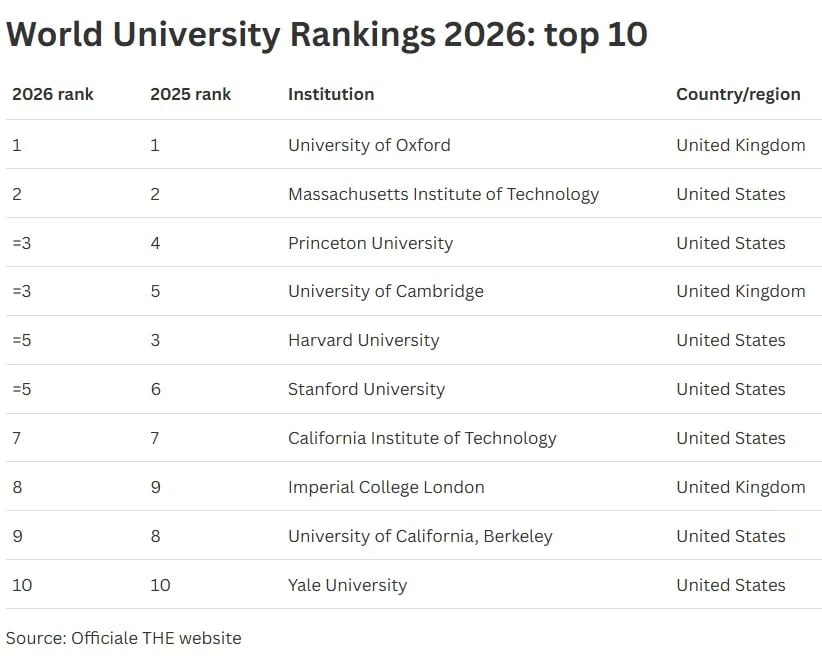
- Oxford University has maintained its global number one ranking for the tenth consecutive year, according to the Times Higher Education (THE) World University Rankings 2026.
About
- The 22nd edition of the UK-based THE World University Rankings evaluates 2,191 universities from 115 countries and territories across 18 performance indicators in five areas: teaching, research environment, research quality, international outlook, and industry impact.
- Beyond the top 100, universities are assigned “rank bands” instead of specific positions.
University rankings 2026: Highlights
- India: Ranked as the second most-represented country, behind only the U.S., with a record 128 institutions — up from 107 last year and just 19 in 2016. The Indian Institute of Science is placed in the 201–250 rank band, followed by Saveetha Institute of Medical and Technical Sciences at 351–400.
- China: Five universities are in the top 40, up from three last year. Tsinghua University, ranked 12th, remains Asia’s top university.
- United States: Seven of the top 10 positions are occupied by the US. However, there is a declining trend overall, with six fewer universities in the top 20 compared to last year and 35 in the top 100, down from 38.
Source: TH
Nobel Peace Prize, 2025
Syllabus: Miscellaneous
Context
- The 2025 Nobel Peace Prize has been awarded to María Corina Machado, the Venezuelan opposition leader, for her efforts in promoting democracy and driving political change.
About the Peace Prize
- It is awarded by a committee elected by the Norwegian Parliament (Stortinget). Peace was the fifth and final prize area that Alfred Nobel mentioned in his will.
- Since 1901 the Nobel Peace Prize has been awarded 105 times, to 139 laureates: 92 men, 19 women and 28 organizations.
- Mahatma Gandhi, despite being nominated five times, never won, though his ideals closely align with the UN Charter.
- In 2024, the Nobel Peace Prize was awarded to Japanese organisation Nihon Hidankyo, a grassroots movement of atomic bomb survivors from Hiroshima and Nagasaki, also known as Hibakusha.
Do you know?
- The Nobel Peace Prize cannot be awarded posthumously. It has been skipped 19 times, mostly due to wars or absence of a suitable candidate, including during 1914–16, 1918, 1923, 1924, 1928, 1932, 1939–43, 1948, 1955–56, 1966–67, and 1972.
Source: TH
Previous article
National Red List Roadmap and Vision 2025–2030
