


Syllabus: GS3/ Science and Technology
Context
- NITI Aayog’s Frontier Tech Hub (NITI-FTH) highlights the potential of quantum computing for economic growth and national security and global competitiveness.
What is Quantum Technology?
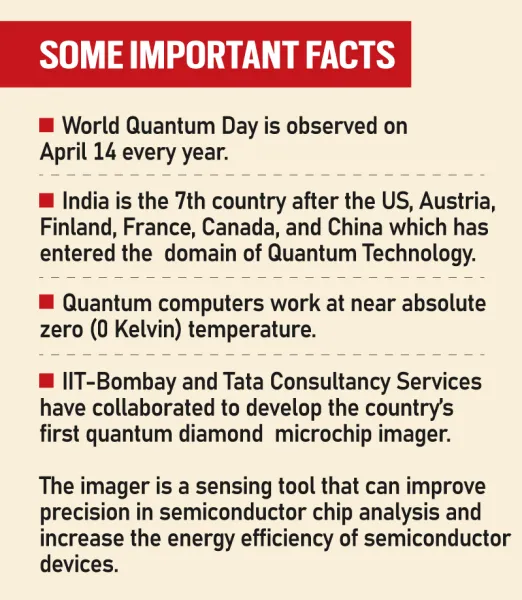
- Quantum technology is a rapidly advancing field that leverages the principles of quantum mechanics to develop new technologies with unprecedented capabilities.
- Quantum mechanics is the branch of physics that studies the behavior of particles at the quantum level, where classical physics no longer applies.
- Quantum computing uses ‘qubit’ (or quantum bit) as its fundamental unit.
- This technology exploits the principles of quantum mechanics, which include superposition, quantum entanglement, and interference.
- Superposition refers to the ability of these particles to exist in multiple locations simultaneously.
Domains of Quantum Technologies
- Quantum communication: It applies the properties of quantum physics to provide better security and improved long-distance communications.
- Quantum simulation: It refers to the use of a quantum system to simulate the behavior of another quantum system.
- Quantum computation: It is a field of computing that utilizes the principles of quantum mechanics to perform certain types of calculations more efficiently than classical computers.
- Quantum sensing and metrology: It leverages the principles of quantum mechanics to achieve highly precise measurements.
| National Quantum Mission (NQM) – It was conceptualized by the Prime Minister Science Technology Advisory Council (PM-STIAC) with a total outlay of Rs 6003.65 Crore for a period of eight years. – The Mission aims to seed, nurture, and scale up scientific and industrial R&D and create a vibrant & innovative ecosystem in Quantum Technology (QT). – The Mission aims to establish four Thematic Hubs (T-Hubs) in domains such as, 1. Quantum Computing, 2. Quantum Communication, 3. Quantum Sensing & Metrology, and 4. Quantum Materials & Devices. |
Role of Quantum computing in reshaping National Security
- Cybersecurity and Cryptography: The technology could break traditional encryption methods, threatening sensitive government and financial data. India must accelerate its transition to Post-Quantum Cryptography (PQC).
- Intelligence Gathering: Quantum computing will enhance intelligence-gathering capabilities, enabling nations to decode encrypted communications swiftly.
- Defense Applications: Quantum-enhanced AI will optimize battlefield logistics, autonomous systems, and missile guidance.
- Geopolitical Power: The report points out that the dominance of a country in quantum technology will give it an edge to shape global technology standards and norms, thus shaping international regulations.
Key Recommendations
- PQC Transition Plan: Involving risk prioritization-based transition and roadmap, accelerated POCs, testing and certification, and exchanging information about the deployments.
- Early Warning System: Leverage scientific intelligence for potential breakthroughs.
- Technology Access Agreements: Establish bilateral partnerships for rapid adoption, especially the modalities that offer scalability, including topology qubit.
- Flexible R&D Funding: Adapt investment priorities based on emerging breakthroughs.
Concluding remarks
- India’s quantum security strategy must integrate technology monitoring, research flexibility, and supply chain security while leveraging global partnerships and domestic innovation.
- A proactive, multi-pronged approach will ensure national security remains resilient in the quantum era.
Source: PIB
Previous article
India Emerges as world’s 3rd Largest Biofuel Producer
Next article
Paris Agreement Target is at Risk
