


Major Ports in India Surpass Cargo Target
Syllabus: GS3/ Infrastructure
Context
- The major ports of India handled 915.17 million tonnes (MT) of cargo in FY 2025–26, exceeding the target of 904 MT and recording a 7.06% year-on-year growth.
About
- There are 14 major ports out of which 12 Major Ports are in Operation and 200 non-major ports (minor ports) in the country.
- New ports: Vadhavan Port in Maharashtra and Galathea Bay Port in Andaman and Nicobar Islands, have been notified as Major Ports.
- While the Major Ports are under the administrative control of the Ministry of Ports, Shipping and Waterways, the non-major ports are under the jurisdiction of respective State Maritime Boards/ State Government.
Operational Major Ports in India
| Western Coast Ports | Eastern Coast Ports |
| Deendayal Port (Kandla, Gujarat) | Paradip Port (Odisha) |
| Mumbai Port (Maharashtra) | Visakhapatnam Port (Andhra Pradesh) |
| Jawaharlal Nehru Port (JNPT, Maharashtra) | Chennai Port (Tamil Nadu) |
| Mormugao Port (Goa) | Kamarajar Port (Ennore, Tamil Nadu) |
| New Mangalore Port (Karnataka) | V.O. Chidambaranar Port (Tuticorin, Tamil Nadu) |
| Cochin Port (Kerala) | Syama Prasad Mookerjee Port (Kolkata–Haldia, West Bengal) |
Key Initiatives Driving India’s Port Sector Progress
- Legislative Reforms: The Major Port Authorities Act, 2021 grants greater autonomy to major ports and encourages PPP participation.
- The Indian Ports Act, 2025 (replacing the 1908 Act) modernises port regulation. 100% FDI is permitted under the automatic route for port development and maintenance.
- Sagarmala Programme (2015): Flagship scheme covering port modernisation, connectivity enhancement, new port development, and coastal community upliftment.
- Maritime India Vision 2030: Outlines 150 initiatives across port infrastructure, logistics efficiency, and global maritime competitiveness.
- Digital & Monitoring Tools: National Logistics Portal (Marine) — SAGAR-SETU; real-time Sagar Manthan performance dashboard for port monitoring.
Source: PIB
OPEC+
Syllabus: GS2/ Regional Groupings
Context
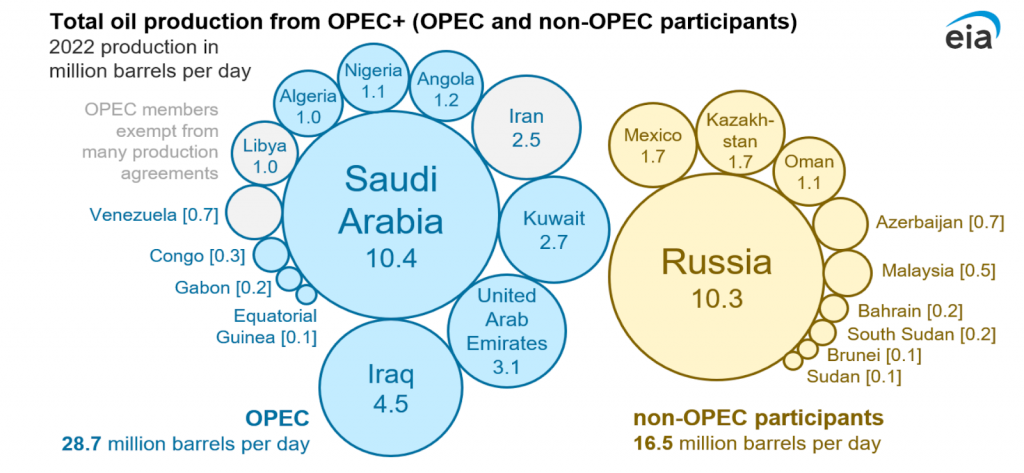
- The Organization of the Petroleum Exporting Countries+ group decided to increase oil production by 206,000 barrels per day amid rising global energy tensions.
- Crude oil prices have surged close to $120 per barrel due to conflict in West Asia.
About OPEC and OPEC+
- The Organization of the Petroleum Exporting Countries (OPEC) is a permanent, intergovernmental Organization, created at the Baghdad Conference in September 1960, by Iran, Iraq, Kuwait, Saudi Arabia and Venezuela.
- OPEC Members (12 Nations): The core organization includes Algeria, Congo, Equatorial Guinea, Gabon, Iran, Iraq, Kuwait, Libya, Nigeria, Saudi Arabia, the United Arab Emirates, and Venezuela.
- Non-OPEC Partners (10 Nations): The extended “Plus” group consists of Azerbaijan, Bahrain, Brunei, Kazakhstan, Malaysia, Mexico, Oman, Russia, South Sudan, and Sudan
- OPEC is headquartered at Vienna, Austria.
- In 2016, OPEC formed an alliance with other oil-producing nations to create OPEC+. The 10 countries now in OPEC+ include Russia, Kazakhstan, Azerbaijan, Mexico, and Oman.
- Member states of OPEC hold more than 80% of the world’s proven oil reserves.
- OPEC produces about 40% of the world’s crude oil and its members’ exports make up around 60% of global petroleum trade.
Source: TH
Stagflation
Syllabus: GS3/ Economy
In Context
- The ongoing US-Israel vs. Iran conflict has triggered a sharp energy supply disruption, reviving fears of 1970s-style stagflation.
What is Stagflation?
- Definition: Simultaneous occurrence of stagnant/negative economic growth + high unemployment + high inflation.
- Term Coined By: British politician Iain Macleod (1960s).
- Why It’s Dangerous: Normal monetary policy tools fail, raising interest rates fights inflation but worsens unemployment; cutting rates boosts growth but fuels inflation further.
How Does It Occur?
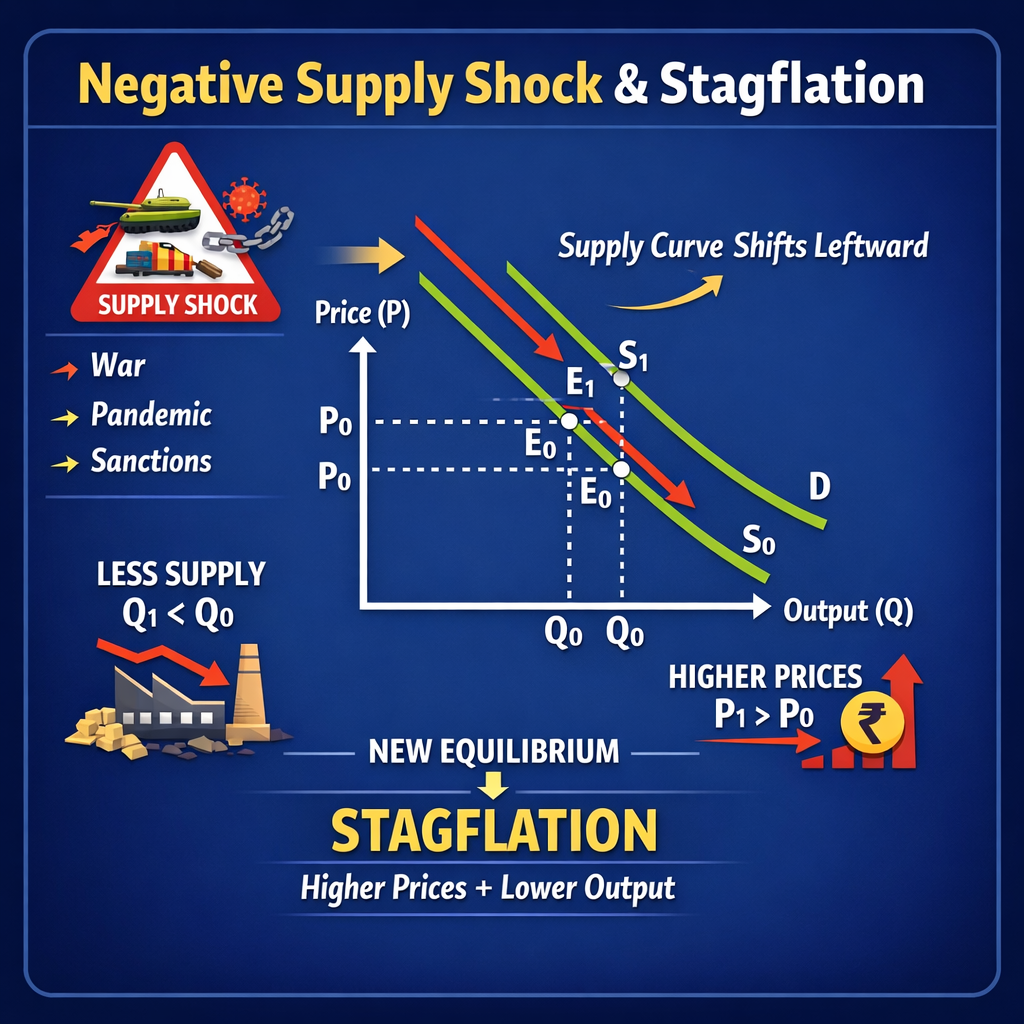
- In a normal economy, prices and output move along a stable supply-demand curve.
- A negative supply shock (war, pandemic, sanctions) shifts the entire supply curve leftward.
- Result, at the same price level, producers supply less output (Q1 < Q0) due to higher input costs or broken logistics.
- New equilibrium = higher prices (P1) + lower output → classic stagflation trap.
Source:TH
Forever Chemicals
Syllabus: GS3/ Environment
In Context
- The European Union has strengthened water pollution regulations to control harmful chemicals such as PFAS, often called “forever chemicals”.
About PFAS
- PFAS (Per- and Polyfluoroalkyl Substances) are a large group of man-made chemicals.
- They contain strong carbon–fluorine bonds, making them highly stable and resistant to breakdown.
- These are classified as Persistent Organic Pollutants (POPs) under the Stockholm Convention.
- The Stockholm Convention on Persistent Organic Pollutants (POPs) is a legally binding international treaty aimed at protecting human health and the environment from highly hazardous chemicals.
Source: DTE
Hectocotylus in Octopuses
Syllabus: GS3/ Biodiversity
Context
- Recent research has highlighted a novel function of the hectocotylus in octopuses, revealing advanced sensory and reproductive adaptation.
About Hectocotylus
- The hectocotylus is a modified arm present in male octopuses, traditionally understood as a structure crucial role in reproduction.
- However, new findings establish that it also performs sensory functions, making it a multifunctional appendage.
- The hectocotylus enables male octopuses to identify female mates through chemical cues.
Source: TH
BRO’s Project Chetak celebrates 47th Raising Day
Syllabus: GS3/Infrastructure/Internal Security
Context
- Project Chetak of the Border Roads Organisation (BRO) celebrated its 47th Raising Day.
About
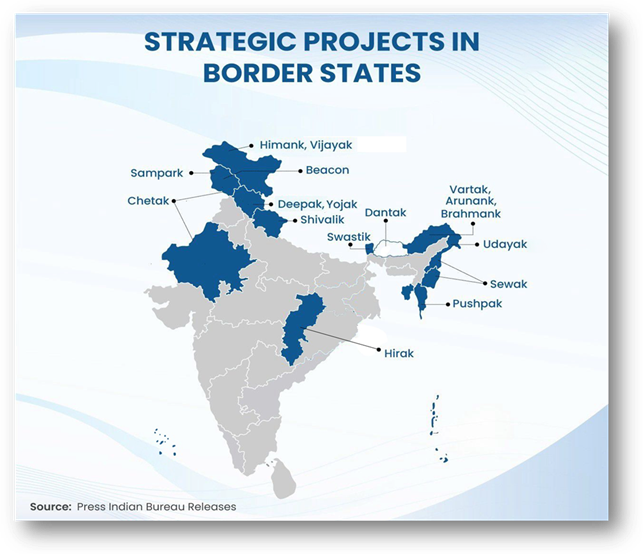
- The Project Chetak is one of the largest projects of the BRO in terms of geographical area.
- Raised in 1980, it has played a key role in developing and maintaining road networks across Rajasthan, Punjab and northern parts of Gujarat.
- It supports the Defence Forces by maintaining key feeder roads towards the International Border.
Border Roads Organisation
- The BRO constructs and maintains strategic roads, bridges, tunnels and airfields in border and inaccessible regions to meet both military and civilian needs.
- Ministry: Ministry of Defence
- Since its inception in 1960, it has built over 64,100 kms of roads, 1,179 bridges, 07 tunnels and 22 airfields across India’s border areas and in friendly neighbouring countries.
- Through overseas infrastructure in Bhutan, Myanmar, Afghanistan and Tajikistan, BRO supports regional connectivity and strategic partnerships.
Source: AIR
BioNEST
Syllabus: Miscellaneous
Context
- Recently, the BIRAC-BioNEST Incubation Centre was inaugurated at CSIR-CFTRI, Mysuru.
About
- The new BioNEST centre is designed to support food bioprocessing, biotechnology research, scale-up validation, and regulatory support.
- Its main goal is to convert scientific research into market-ready products.
- Focus Areas: The startups are working in emerging areas such as Nutraceuticals, Precision fermentation, Probiotics and postbiotics, CRISPR-based technologies and Botanicals.
- CFTRI’s Role: CFTRI has developed over 450 technologies, which have been transferred to thousands of licensees.
- It has emerged as a major national hub for food research, incubation, and industry collaboration.
| CFTRI | BIRAC |
| – CSIR−Central Food Technological Research Institute (CFTRI), Mysuru is a constituent laboratory of Council of Scientific and Industrial Research, New Delhi. – It came into existence during 1950. – Its vision is to pursue in-depth research and development in the areas of food science and technology. – Key areas of research CSIR-CFTRI include: a. Engineering Sciences b. Technology Development c. Translational Research d. Food Protection and Safety – CFTRI has its Resource Centres at Hyderabad, Lucknow and Mumbai. | – Biotechnology Industry Research Assistance Council (BIRAC) is a not-for-profit Section 8, Schedule B, Public Sector Enterprise, set up by the Department of Biotechnology (DBT), Government of India as an Interface Agency. – It strengthens and empowers the emerging Biotech enterprise to undertake strategic research and innovation, addressing nationally relevant product development needs. – BIRAC provides access to risk capital through targeted funding, technology transfer, IP management and handholding schemes that help bring innovation excellence to the biotech firms and make them globally competitive. |
Source: TH
Bharat Tribes Fest 2026
Syllabus: GS2/Governance
Context
- Bharat Tribes Fest 2026 was concluded recently.
About
- It is a flagship initiative of the Ministry of Tribal Affairs organised in association with TRIFED.
- The 19-day festival brought together tribal artisans, entrepreneurs, and self-help groups from across the country, showcasing India’s diverse tribal heritage and products.
- Top-performing tribal artisans and sellers were felicitated across ten categories, including pottery, cane and bamboo, jewellery, cuisines, textiles, and forest-based products.
- Key attractions included the RISA Pavilion promoting contemporary tribal design and the Bharat Tribes Fest Bazaar, aimed at strengthening market linkages.
Source: PIB
Previous article
Indian Ports have to transform using AI
Next article
One Health Approach for an Interconnected World
