


Syllabus: GS2/Governance; GS3/Economy
Context
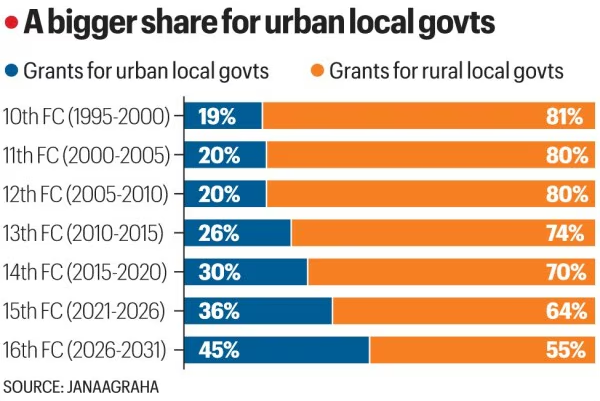
- Recently, the 16th Finance Commission (FC) report, tabled in Parliament, has significantly enhanced the share of grants to Urban Local Bodies (ULBs), signalling a structural shift in India’s fiscal federalism in favour of urban governance.
Key Highlights of the 16th FC For ULBs
- Increased Share for Urban Local Bodies: Share of grants to ULBs increased to 45%; (36% in 15th FC, & 26% in 13th FC).
- Sharp Rise in Absolute Allocation: Recommended grants to ULBs: ₹3.56 lakh crore;
- More than double the 15th FC’s ₹1.55 lakh crore;
- Nearly 15 times higher than the 13th FC allocation;
- It marks the largest ever fiscal support to urban governance in India.
Finance Commission: Constitutional Mandate
- Article 280 of the Constitution provides for the constitution of a Finance Commission every five years.
- It recommends:
- Distribution of tax revenues between the Centre and States (Vertical Devolution);
- Distribution among States (Horizontal Devolution);
- Grants-in-aid to States and Local Bodies;
- Since the 73rd and 74th Constitutional Amendments, Finance Commissions have also recommended grants for Panchayats and Urban Local Bodies.
Rationale Behind Increasing Share in 16th FC
- Cities As Growth Pole: Cities contribute nearly two-thirds of India’s GDP, making them engines of economic growth.
- India adds millions to its urban population annually due to migration and natural growth.
- Rising Urbanisation & Growing Urban Population: Urbanisation in India is steadily increasing, demanding higher fiscal capacity at the city level.
- Census 2011: 31% population urban;
- Projected urbanisation by 2031: 41%
- Global comparison: China (45%); Indonesia (54%); and Brazil (87%)
- Data Gaps in Urbanisation: A World Bank report (2015) suggested up to 78% of the population living in cities and urban clusters.
- Lack of credible and updated data (next Census awaited) affects policy planning and fiscal allocations.
- The 16th FC’s higher allocation pre-emptively addresses future urban growth, even if Census 2027 shows urbanisation at higher levels (e.g., 48%).
Major Urban Challenges & Concerns
- Uneven Distribution Across States: The grants are distributed based on a population-based formula, leading to significant inter-state variation.
- Major Gainers: Kerala (Over 400% increase); and Maharashtra (Over 300% increase);
- Limited Gains / Reductions: Odisha (13% increase); Bihar (8% decrease);
- It reflects demographic changes and formula-based allocation rather than uniform distribution.
- Water Supply & Sanitation: Intermittent water supply in most cities; high Non-Revenue Water (NRW) losses; and sewage treatment gaps.
- Urban Housing & Slums: ~65 million people living in slums (2011 Census); rapid expansion of informal settlements; and inadequate affordable housing.
- Urban Transport & Congestion: Traffic congestion in Tier-1 & Tier-2 cities; rising air pollution; and weak public transport integration.
- Weak Finances of ULBs: Limited own-source revenue, heavy dependence on state transfers, poor property tax coverage, and weak municipal bond market.
- Weak Implementation of 74th Constitutional Amendment: Many States have not fully devolved the 18 functions listed in the Twelfth Schedule.
- State governments retain control over urban planning, water supply boards, and development authorities.
- Capacity Deficit: Shortage of trained urban planners, limited digital governance integration, and poor data systems.
- Climate Vulnerability: Urban flooding (e.g., Chennai, Bengaluru), heat waves, and coastal vulnerability.
Implications For Urban Governance
- Strengthening the Third Tier: Enhances fiscal autonomy of ULBs, and improves ability to provide basic services (water, sanitation, waste management); urban infrastructure; and public health and mobility.
- Reduced Fiscal Stress Post-Census: ULBs will not face sudden resource gaps due to already enhanced allocation, if future Census data shows higher urbanisation.
- Deepening Fiscal Federalism: It reflects shift towards recognising urban India as a key growth driver. It aligns with goals of Atmanirbhar Bharat, and Urban reforms under AMRUT, Smart Cities Mission.
Urban Reforms and Flagship Missions
- Smart Cities Mission (2015): Key objectives are area-based development, ICT-enabled governance, and sustainable infrastructure.
- AMRUT: Key focus areas are water supply, sewerage, and urban green spaces.
- Swachh Bharat Mission (Urban): Key achievements are Open Defecation Free (ODF) certification, and solid waste management reforms.
- PM SVANidhi: It supports street vendors with micro-credit, and demonstrates integration of urban governance with social protection frameworks.
Citizen Participation and Digital Governance
- Recent reforms emphasize e-governance portals, online grievance redressal, GIS-based property tax systems, and participatory budgeting (Pune model).
- MoHUA promotes digital dashboards and open data platforms.
Previous article
India Bhutan Cooperation on HydroPower Projects
Next article
News In Short 28-02-2026
