

Syllabus: GS2/IR; GS3/Economy
Context
- India and the European Union (EU) announced the conclusion of negotiations for a Free Trade Agreement (FTA).
About
- The FTA enables deeper market integration between the world’s 4th and 2nd largest economies.
- Together, India and the EU account for nearly 25% of global GDP and close to one-third of global trade.
- Bilateral trade in goods and services currently stands at around €190 billion annually, including €120 billion in goods and more than €80 billion in services.
- The agreement is expected to expand this relationship substantially over the coming decade.
Major Highlights of the FTA
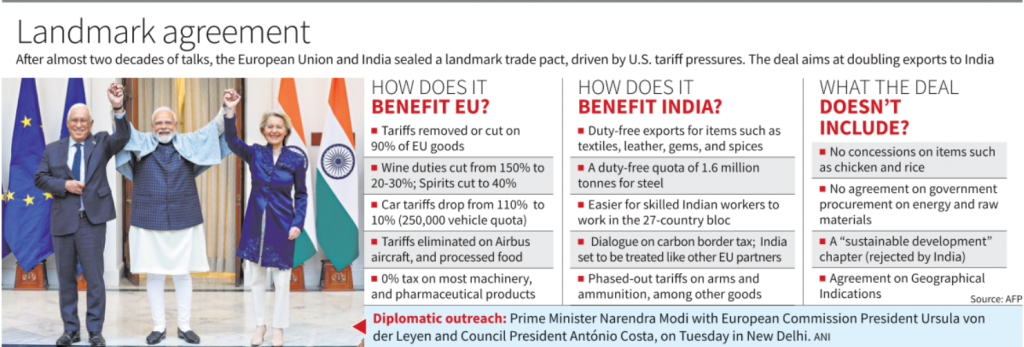
- Market Access: India has gained preferential access to the European markets across 97% of tariff lines, covering 99.5% of trade value.
- India is offering 92.1% of its tariff lines which covers 97.5% of the EU exports.
- Safeguard to Sensitive Sectors: India has safeguarded sensitive sectors, including dairy, cereals, poultry, soymeal, certain fruits and vegetables, etc. balancing export growth with domestic priorities.
- Service Sector: Commitments have been secured from the EU across 144 services subsectors, including IT/ITeS, professional services, education, and other business services.
- Indian service providers will get a stable and conducive regime in the EU market to supply their services.
- Key industrial products:Indian duties of up to 44% on machinery, 22% on chemicals and 11% on pharmaceuticals are set to be largely eliminated over phased timelines of five to ten years.
- Tariffs on car parts will be abolished over time, while duties on fully built vehicles will be reduced from 110% to as low as 10% under a quota-based system.
- CBAM-related provisions include a forward-looking most-favoured nation assurance, ensuring that any flexibilities extended to third countries will also apply to India.
- The agreement also provides for enhanced technical cooperation on recognising carbon pricing mechanisms, mutual recognition of verifiers, and financial assistance and targeted support to help Indian exporters reduce emissions and comply with emerging carbon requirements.
- Climate Resilient Infrastructure: The European Investment Bank has committed €2 billion to climate-resilient infrastructure through the Coalition for Disaster Resilient Infrastructure, while a proposed EU-India climate cooperation platform is expected to launch in 2026.
- Mobility Framework: The FTA establishes an assured regime for temporary entry and stay for professionals, including Business Visitors, Intra-Corporate Transferees, Contractual Service Suppliers, and Independent Professionals.
- Indian Traditional Medicines: In the EU Member States where regulations do not exist, AYUSH practitioners will be able to provide their services using the professional qualifications they gain in India.
Significance for India
- Gain in Exports: FTA is expected to enhance India’s exports to the EU, which stood at approximately USD 16.6 billion, and improve share in EU’s nearly USD 2 trillion engineering goods imports.
- Marine Exports: Preferential access covering 100% of trade value, by reducing tariffs of up to 26% will unlock the EU marine market for imports.
- This enhanced market access is expected to significantly improve the competitiveness of India’s marine exports empowering coastal communities in Andhra Pradesh, Gujarat, Kerala, and India’s blue economy.
- Gain for Key labour-intensive sectors: Sectors such as textiles, apparel, marine, leather, footwear, chemicals, plastics/rubber, sports goods, toys, gems, and jewellery will enter zero duty from entry into force of the FTA and thus gain enhanced competitiveness in the EU market.
- Imports of EU’s high technology goods are expected to diversify India’s import sources, thereby reducing input costs for businesses, benefit consumers and will create opportunities for Indian businesses to integrate into global supply chains.
- Impact on Agriculture: India secures preferential market access for its agricultural exports for processed foods, tea, coffee, spices, table grapes, gherkins and cucumbers, sheep and lamb meat, sweet corn, dried onion, and some other fruits and vegetable products.
- This will strengthen rural incomes, women’s participation, and India’s position as a premium, trusted supplier in Europe.
| India – EU Trade Relations – The EU is India’s largest trading partner, accounting for trade in goods worth €120 billion in 2024, or 11.5% of India’s total trade. – India is the EU’s 9th largest trading partner, accounting for 2.4% of the EU’s total trade in goods in 2024, well behind the USA (17.3%), China (14.6%) or the UK (10.1%). – Trade in goods between the EU and India has increased by almost 90% in the last decade. – The EU’s imports from India comprise mainly machinery and appliances, chemicals, base metals, mineral products, and textiles. – The EU’s main exports to India consist of machinery and appliances, transport equipment, and chemicals. – Trade in services amounted to €59.7 billion in 2023 (with EU exports of €26 billion). – The EU’s share of foreign direct investment (FDI) stock in India reached €140.1 billion in 2023, up from €82.3 billion in 2019. – Some 6,000 European companies are present in India. 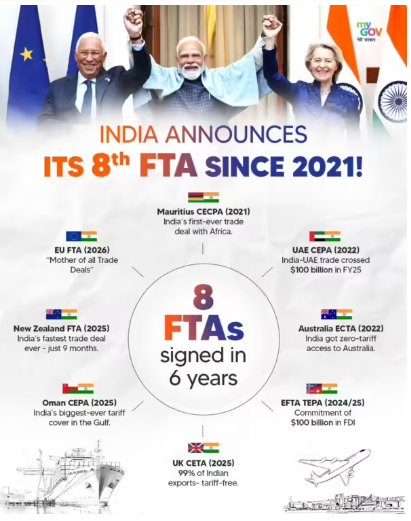 |
Source: PIB
Previous article
News In Short 27-01-2026
Next article
International Data Privacy Day
