


Polar vortex
Syllabus: GS1/Geography
Context
- A powerful winter storm has been fueled by the activity of the polar vortex in the US triggering heavy snow.
About
- The polar vortex is a large area of low-pressure and cold air that swirls like a wheel around both of the Earth’s polar regions.
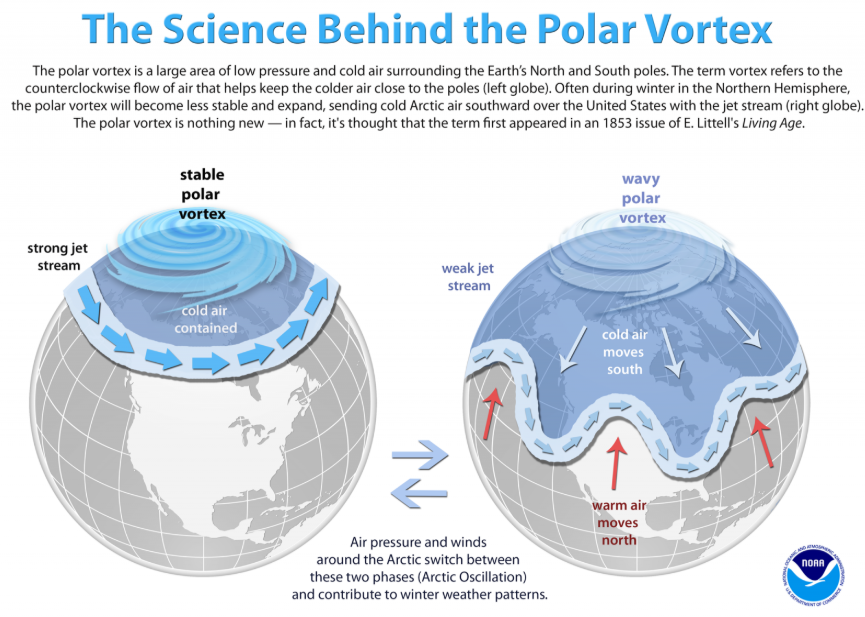
- There are two types of polar vortex: tropospheric and stratospheric.
- The tropospheric polar vortex occurs at the lowest layer of the atmosphere; it extends from the surface up to about 10 km to 15 km where most weather phenomena occur.
- The stratospheric polar vortex occurs at around 15 km to 50 km high.
- Unlike the tropospheric polar vortex, the stratospheric polar vortex disappears during the summer and is the strongest during the autumn.
Impact of the Polar Vortex
- The US, parts of Europe, and Asia experience chilly winds when the polar vortex at the North Pole weakens and travels from its usual position.
- As this system weakens, some of the cold, arctic air can break off and migrate south, bringing plenty of cold air with it.
Source: IE
Indian Railways Deploys Humanoid Robot ‘ASC ARJUN’
Syllabus: GS2/ Governance
In Context
- Indian Railways has deployed a humanoid robot named ‘ASC ARJUN’ at Visakhapatnam Railway Station.
About
- ASC ARJUN is a humanoid robot that works with the Railway Protection Force (RPF) for security, surveillance and assistance at the station.
- It is fully designed and developed in Visakhapatnam using indigenous, home-grown technology by a dedicated technical team.
Significance
- Enhance safety and security of passengers at a busy station.
- Optimise manpower by taking over routine patrolling and monitoring tasks so RPF staff can focus on critical work.
- Use emerging technologies (AI, IoT, robotics) to improve service delivery and modernise rail operations.
Source: PIB
Shri Narayan Ramachandran Committee
Syllabus: GS3/ Economy
In News
- The PFRDA has constituted the Committee for Strategic Asset Allocation and Risk Governance (SAARG) chaired by Narayan Ramachandran to review the National Pension System (NPS) investment guidelines.
About
- The committee will review and modernise NPS investment guidelines for both Government and Non‑Government sectors so that returns, risk and long‑term security for subscribers are better balanced.
- It aims to align NPS with global pension standards, changes in Indian financial markets, and the evolving needs of long‑horizon investors like government employees and private sector subscribers.
Main tasks
- Foundational review & benchmarking: Examine whether current rules (caps, exposure norms, valuation, etc.) are adequate and compare them with large foreign pension systems (e.g., Canada, Netherlands).
- Asset classes & diversification: Reassess equity, debt, money market and recommend new asset classes (like REITs/InvITs, certain alternatives) to improve diversification and resilience to shocks.
- Strategic asset allocation: Suggest optimal mixes between equity and fixed income, with prudential limits to protect conservative savers while giving growth potential to younger subscribers.
- Performance & accountability: Rework benchmarks, evaluation frameworks and disclosure so that Pension Funds are judged fairly on risk‑adjusted performance and are more accountable for under/over‑performance.
- Risk & ALM (asset–liability management): Propose comprehensive frameworks for market, credit, liquidity and operational risk, linked explicitly to long‑term pension liabilities rather than just short‑term NAV moves.
Source: TH
Agarwood
Syllabus: GS3/ S&T
In News
- The Union Minister laid the foundation stone of the ₹80 crore Agarwood Value Chain Development Scheme in Tripura.
About Agarwood
- Agarwood is a rare, highly fragrant wood that forms inside certain trees (Aquilaria) when they get infected or wounded, and the tree produces a special dark resin as a defence.
- This resin‑rich wood is then used to make high‑value perfume oils (oud), incense and traditional medicines, and is traded globally, especially in West Asia and East Asia.
- It is mainly found in tropical, high‑rainfall regions of South and Southeast Asia, including Tripura and other parts of Northeast India, where the climate and soils suit Aquilaria trees.
- Only a small share of trees naturally develop resin, and it can take decades, which is why agarwood is rare and expensive.
Source: PIB
Ammonium Nitrate
Syllabus: GS3/ Science & Technology
In News / Context
- Security agencies seized 10,000 kg of ammonium nitrate ahead of Republic Day celebrations.
About Ammonium Nitrate
- Ammonium nitrate is a white, crystalline chemical compound (NH₄NO₃) that serves as both a high-nitrogen fertilizer for agriculture and a key ingredient in industrial explosives when mixed with fuel oil (like ANFO).
- It’s highly soluble in water and acts as a strong oxidizer, providing oxygen to fuel rapid combustion but doesn’t explode on its own.
- Its dual-use nature creates risks: while vital for farming (supplying 34% nitrogen to crops) and mining, it can be diverted to make powerful improvised explosive devices (IEDs).
- India tightly controls it under the Explosives Act, 1884 and Ammonium Nitrate Rules, 2012, mandating licenses for production, storage, transport and sales.
Source: PIB
Bactrian Camels
Syllabus: GS3/Species in News
Context
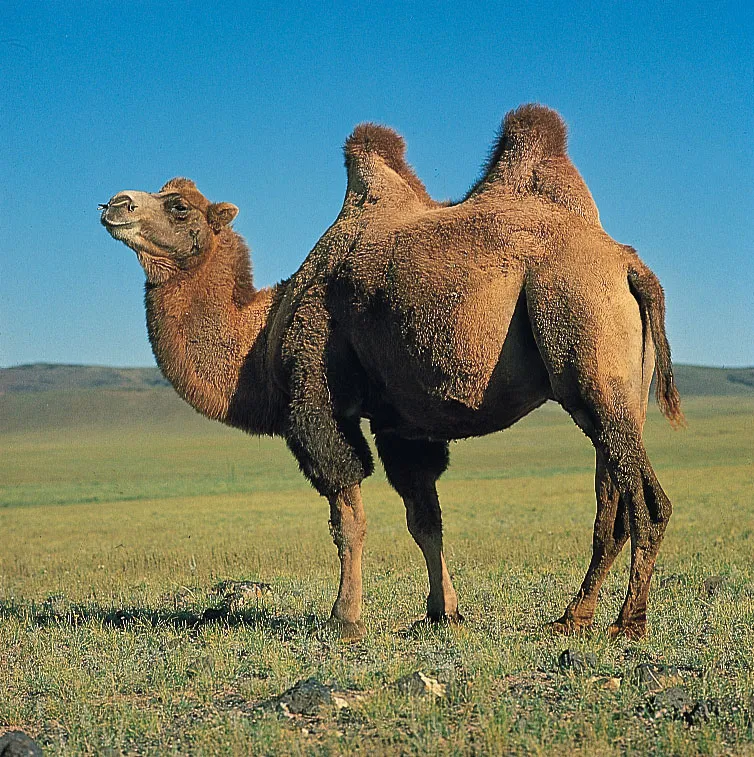
- Two majestic Bactrian camels named ‘Galwan’ and ‘Nubra’, were showcased at the Republic Day Parade on Kartavya Path.
- ‘Galwan’ and ‘Nubra’ are named after places in the cold desert of Ladakh, the only place in India where this species is found.
Bactrian camels (Camelus bactrianus)
- The name “Bactrian” comes from a region (former kingdom conquered by Alexander the Great) located between Afghanistan, Iran, and Kazakhstan.
- It is a double-humped camel, also called the Asian or Mongolian camel and is listed as Critically Endangered on the IUCN Red List.
- It is mainly found in Northern Pakistan, Iran, Turkey, India, with the largest domestic population in China.
- Bactrian camels are considered omnivorous; however, they are primarily herbivorous, feeding on a wide selection of vegetation, even those that other animals might refuse, such as thorny, tough, or dry plants.
- Bactrian camels, known as the ‘Ships of the Silk Road’, were crucial for crossing the harsh trade routes of Central Asia.
Source: DTE
Jeevan Raksha Padak Awards
Syllabus: Miscellaneous
In News
- The President of India has approved the conferment of the Jeevan Raksha Padak Series of Awards–2025 on 30 individuals for displaying exceptional courage in saving human lives.
About
- The Jeevan Raksha Padak series are civilian life‑saving gallantry awards that honour people who risk their own lives to save others in emergencies like drowning, fires, accidents, electrocution, mine incidents or natural calamities.
- It started in 1961 as a civilian offshoot of the Ashoka Chakra series to recognise brave, humane acts by ordinary people.
- Its aim is to reward civic courage, altruism and humanitarian values when someone voluntarily puts themselves in danger to save another person.
- It is open to all people, any gender, any profession; can also be given posthumously.
- It is of three categories:
- Sarvottam Jeevan Raksha Padak: For saving life in situations of very great danger to the rescuer.
- Uttam Jeevan Raksha Padak: For courage and prompt action in situations of great danger.
- Jeevan Raksha Padak: For courageous, quick action where there is serious risk of bodily injury to the rescuer.
- Each award consists of a medal and certificate, plus a one‑time cash amount (approximately: Sarvottam – ₹2 lakh, Uttam – ₹1.5 lakh, Jeevan Raksha – ₹1 lakh).
Source: PIB
Padma Awards
Syllabus: Miscellaneous
In News
- On the eve of Republic Day, President Droupadi Murmu approved the conferment of 131 Padma Awards.
About
- The awards instituted in 1954 initially as a single class, they were restructured in 1955 into the current three levels.
- Padma Awards are among India’s highest civilian honours, recognising exceptional contributions across diverse fields like art, social work, science and public affairs.
- They are presented in three categories, Padma Vibhushan (topmost for extraordinary service), Padma Bhushan (high-order service), and Padma Shri (distinguished service)—with Bharat Ratna as the nation’s supreme civilian award above them.
Eligibility and Process
- Open to all persons, including citizens, foreigners / NRI / PIO / OCI & posthumous awards allowed in highly deserving cases.
- Government servants, including PSU employees are not eligible except Doctors and Scientists.
- Nominations go to a Padma Awards Committee (chaired by Cabinet Secretary), whose recommendations reach the Prime Minister and President for approval.
- Cannot be used as titles (per Article 18(1) and 1996 Supreme Court ruling) and higher awards require a 5-year gap from prior ones.
Source: PIB
Previous article
Government to Launch Vehicle-to-Vehicle (V2V) Safety Technology
Next article
FTA Concluded Between India and EU
