

Syllabus: GS3/Agriculture; Natural Resource
Context
- Recently, the ‘Global Water Bankruptcy: Living Beyond Our Hydrological Means in the Post-Crisis Era’ was published by the United Nations University Institute for Water, Environment and Health (UNU-INWEH) ahead of the UN Water Conference (2026).
What Is Water Bankruptcy?
- Water bankruptcy is a persistent post-crisis condition of a human–water system where long-term water use has exceeded renewable inflows and safe depletion limits, resulting in irreversible or effectively irreversible degradation of water and ecosystem functions.
- It means societies have withdrawn more water than nature can replenish, and degraded water quality and ecosystems to the point that previous levels of water availability can no longer be restored.
- It is a systemic overspending of hydrological capital, the water stored in aquifers, glaciers, rivers, soils, and wetlands accumulated over centuries.
| How Does It Differ from Water Stress or Crisis? | ||
| Condition | Description | Recovery Potential |
| Water Stress | High demand relative to available supply, but recovery is possible through better management and conservation. | Reversible |
| Water Crisis | An acute and temporary emergency (e.g., drought, contamination, or supply disruption). | Temporarily Reversible |
| Water Bankruptcy | Long-term, structural overuse and degradation where recovery is physically or economically impossible. | Largely Irreversible |
Concerns & Issues: Patterns of Water Bankruptcy
- Systemic Global Water Insecurity: 2.2 billion people lack safely managed drinking water.
- 3.5 billion people lack safely managed sanitation.
- 4 billion people experience severe water scarcity for at least one month each year.
- Nearly 75% of the world’s population lives in countries classified as water-insecure or critically water-insecure.
- The world is off-track to meet Clean Water and Sanitation (SDG 6) by 2030, and the risks are global, interconnected, and escalating.
- Declining Water Storage and Agricultural Stress: Around three billion people and over half of global food production depend on regions where total water storage, including surface water, soil moisture, snow, ice, and groundwater is declining or unstable.
- More than 170 million hectares of irrigated cropland face high or very high water stress.
- Simultaneously, over 50% of global agricultural land is moderately or severely degraded, reducing soil moisture retention and accelerating desertification.
- Salinisation has further degraded over 100 million hectares of cropland, undermining yields in major food-producing regions.
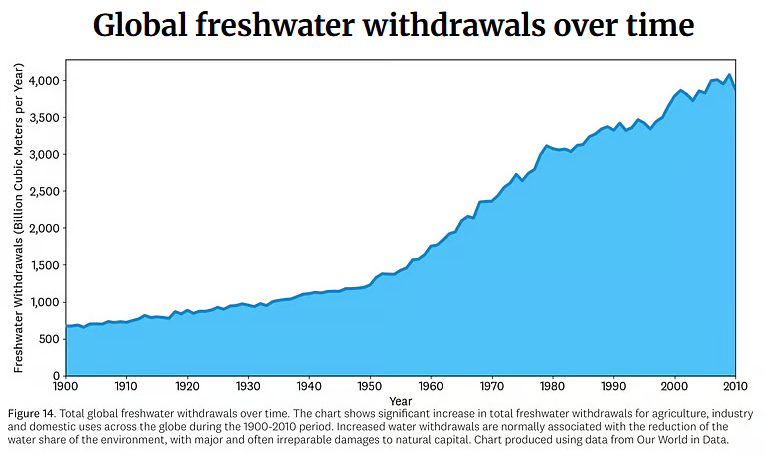
- Visible Global Consequences:
- Rivers dry up before reaching the ocean (e.g., Colorado, Indus, Yellow Rivers).
- Shrinking lakes and glaciers (e.g., Aral Sea, Lake Chad, Himalayan glaciers).
- Subsiding lands and salinized aquifers due to over-pumping.
- Expanding deserts and dust storms due to ecosystem collapse.
- Cities facing ‘Day Zero’ scenarios where taps run dry (e.g., Cape Town, Chennai, Mexico City).
- Challenges of Irreversibility and Equity: The report stresses that water bankruptcy is both an environmental and justice issue.
- Some damages (e.g., aquifer compaction, ecosystem extinction) are irreversible.
- Others can only be repaired at extraordinary economic and temporal costs.
- Managing water bankruptcy therefore requires equitable burden-sharing, ensuring access to basic water needs while compensating communities facing loss of livelihoods.
- Outdated Global Water Governance: The report critiques the existing global water agenda, focused mainly on WASH (Water, Sanitation, and Hygiene) targets; Incremental efficiency improvements; and Generic Integrated Water Resources Management (IWRM) frameworks.
- These approaches are no longer fit for purpose in an era defined by non-reversible water degradation and geopolitical fragmentation.
- Anthropogenic Droughts and Economic Losses: Droughts are now largely anthropogenic in both cause and effect.
- Between 2022 and 2023, 1.8 billion people lived under drought conditions, and global drought-related damages have reached $307 billion annually, exceeding the GDP of many UN Member States.
- These losses stem not only from reduced rainfall but also from decades of land degradation, groundwater over-extraction, and outdated water infrastructure.
- Cryosphere Crisis: The world has lost over 30% of its glacier mass since 1970, with several mountain ranges on course to lose glaciers entirely within decades.
- Glaciers are disappearing, threatening 1.5 to 2 billion people who rely on glacier-fed systems like the Indus, Ganges-Brahmaputra, Yangtze, Yellow, Amu Darya, and Andean rivers.
Reasons Behind Water Bankruptcy
- Overextraction of Water Resources;
- Climate Change and Altered Hydrology;
- Pollution and Water Quality Degradation;
- Loss of Natural Water Infrastructure;
- Unsustainable Economic and Urban Growth;
- Poor Governance and Fragmented Water Policies;
- Neglect of Justice and Equity in Water Distribution.
Key Suggestions and Recommendations
- Acknowledge Water Bankruptcy: Governments and international agencies need to formally acknowledge that many regions are water-bankrupt, operating beyond hydrological renewal limits.
- There is a need to establish scientific criteria and metrics for diagnosing water bankruptcy, measuring renewable inflows, depletion rates, and ecological collapse.
- Transform Water Governance Systems: Water governance needs to reset water rights and usage expectations, just as financial bankruptcy resets debt and balance sheets.
- Introduce mechanisms for ‘hydrological restructuring’ reallocating water fairly and sustainably across sectors.
- Build coordination between local, national, and transboundary institutions to manage shared water systems.
- Focus on Justice and Equity: Prioritize basic human needs and environmental flows even during scarcity.
- Protect vulnerable populations from disproportionate water losses through social protection, compensation, and livelihood transition programs.
- Create social safety nets and retraining programs to prevent unemployment and displacement.
- Empower local communities with legal and participatory rights in water decision-making.
- Rebuild Hydrological and Ecological Capital: Prioritize the restoration of wetlands, floodplains, aquifers, forests, and peatlands that provide natural storage and filtration.
- Integrate Ecosystem-based Adaptation (EbA) into national water strategies.
- Enforce strict regulations against aquifer overdrafting, river diversion beyond limits, and wetland conversion.
- Integrate Water Bankruptcy Management into Global Frameworks: Embed water bankruptcy principles into SDG 6 and link them with climate (SDG 13), biodiversity (SDG 15), and peace (SDG 16) goals.
- Integration with Global Agendas and Conventions: The report urges alignment of water governance with the Rio Conventions (Climate, Biodiversity, Desertification) and efforts to bridge divides between Global North and South, urban and rural, and left and right political blocs.
- Water should be positioned as a ‘bridge sector’ to rebuild cooperation amid the global fragmentation of multilateralism.
Next article
Western Disturbance
