

Goldilocks economy
Syllabus:GS3/Economy
In News
- India’s 2025 agricultural year benefited from a rare “Goldilocks” combination of surplus monsoon rainfall and moderate temperatures, unlike 2024, which was the warmest year on record despite a good monsoon.
Goldilocks economy
- It is an ideal but temporary state of balanced growth, low inflation, and full employment, supported by stable interest rates.
- It offers a favorable environment for investment, particularly in equities
- It is maintained through careful monetary and fiscal policies, with central banks playing a key role in balancing growth and inflation.
Statistics for India
- In 2025, near-normal temperatures and abundant rainfall led to a strong rebound in farm output, pushing food inflation into negative territory after high levels in 2023–24.
- High water availability and favorable conditions boosted rabi sowing to record levels, with most crops, including wheat and potatoes, performing well, though mustard faces some pest issues.
- Large domestic grain stocks and record global crop production further support low food prices, making a return of food inflation unlikely unless extreme weather occurs.
Source :IE
Right of Governor to address and send messages to the House
Syllabus:GS2/Governance
Context
- Recently, the Kerala Chief Minister alleged that the Governor altered his policy address to the Assembly by changing or omitting key paragraphs, particularly those related to the State’s fiscal stress, pending Bills, and issues of tax devolution.
Governor
- The Governor is the executive head of a State under Articles 153 and 154, exercising executive authority directly or through subordinate officers.
- Generally, under Article 163, the Governor functions on the aid and advice of the Council of Ministers while performing duties such as summoning or proroguing the Legislature, giving assent to Bills, promulgating Ordinances, and appointing Ministers.
- However, in certain matters—like sending reports to the President under Article 356 or reserving Bills for the President’s consideration under Article 254(2)—the Governor may act at their discretion.
Governor power’related to delivering speech
- Articles 175 and 176 of the Constitution outline the Governor’s communication with the State Legislature.
- Article 175 gives the Governor the right to address either or both Houses of the State Legislature and to require members’ attendance. The Governor can also send messages to the Legislature on any matter, including pending bills, which must be considered promptly.
- Article 176 of the Constitution mandates a special address by the Governor to State legislatures at the commencement of the first session after a General Election to the Assembly and at the commencement of the first session of each year.
Source :TH
Board of Peace for Gaza
Syllabus:GS2/IR
In News
- The government is considering its response to US President Donald Trump’s invitation to join the proposed Gaza Peace Board
The Board of Peace
- It is an international body chaired by US President Donald Trump, created to oversee the October 2025 ceasefire in the Israel-Hamas war and manage Gaza’s post-war transition.
- The initiative was proposed in October 2025 and was endorsed the following month by the United Nations Security Council.
Members
- Around 35 global leaders have agreed to join the proposed Board of Peace, out of about 50 invited.
- Participants include key Middle Eastern allies such as Israel, Saudi Arabia, the UAE, Bahrain, Jordan, Qatar and Egypt, along with NATO members Turkey and Hungary. Several other countries across Asia, Africa, Europe and Latin America—including Pakistan, Indonesia, Vietnam, Morocco, Armenia and Azerbaijan—have also joined.
- Membership terms would run for three years, with the option of renewal.
- Countries seeking to extend their participation beyond the initial term may be required to contribute $1 billion, while short-term participation would not involve any financial commitment.
Mandate of Board
- The Board will supervise a transitional Palestinian technocratic administration in the Gaza Strip, known as the National Committee for the Administration of Gaza (NCAG).
- The Board’s mandate also includes efforts to disarm Hamas and oversee the deployment of an International Stabilization Force (ISF), a multinational peacekeeping mission tasked with maintaining security and training a new Palestinian police force.
Source :ET
Cabinet approves continuation of Atal Pension Yojana (APY)
Syllabus: GS2/Welfare Schemes
Context
- The Union Cabinet chaired by the Prime Minister approved the continuation of Atal Pension Yojana (APY) up to FY 2030-31 along with extension of funding support for promotional and developmental activities and gap funding.
About the Atal Pension Yojana (APY)
- Launch: APY was launched in 2015 with the objective of providing old-age income security to workers in the unorganised sector.
- Target Group: Initially available to all citizens of India between 18 and 40 years of age.
- With effect from 1st October 2022, individuals paying income tax are not eligible to join the scheme.
- Scheme Features: APY offers a guaranteed minimum pension of Rs.1,000 to Rs.5,000 per month starting at age 60, based on contributions.
- Administering Body: Administered by Pension Fund Regulatory and Development Authority (PFRDA).
- Managed under the National Pension System (NPS) architecture.
- Progress: As of January, 2026, over 8.66 crore subscribers have been enrolled, making APY a cornerstone of India’s inclusive social security framework.
- Need for Extension: Sustained government support is essential for continued awareness, capacity building, and bridging of viability gaps to ensure the scheme’s sustainability.
Source:PIB
Kaladi to Be Upscaled Using Advanced Food Technologies
Syllabus: GS3/ Food Processing Sector
Context
- The Union Minister of State for Science & Technology has directed the upscaling of Kaladi, a traditional dairy product of Udhampur district, Jammu & Kashmir.
- The initiative is aligned with the One District One Product (ODOP) scheme to enable value addition.
About Kaladi
- Kaladi is a traditional dairy product prepared from raw full-fat milk, using whey water as a coagulant.
- It is known for its milky flavour, stretchable texture, and soft mouthfeel, often referred to as the “mozzarella of Jammu”.
- It has received the Geographical Indication (GI) tag, enhancing its economic and cultural significance.
Key Challenges
- Very short shelf life, especially under non-refrigerated conditions, limiting wider market access.
- Lack of standardised processing methods, as preparation varies across regions.
- Constraints in packaging, preservation, and scalability without altering traditional characteristics.
Source: PIB
Japan to Restart Kashiwazaki-Kariwa Nuclear Power Plant
Syllabus: GS1/ Places, GS3/ Energy
Context
- Japan has restarted operations at the world’s largest nuclear plant (Kashiwazaki-Kariwa) for the first time since the 2011 Fukushima disaster.
- Only one reactor is scheduled to restart initially, while the remaining units will require separate approvals.
About
- Location: It spans the towns of Kashiwazaki and Kariwa in Niigata Prefecture, (Island of Honshu) Japan, on the coast of the Sea of Japan.
- Capacity: Approximately 8,200 MW, making it the largest nuclear power plant globally.
- Operator: Tokyo Electric Power Company (TEPCO).
Japan’s Focus on Nuclear Energy
- Japan is the world’s fifth-largest single-country emitter of carbon dioxide, after China, the United States, India and Russia, and is heavily dependent on imported fossil fuels.
- Nearly 70% of Japan’s power needs in 2023 were met by power plants burning coal, gas and oil.
- Before the 2011 quake and tsunami, nuclear power generated about a third of Japan’s electricity.
- Fourteen reactors, mostly in western and southern regions, have resumed operation since the post-Fukushima shutdown after strict safety standards were imposed.
- Japan aims to make renewables its top power source by 2040.
- Under the plan, nuclear power will account for around 20% of Japan’s energy supply by 2040 – up from 5.6% in 2022.
Source: TH
C-295 aircraft
Syllabus:GS3/Defence
In News
- The first ‘Made in India’ C-295 aircraft from the Airbus–Tata Vadodara assembly line is set to roll out before September 2026, highlighting deepening India-Spain defence collaboration.
C295
- It is a versatile, reliable tactical transport aircraft capable of troop/cargo transport, maritime patrol, surveillance, medical evacuation, and firefighting.
- It carries up to 8 tonnes or 70 troops, cruises at 260 knots, and operates from short, unpaved runways.
- It offers 13-hour endurance, excellent maneuverability, and fuel efficiency.
- The Airbus C295 (previously CASA C-295) is a medium-range twin-engine turboprop tactical transport aircraft that was designed and initially manufactured by the Spanish aerospace company CASA, which is now part of the European multinational Airbus Defence and Space division.
India’s Agreements
- In 2021, India signed a Rs 21,935 crore deal with Airbus Defence and Space to procure 56 C295 aircraft. Under the agreement, Airbus was to deliver the first 16 aircraft in ‘fly-away’ condition from its final assembly line in Seville, Spain, within four years and the subsequent 40 aircraft were to be manufactured by Tata Advanced Systems Ltd in India.
Source :TH
Mozambican Rights Activist to get Indira Gandhi Peace Prize
Syllabus: Miscellaneous
Context
- Mozambican rights activist and humanitarian Graca Machel has been selected for the Indira Gandhi Prize for Peace, Disarmament and Development for 2025, announced by the Indira Gandhi Memorial Trust.
- Ms. Machel was chosen for her “path-breaking work” in the fields of education, health and nutrition, economic empowerment and humanitarian action.
About
- It is an annual award established by the Indira Gandhi Memorial Trust in India.
- The prize is named in honor of the late Prime Minister of India, Indira Gandhi, and it was instituted in 1986.
- The award is presented to individuals or organizations that have made significant contributions to the promotion of international understanding and peace, the development of new international economic order, and the strengthening of democracy.
- The award carries a cash prize of ₹1 crore along with a citation and a trophy.
- Categories: The award is presented in three categories:
- Peace: Recognizes efforts to promote and maintain international peace and security.
- Disarmament: Acknowledges contributions to the reduction and elimination of weapons of mass destruction.
- Development: Honors work in promoting economic and social development.
- The award ceremony typically takes place on November 19th, the birth anniversary of Indira Gandhi.
Source: TH
Israel fully Legalises West Bank Outpost as New Settlement
Syllabus: GS1/Places in News
Context
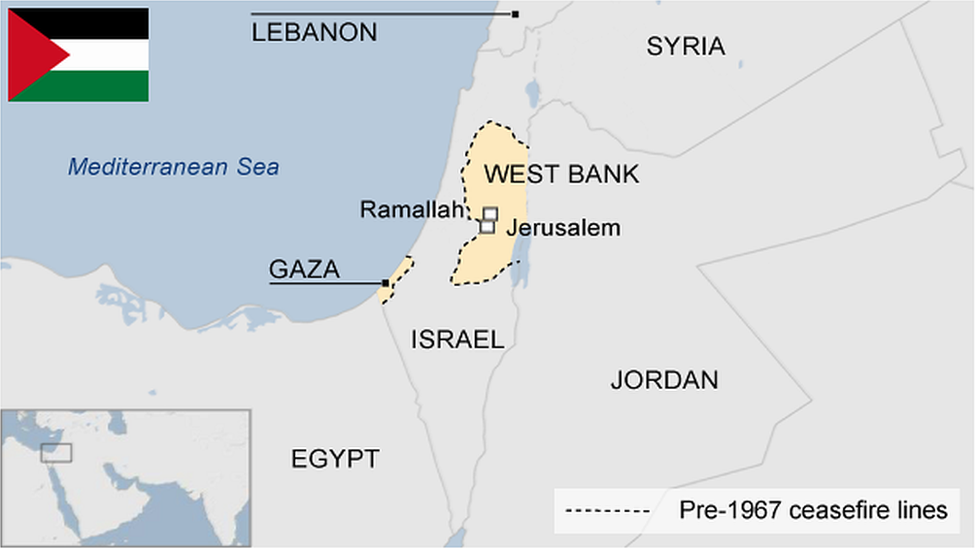
- Israel has fully legalized the West Bank outpost as a new settlement called Yatziv.
About
- The newly legalized Jewish settlement called Yatziv sits adjacent to the Palestinian town of Beit Sahour in the West Bank.
- The recognition of Yatziv followed years of advocacy by residents and local leaders.
- The establishment of Yatziv comes amid ongoing debate over settlement policy, which remains a central issue in Israeli-Palestinian relations.
West Bank
- The West Bank lies to the west of the Jordan River, bordered by Israel to the west, Jordan to the east, and Jerusalem to the south-west.
- Major cities include Ramallah (administrative capital of the Palestinian Authority), Hebron, Nablus, Jenin, and Bethlehem.
- 1948: After the Arab-Israeli War, the West Bank was occupied and later annexed by Jordan (1949–1967).
- 1967: During the Six-Day War, Israel captured the West Bank from Jordan, and it has remained under varying degrees of Israeli control since.
- 1993–1995 Oslo Accords: These agreements created the Palestinian Authority (PA) and divided the West Bank into three areas:
- Area A: Full Palestinian civil and security control.
- Area B: Palestinian civil control and joint Israeli–Palestinian security.
- Area C: Full Israeli control (about 60% of the West Bank).
- The Palestinians seek the West Bank, captured by Israel in 1967, as part of a future state.
Source: TH
Tantya Mama Bhil
Syllabus:GS1/History
Context
- The installation of a statue of tribal freedom fighter Tantya Mama Bhil in Khargone on Tribal Pride Day caused embarrassment for the administration, as a fibre-reinforced polymer (FRP) statue was erected instead of the planned marble or metal one.
About Tantya Mama Bhil
- Born: 1840, Badda village, Khandwa district (Madhya Pradesh).
- Original name: Tantia Bhil
- He earned the name “Tantya”, meaning fighter, due to his early resistance against British rule.
- Inspiration: He idolised Tatya Tope, the 1857 revolt leader, and adopted guerrilla warfare tactics from him.
- Tantya Bhil carried out swift attacks on British targets, including trains, and redistributed the looted wealth among the poor, earning him the reputation of a Robin Hood–like figure.
- His ability to strike and disappear quickly made him a persistent challenge for the British administration.
- Beyond armed resistance, he played a significant social role by helping the poor, assisting women, arranging marriages for underprivileged girls, and standing with people in times of distress. This deep connection with the masses earned him the honorific “Mama” (Uncle).
- Martyrdom: On December 4, 1889, the British executed Tantya Bhil by hanging. His body was later dumped near Patalpani station on the Khandwa railway line.
Do You Know?
- Tribals constitute about 21% of Madhya Pradesh’s population, the highest among Indian states.
- Tantya Bhil belonged to the Bhil community, which accounts for nearly 40% of the state’s 1.53 crore tribal population.
Source: IE
