

Syllabus: GS3/Environment
Context
- In the next five years, technologies like energy storage and green hydrogen would fundamentally reshape India’s renewable energy ecosystem.
India’s Green Hydrogen Mission
- Green hydrogen has emerged as a clean, scalable fuel alternative that can decarbonize hard-to-abate sectors, reduce import dependence on fossil fuels, and support India’s goals for energy security.
- The Indian government launched the National Green Hydrogen Mission (NGHM) in 2023, as an umbrella programme that aims to establish a Green Hydrogen ecosystem.
- India targets 5 MMT of Green Hydrogen production annually by 2030.
- Hydrogen mobility pilots launched across 10 routes, involving 37 fuel cell and hydrogen internal combustion engine vehicles.
- The Mission focuses on four key pillars, including policy and regulatory framework, demand creation, research and development & innovation, and enabling infrastructure and ecosystem development.
| What is Green Hydrogen? – Green Hydrogen is Hydrogen produced using renewable energy, such as solar or wind power, instead of fossil fuels. – In this processwater is split into hydrogen and oxygen through electrolysis, using electricity from solar panels or wind turbines. – Hydrogen made this way is considered “green” if the total emissions from the process are very low, not more than 2 kg of CO₂ equivalent for every 1 kg of Hydrogen produced. – Green Hydrogen can also be produced byconverting biomass (like agricultural waste) into hydrogen, as long as emissions remain below the same limit. 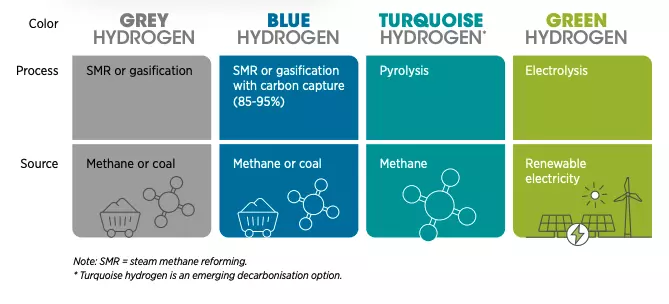 |
India’s Targets
- India has a vision to achieve Net Zero Emissions by 2070, in addition to attaining the short-term targets which include:
- Increasing renewables capacity to 500 GW by 2030,
- Meeting 50% of energy requirements from renewables,
- Reducing cumulative emissions by one billion tonnes by 2030, and
- Reducing emissions intensity of India’s gross domestic product (GDP) by 45% by 2030 from 2005 levels.
| India’s Current Electricity Generation through Non Fossil Fuel Sources – The country’s total installed electricity capacity has crossed 500 GW, reaching 500.89 GW. – Non-fossil fuel sources (renewable energy, hydro, and nuclear): 256.09 GW – over 51 % of the total. – Fossil-fuel-based sources: 244.80 GW about 49 % of the total. – Within renewables: Solar power generates 127.33 GW. Wind power generated 53.12 GW. – India has already achieved one of its major COP26 Panchamrit goals i.e. to have 50% of installed electric power capacity from non-fossil fuel sources by 2030, five years early. |
Challenges in Green Hydrogen Production
- High Production Costs: Green hydrogen is currently much more expensive than conventional (grey) hydrogen in India.
- Infrastructure Deficit: No dedicated nationwide hydrogen transport network (pipelines) exists yet requiring costly trucking or rail transport.
- Supply Chain and Technology Gaps: Limited domestic electrolyser manufacturing capacity means high dependency on imports of key components, raising costs and vulnerability to supply disruptions.
- Renewable Power & Grid Integration Issues: Green hydrogen requires continuous, affordable renewable electricity but round-the-clock clean supply is limited and energy storage remains costly.
- Grid instability in some regions complicates green hydrogen production, as electrolyser utilization drops without reliable power.
- Water Scarcity: Electrolysis demands high-purity water, which poses stress in already water-scarce regions.
- Financing and Investment Barriers: Green hydrogen projects are capital intensive with long gestation periods, posing challenges for Indian banks and traditional financing models.
- Export and Global Competition: India aims to be a global green hydrogen exporter, but global demand uncertainties and competing hubs in Europe, Australia, and the Middle East complicate market entry.
Government Initiatives
- Strategic Interventions for Green Hydrogen Transition (SIGHT) Scheme: A financial incentive mechanism up to 2029-30 provides incentives for the manufacturing of electrolysers that are used for production of green hydrogen.
- Development of Green Hydrogen Hubs: In 2025, the Ministry of New and Renewable Energy (MNRE) has announced the recognition of three major ports Deendayal Port Authority (Gujarat), V.O. Chidambaranar Port Authority (Tamil Nadu), and Paradip Port Authority (Odisha) as Green Hydrogen Hubs under the NGHM.
- These coastal gateways will serve as integrated centres for production, consumption, and future export.
- Standards, Certification and Safety: Launched in 2025, the Green Hydrogen Certification Scheme of India (GHCI) provides a national framework to certify hydrogen as “green” by assessing its greenhouse gas emissions across the entire production cycle.
- It provides transparency, traceability, and credibility for producers, buyers, and export markets.
- The Bureau of Energy Efficiency (BEE) is the Nodal Authority responsible for accrediting agencies that monitor and certify projects.
- Strategic Hydrogen Innovation Partnership (SHIP): The Mission fosters public-private partnerships for R&D through the Strategic Hydrogen Innovation Partnership (SHIP).
- It is designed to support the development of advanced, globally competitive hydrogen technologies through collaborative research involving Government institutions, industry, and academic organisations.
Source: TH
Previous article
India’s Gain From RCEP Without Risking China
Next article
Marginal Farmers Largely Outside Cooperatives
