

Syllabus: GS3/Indian Economy
Context
- India’s manufacturing sector has long underperformed relative to its potential, constrained by structural inefficiencies, policy missteps, and a premature leap into services despite several policy pushes.
Background: India’s Manufacturing Sector
- It has evolved from a modest post-independence base to a strategic pillar of economic growth.
- India adopted a mixed economy model with a strong emphasis on public sector-led industrialization post-independence.
- The Second Five-Year Plan (1956–61) laid the foundation for heavy industries, steel plants, and public enterprises.
- It contributed around 15–17% to GDP by the 1990s.
- India’s manufacturing sector has lagged behind despite starting from similar economic positions as China and South Korea in the early 20th century.
Current Status
- Manufacturing’s contribution to India’s GDP has broadly hovered in the mid-teens (around 13–17 percent in recent decades), compared to roughly 25–29 percent in China, around 27 percent in South Korea, and about 24–25 percent in Vietnam.
- On employment, over 45 percent of India’s workforce is still in agriculture, while only about 11.4 percent is employed in manufacturing and roughly 29 percent in services.
- A large share of manufacturing employment is informal, which constrains formal training, technology absorption, quality upgradation and stable industrial relations.
Why Manufacturing Has Lagged in India?
- Low Productivity and Fragmented Industry: Most Indian manufacturers are small-scale units with limited automation and poor economies of scale.
- According to CMIE data, the average productivity per worker in Indian manufacturing is less than 20% of China.
- Infrastructural Deficiencies: Persistent issues in logistics, power reliability, and port connectivity, which increase costs by 14–18% of product value (compared to 8% in East Asia).
- Even after schemes like PM Gati Shakti, execution delays remain a major barrier.
- Policy Instability and Regulatory Complexity: India’s frequent policy reversals, overlapping compliance from Centre and States, and especially around import tariffs and Production-Linked Incentive (PLI) guidelines.
- Weak Domestic Supply Chains: India imports a large share of intermediate goods stifling the growth of indigenous supply chains.
- Skill Gaps: Only about 5% of India’s workforce is formally skilled, compared to 24% in China and 52% in the USA.
- Vocational programs like Skill India have limited industry linkage, leading to skill demand mismatches.
- Land and Labour Market Rigidities: Land acquisition remains costly and time-consuming.
- Setting up an industrial plant can take 3–5 years, versus 18 months in Vietnam.
- Labour laws still cause hesitation for large-scale manufacturing employment.
- Weak R&D and Innovation Culture: Manufacturing R&D in India is less than 0.7% of GDP, versus 2.1% in China.
- Indian firms often ‘assemble’ rather than ‘innovate’, relying heavily on foreign designs.
- Domestic Demand Constraints: Income inequality limits domestic demand for manufactured goods beyond basic products.
- The consumption base for durable goods is still narrow.
- Policy Bias Toward Services: Government incentives, education, and infrastructure have historically favored IT and services over manufacturing.
- As a result, India ‘skipped industrialization’, jumping from agriculture to services.
Does India Resemble Dutch Disease?
- Dutch Disease describes how the boom of one sector (often resource-based) crowds out others, particularly tradable sectors like manufacturing, through two main channels:
- Wage Effect: Labour is pulled towards the booming sector, raising overall wages.
- Exchange Rate Effect: Increased exports appreciate the real exchange rate, making other exports less competitive.
- In India, high government salaries in the public sector acted as the ‘booming sector’, drawing labour away from manufacturing and driving up wages across the economy. It had three major consequences:
- Manufacturing lost competitiveness because firms couldn’t match government pay scales.
- Domestic prices rose, making imports cheaper and domestic goods relatively expensive.
- Real exchange rate appreciation occurred, even without a change in nominal currency value, further hurting exports.
- In essence, India experienced a policy-induced Dutch disease, where the expansion of a high-wage public sector distorted incentives against industrial growth.
Policy Reforms Fueling Growth
- Production-Linked Incentive (PLI) Schemes: Targeting 14 key sectors, including electronics, automotive, and pharmaceuticals, the PLI schemes aim to boost domestic production, attract FDI, and create jobs.
- PM MITRA Parks: These integrated textile parks are designed to enhance scale and efficiency in the textile value chain, promoting exports and employment.
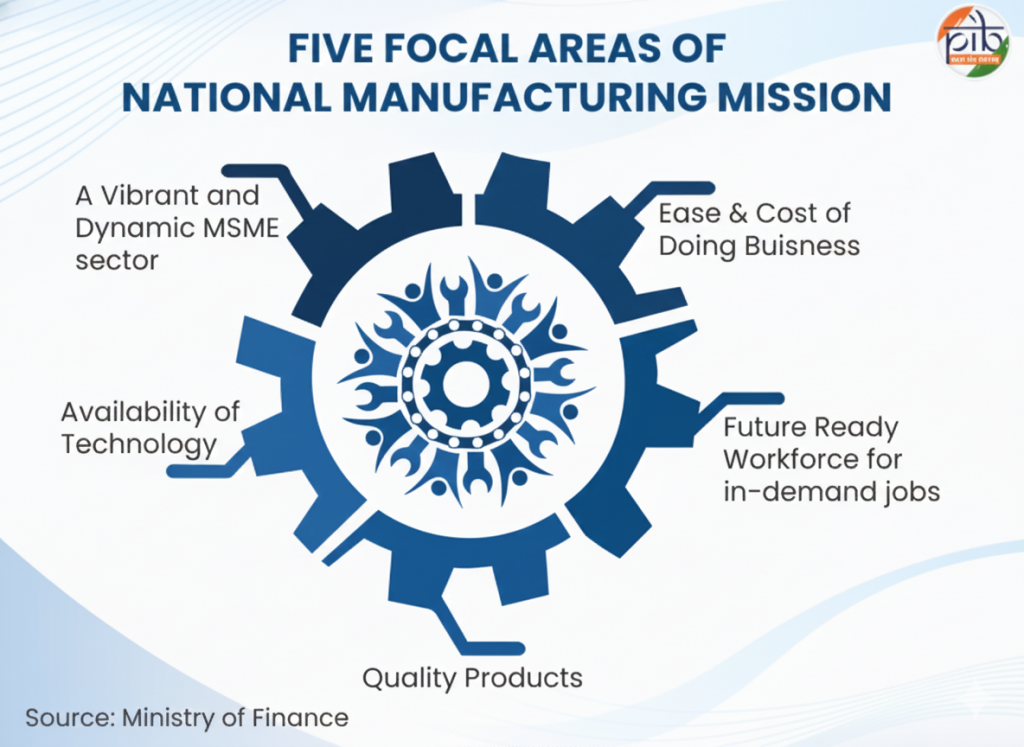
- National Manufacturing Mission: It was announced in the Union Budget 2025–26, as a long-term strategic roadmap that integrates policy, execution, and governance into a single, unified vision.
- It prioritizes clean-tech manufacturing from solar PV modules and EV batteries to green hydrogen and wind turbines ensuring India’s rise in global supply chains aligns with its net-zero 2070 commitment.
Building Industrial Ecosystems
- Skill India Mission: Trains youth in industry-relevant skills, with a focus on Industry 4.0 technologies like AI, robotics, and additive manufacturing.
- Gati Shakti Master Plan: Integrates transport and logistics infrastructure to reduce costs and improve supply chain efficiency.
- Digital India and Startup India: Encourage innovation and MSME participation in advanced manufacturing.
- These efforts aim to create industrial clusters that mirror the success of hubs like Tamil Nadu (automobiles), Gujarat (chemicals), and Karnataka (electronics).
Way Forward: Toward Global Manufacturing Leadership
- India’s vision is to become a global manufacturing hub by 2047. The NITI Aayog’s Roadmap to Global Leadership in Advanced Manufacturing outlines key strategies:
- Digital Transformation: Embracing Industry 4.0 technologies like AI, IoT, and robotics to modernize production.
- Green Manufacturing: Integrating sustainability and circular economy principles to reduce environmental impact.
- Cluster Development: Building industrial ecosystems in states like Tamil Nadu, Gujarat, and Maharashtra to foster innovation and scale.
- R&D Investment: Increasing public-private collaboration in research to drive product innovation and quality.
- The goal is to raise manufacturing’s share in GDP to 25% and generate 100 million jobs (National Manufacturing Policy), positioning India as a resilient and inclusive industrial economy.
Next article
News In Short 26-12-2025
