
Where Does India Stand on Child Marriage?

Syllabus: GS1/ Social Issues

In News

  • Despite a strong legal framework and multiple schemes tackling Child marriage in India, India is still off-track to fully eliminate child marriage by the 2030 SDG deadline.

Concept, Trend and Legal Framework

  • Definition: Child marriage refers to any marriage in which at least one party is below 18 years of age; globally, the UN Convention on the Rights of the Child defines a child as any human below 18 years.
  • NFHS data: The proportion of women aged 20–24 years married before 18 declined from about 47.4% (2005–06, NFHS-3) to 26.8% (2015–16, NFHS-4) and further to 23.3% (2019–21, NFHS-5).
  • State variation: Eight states are above the national average; West Bengal, Bihar and Tripura have over 40% of women 20–24 years married before 18, making them among the worst performers.
  • Indian law: The Prohibition of Child Marriage Act (PCMA), 2006 defines a “child” as a male below 21 years and a female below 18 years, and a “child marriage” as a marriage where either party is a child.
  • Child Marriage Prohibition Officer: Under Section 16, states appoint these officers to prevent child marriages, collect evidence for prosecution, create awareness and maintain statistics.

Major Factors

  • Poverty and economic insecurity: Poor households often see early marriage as a way to reduce economic burden and “secure” a girl’s future
  • Patriarchy and gender norms: Girls’ education and autonomy are devalued; they are pushed into unpaid domestic labour and early marriage to uphold family “honour”.
  • Socio‑cultural and religious practices: In some communities, marrying girls before or soon after puberty is considered auspicious.
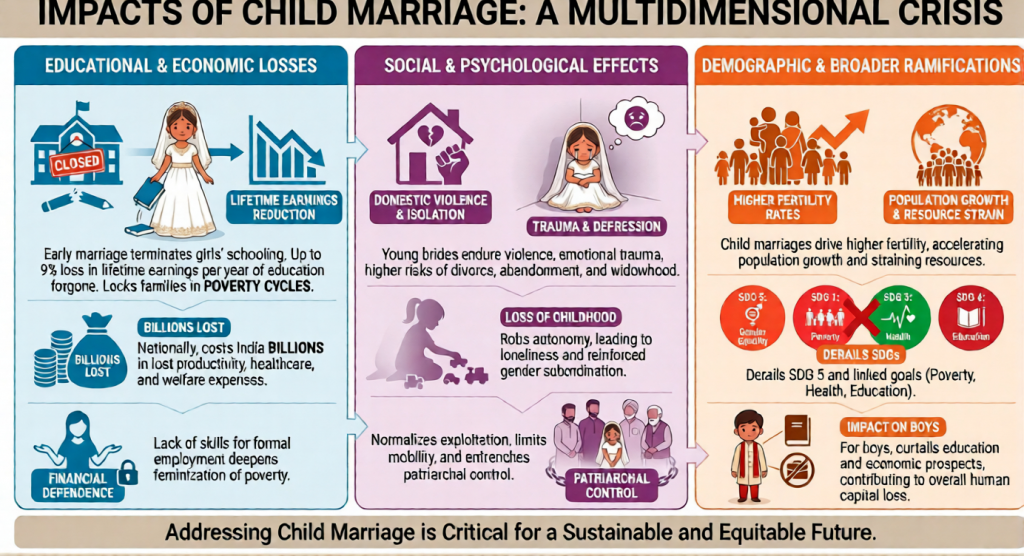
where does india stand on child marriage?

Initiatives

  • The Prevention of Child Marriage Act was passed in 2006, and national child marriage rates have halved since then. 
  • The Protection of Children from Sexual Offences Act, 2012 has also helped prevent child marriage. 
  • Beti Bachao Beti Padhao (BBBP) aims to improve the child sex ratio and promote girls’ education.
  • District‑level models (e.g., Panchayats declaring themselves “child marriage‑free”) use community monitoring, school‑based vigilance and local campaigns to deter such marriages.
  • States cash transfers and scholarship schemes to encourage girls schooling.
  • India is party to the UN Convention on the Rights of the Child and has endorsed the 2030 Agenda, including SDG Target 5.3 to eliminate child, early and forced marriage.

Source: TH


Other News of the Day

Syllabus: GS2/International Relation Context According to a recent report by the Parliamentary Standing Committee on External Affairs, India is facing its most formidable strategic challenge in Bangladesh since the 1971 Liberation War. Key Highlights of Report  Strategic Challenge Post-2024 Regime Change: India faces its ‘greatest strategic challenge’ in Bangladesh since the 1971 Liberation War. The...
Read More

Syllabus: GS3/ Economy Context The Central Board of Directors of the Reserve Bank of India (RBI) approved a risk-based deposit insurance framework for banks at its 620th meeting, held in Hyderabad. What is the Deposit Insurance Framework? Deposit insurance is a mechanism to protect bank depositors against the risk of bank failure. In India, deposit...
Read More

Syllabus: GS3/Science and Technology Context The Indian government is considering implementing “data exclusivity” in the pharmaceutical drugs sector. The government’s approach appears to be driven by the expectation that the provision could help bring in additional investment in the country.  Patent in Pharmaceutical Industry In the pharmaceutical industry, patents are broadly classified based on what...
Read More

Syllabus: GS3/Science and Technology Context Scientists have found a way to detect thorium-229’s nuclear ‘tick’ in a solid, opening a path to miniaturised nuclear clocks. About Conventional atomic clocks count electron transitions, which are sensitive to external disturbances (electric/magnetic fields). Nuclear energy levels are far more shielded, promising more stable timekeeping. Why Thorium-229 (²²⁹Th)? It...
Read More

Syllabus: GS3/ Environment Context The National Tiger Conservation Authority appraised the expansion of Project Cheetah and reviewed measures to address human-wildlife conflict.  What is human-wildlife conflict (HWC)? HWC refers to the negative interaction between humans and wild animals, leading to adverse impacts such as injury or loss of human lives, crop, livestock and other properties,...
Read More

Chillai-Kalan Syllabus: GS1/Geography In News Kashmir is currently under the grip of ‘Chillai-Kalan’. ‘Chilai Kalan’ It is  the coldest phase of winter in Kashmir, starts on December 21 and ends on January 31. The 40-day ‘Chilai Kalan’ is followed by a 20-day-long ‘Chillai-Khurd’ (small cold) and a 10-day-long ‘Chillai-Bachha’ (baby cold). Relevance  Heavy snowfall during...
Read More
scroll to top