


Syllabus: GS3/Science and Technology
Context
- A crucial set of tests on the Samudrayaan, India’s first manned-submersible mission, has been pushed to mid-next year due to delays in procuring syntactic foam cladding from France.
- This foam is essential for buoyancy and must be fitted before the scheduled 500-metre trial dive.
About Samudrayaan Mission
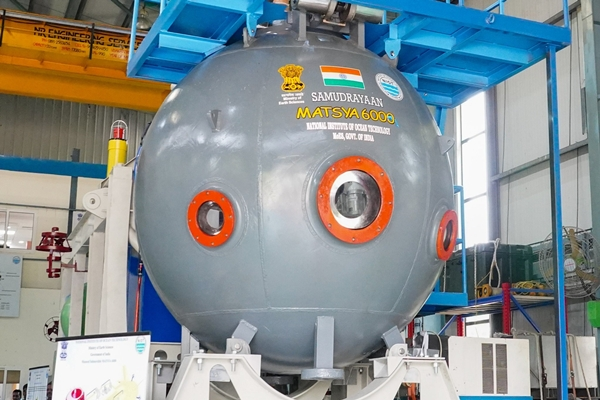
- The Samudrayaan Mission is a key component of India’s Deep Ocean Mission. It involves the development of MATSYA 6000, an indigenously designed, fourth-generation manned submersible capable of carrying three people to a depth of 6,000 metres.
- MATSYA 6000 is designed to operate for 12 hours, with an emergency endurance of up to 96 hours.
- It is being developed by National Institute of Ocean Technology (Chennai), an autonomous institute under the Ministry of Earth Sciences (MoES).
- India’s research vessel Sagar Nidhi will be used to deploy and recover the MATSYA 6000.
- The mission has an estimated budget of ₹4,077 crore and is being implemented in phases over a five-year period from 2021 to 2026.
Significance
- India can harness its 11,098-km coastline, nine coastal states, and 1,382 islands through a blue economy strategy strengthened by the Samudrayaan Mission.
- Enables exploration of deep-sea minerals, fuels, and biodiversity, with nearly 95% of the deep ocean still unexplored.
- Strengthens the security of undersea telecommunication cables, which is crucial as India’s data transmission capacity is expected to quadruple with new submarine cables by 2025.
- Places India among an elite group of nations including the US, Russia, China, Japan, and France with deep-sea human exploration capability.
Key Challenges
- Vessel Development: Precise thickness of titanium alloy sphere is required, and even 0.2 mm deviation in thickness risks collapse.
- The 2023 implosion of OceanGate’s Titan submersible on a Titanic dive highlights the critical importance of precision engineering.
- Life Support Systems: Oxygen regulation and carbon dioxide scrubbing are critical.
- Aquanaut Health: Requires high physical fitness, tolerance for limited food and water, and the ability to stay in confined spaces for up to 96 hours.
- Communication: Radio waves fail underwater, requiring acoustic telephones.
- India developed its own system, though initial tests struggled with temperature and salinity effects. Later trials in the open ocean confirmed functionality.
- Foreign Dependence: Syntactic foam (for buoyancy) sourced from France. Pressure testing of the titanium hull will be conducted in Russia.
Current Update
- NIOT has built a steel prototype of the submersible for preliminary trials.
- Simulated dives up to 100 metres completed successfully.
- Pending: 500-metre test, delayed due to late arrival of syntactic foam.
- After 500-m trials, the final titanium hull will be sent to Russia for pressure testing for 6,000-m depth.
Source: TH
Previous article
IMF Gives India a ‘C’ on Its GDP and Other National Accounts Data
Next article
News In Short 29-11-2025
