


Naive Painting of Kovacica
Syllabus: GS1/Art & Culture
Context
- Last year UNESCO recognised the Kovacica painters on its list of Intangible Cultural Heritage of Humanity.
About
- The naïve painting practices of Kovačica, Serbia refer to the tradition of painting and decorating objects with representations of the folk life, rural environment, history and everyday lives.
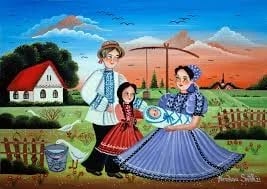
- It originated in the town of Kovačica in the 1930s and spread to other towns with Slovak communities in Serbia over time.
- Practitioners are self-taught, they use oil paint in bright hues to depict traditional culture, objects, history and values.
- An identifying factor, the practice is a means of transmitting the cultural heritage and history of the Slovak community in Serbia.
- The Slovak minority accounted for less than one percent of Serbia’s population in the 2022 census.
- A 2024 study found the community has declined over the last three decades, partly due to its ageing population and migration to Slovakia.
UNESCO Intangible Cultural Heritage
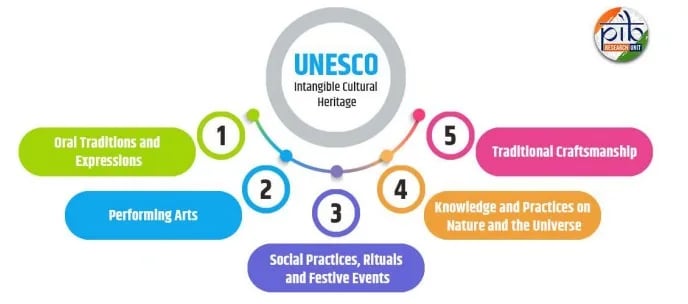
- So far, approximately 730 elements corresponding to 5 regions and 145 countries have been listed as Intangible Cultural Heritage.
- India has 15 elements included in this prestigious list, all of which are part of the Representative List of the Intangible Cultural Heritage of Humanity.
- Garba from Gujarat was the most recent addition to the list in 2023.
Source: TH
India and Indonesia Make Progress on BrahMos Deal
Syllabus: GS2/IR
Context
- Defence Ministers of India and Indonesia co-chaired the third India–Indonesia Defence Ministers’ Dialogue in New Delhi.
About
- Both sides made notable progress on the proposed BrahMos supersonic missile deal.
- Indonesia has maintained strong interest in acquiring BrahMos, especially to bolster maritime security in the Malacca Strait and the broader Indo-Pacific.
- Indonesia will be the second country to procure the weapon system from India, after the Philippines which has procured it in 2022.
- Progress in joint exercises — Super Garuda Shield, Garuda Shakti, Samudra Shakti, MILAN, and upcoming air manoeuvre drills — was reviewed, alongside plans to expand officer exchanges and training programmes.
- The meeting reaffirmed the robust foundation of defence ties driven by the Defence Cooperation Agreement and the Joint Defence Cooperation Committee.
About BrahMos
- The missile has been jointly developed with Russia and is named after the rivers Brahmaputra and Moskva in Russia.
- The supersonic missile can cruise at around Mach 3 (more in the case of supersonic speeds) and has a range of up to 290 kilometres (up to 500 or 800 kilometres in its advanced variants).
- It is also equipped to deliver a 200- to 300-kilogram high-explosive warhead.
- Fire-and-Forget: No further operator input required after firing.
- Its ongoing development towards greater range, speed, and stealth capabilities sees BrahMos sitting at the top as one of the world’s leading cruise missile systems.
Source: TH
Tex-RAMPS Scheme
Syllabus: GS3/Economy
In News
- The Government of India has approved the Textiles Focused Research, Assessment, Monitoring, Planning and Start-up (Tex-RAMPS) Scheme, to Strengthen Research, Innovation and Competitiveness in the Textiles Sector.
Textiles Focused Research, Assessment, Monitoring, Planning and Start-up (Tex-RAMPS) Scheme
- It brings together research, data, and innovation to empower India’s textile sector and position the nation as a global leader in sustainability, technology, and competitiveness
- It is designed to address critical gaps in research, data systems, innovation support and capacity development..
- It will be implemented as a Central Sector Scheme, fully funded by the Ministry of Textiles.
Features
- Research & Innovation: Advancing smart textiles, sustainability, and emerging technologies to strengthen innovation capacity.
- Data, Analytics & Diagnostics: Building robust systems for employment studies, supply chain mapping, and evidence-based policy.
- Integrated Textiles Statistical System (ITSS): Creating a real-time analytics platform for structured monitoring and decision-making.
- Capacity Development & Knowledge Ecosystem: Enhancing state-level planning, sharing best practices, and organizing workshops and sectoral events.
- Start-up & Innovation Support: Promoting incubators, hackathons, and academia-industry collaboration to foster high-value textile entrepreneurship
Benefits
- Enhance India’s competitiveness in global markets
- Strengthen research and innovation ecosystems
- Improve data-driven policymaking
- Generate employment opportunities
- Foster deeper collaboration between States, industry, academia, and government institutions
Source :PIB
Basic Animal Husbandry Statistics 2025
Syllabus: GS3/Economy
In News
- The Ministry of Fisheries, Animal Husbandry & Dairying and Panchayati Raj released the annual publication of ‘Basic Animal Husbandry Statistics 2025’.
- It provides comprehensive data on milk, eggs, meat, and wool production, along with state-wise estimates of per-capita availability and animal numbers involved in production.
Key Findings
- Milk: India ranks 1st globally, producing 247.87 million tonnes in 2024-25, up 3.58% from last year. Per capita availability rose to 485 gm/day.
- Top producers are Uttar Pradesh, Rajasthan, Madhya Pradesh, Gujarat, and Maharashtra (together 54.09%). Growth was seen across crossbred cattle (+4.97%), indigenous cattle (+3.51%), and buffaloes (+2.45%).
- Eggs: India is 2nd globally, with 149.11 billion eggs produced in 2024-25, a 4.44% rise. Per capita availability increased to 106 eggs/year.
- Andhra Pradesh, Tamil Nadu, Telangana, West Bengal, and Karnataka contribute 64.37% of output. Commercial poultry dominates (84.49%), while backyard poultry adds 15.51%.
- Meat: India ranks 4th globally, producing 10.50 million tonnes in 2024-25, up 2.46%. Poultry accounts for half the output (5.18 million tonnes).
- West Bengal, Uttar Pradesh, Maharashtra, Andhra Pradesh, and Telangana together contribute 57.55%.
- Wool: Production reached 34.57 million kg, rising 2.63%.
- Rajasthan leads with 47.85%, followed by Jammu & Kashmir, Gujarat, Maharashtra, and Himachal Pradesh, together contributing 85.98%.
Source :PIB
Central Empowered Committee
Syllabus: GS3/Environment and Conservation
Context
- The Supreme Court directed that the Union government not to take any steps to disband the Central Empowered Committee (CEC) without first obtaining the prior approval of the Court.
About
- The Cabinet Secretariat has cited the example of the National Green Tribunal (NGT), and said that with both NGT and CEC functional, duplicity of agencies may be leading to a delay in deciding the jurisdiction between the two.
- The Cabinet Secretariat had asked the Environment Ministry to refer the matter of the CEC’s future to the Law Commission.
Central Empowered Committee (CEC)
- The CEC was formed in 2002 (and reconstituted in 2008) by the Supreme Court under the T.N. Godavarman Thirumulpad vs. Union of India judgement.
- It became a statutory body in 2023.
- The Committee functions under the administrative control of the Central Government in the Ministry of Environment.
- Composition: A member secretary, and the remaining three expert members, who are civil servants appointed by the Union Ministry of Environment Forest and Climate Change (MoEFCC).
- Functions: It advises the court on writ petitions related to environment and forest matters, and assists in monitoring and compliance of its orders.
- The CEC also deals with any application made to it by any aggrieved person.
Source: IE
Skyroot’s first orbital rocket, Vikram-I
Syllabus:GS3/Space
In News
- Prime Minister Narendra Modi inaugurated Indian space startup Skyroot’s Infinity Campus and Skyroot’s first orbital rocket, Vikram-I, with the capability to launch satellites to orbit.
| Do you know? – Skyroot is India’s leading private space company, founded by Pawan Chandana and Bharath Dhaka, both alumni of the Indian Institutes of Technology and former scientists of ISRO turned entrepreneurs. – In November 2022, Skyroot launched its sub-orbital rocket, Vikram-S, becoming the first Indian private company to launch a rocket to space. 1. The rapid rise of private space enterprises is a testament to the success of the transformative reforms carried out by the Government in the last few years, reinforcing India’s leadership as a confident and capable global space power. |
Vikram-I
- It is built by Skyroot Aerospace and is named after Vikram Sarabhai, the father of India’s space programme.
- It is India’s first private orbital-class launch vehicle designed to serve the small satellite market with rapid, cost-effective launches.
- It is a four-stage, 20-metre rocket which produces 1,200 kN thrust with an all-carbon composite structure.
- It combines solid-fuelled stages with a hypergolic liquid upper stage for precise manoeuvres.
- It can deploy up to 350 kg into low Earth orbit (LEO) and 260 kg into a sun-synchronous orbit (SSO), with specific payload capacities based on mission profiles, such as 290 kg for a 500 km SSO and 480 kg for a 500 km LEO at a 45-degree inclination.
- Key innovations include 3D-printed engines, advanced avionics, and low-shock separation systems
Relevence
- Vikram-I is set to debut in early 2026, supporting India’s projected $77 billion space economy by 2030.
- Industry leaders highlight its role in easing ISRO’s load, fostering indigenous access to orbit, and strengthening India’s private space ecosystem, which will accelerate satellite deployment and downstream applications in defence, disaster management, environment, and infrastructure, positioning India as a global space technology hub.
Source :IE
Previous article
Road Map to Build Future-ready Force
Next article
India’s Updated Seismic Zonation Map (2025)
