


Greenland
Syllabus: GS1/ Places In News
In News
- Greenland’s Parliament has adopted legislation limiting foreigners’ right to own property on the vast Arctic island.
About Greenland (Capital: Nuuk)
- Greenland is the world’s largest island, lying in the North Atlantic Ocean.
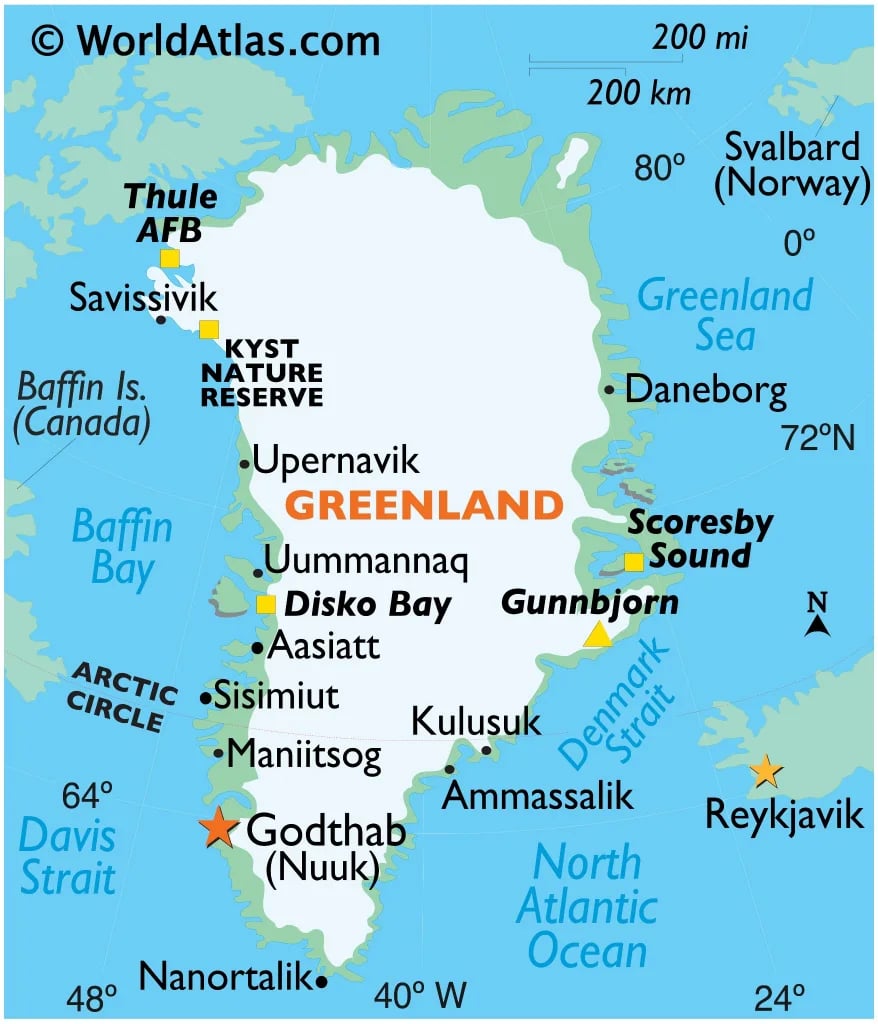
- It remains part of the Kingdom of Denmark, the island’s home-rule government is responsible for most domestic affairs. It is not a member of the European Union.
- It is located between the Atlantic and Arctic Oceans and Greenland shares its maritime borders with Canada, Iceland and Norway.
- It is noted for its vast tundra and immense glaciers.
- Greenland Ice Sheet, the single ice sheet or glacier covering about 80 percent of the island of Greenland and the largest ice mass in the Northern Hemisphere, globally second in size to only the ice mass that covers Antarctica.
Source: TH
Strait of Hormuz
Syllabus: GS1/ Places In News
In News
- Iranian forces recently seized a Marshall Islands flagged oil tanker as it passed through the Strait of Hormuz, the world’s most sensitive energy chokepoint.
About Strait of Hormuz
- Geography: It is a narrow strait (33 km wide) connecting the Persian Gulf with the Gulf of Oman and Arabian Sea.
- Iran lies to the north; Oman (Musandam Peninsula) to the south.
- Strategic Importance: It is a critical chokepoint in global oil transit, with nearly one-fifth of the world’s petroleum passing through it daily.
Source: TH
Lake Turkana
Syllabus: GS1/Geography
Context
- Researchers from Syracuse University and the University of Auckland revealed that long-term climate-driven declines in Lake Turkana’s water levels have increased earthquake and volcanic activity in the East African Rift System.
Lake Turkana
- It lies mainly in northern Kenya, with its northern end stretching into Ethiopia.
- It is the most saline lake in East Africa and the largest desert lake in the world, surrounded by an arid, seemingly extraterrestrial landscape that is often devoid of life.
- It is Africa’s fourth largest lake, fondly called the Jade Sea because of its breathtaking color.
Source :DTE
GCC Approved “one-stop” Travel System
Syllabus: GS2/ Regional Grouping
In News
- In a major step toward deeper regional integration, the Gulf Cooperation Council (GCC) has approved a “one-stop” travel system that will simplify movement across member nations.
- The one-stop travel system eliminates redundant travel procedures and foster stronger cooperation between member states.
About Gulf Cooperation Council (GCC)
- Overview: The Gulf Cooperation Council (GCC) is a regional political and economic grouping of six Arab countries in the Persian Gulf.
- Established: 1981 (Riyadh)
- Members: Bahrain, Kuwait, Oman, Qatar, Saudi Arabia and UAE.
- Economic significance: The GCC accounts for ~30% of global oil reserves and around 20% of global gas reserves.
Source: TOI
Operation SOUTHERN SPEAR
Syllabus: GS2/IR
Context
- The United States has launched Operation SOUTHERN SPEAR in Latin America, aimed at “removing narco-terrorists.”
About the Operation
- SOUTHCOM stands for the U.S. Southern Command, whose area of responsibility includes 31 countries across South America, Central America and the Caribbean.
- According to the U.S., the mission aims to:
- Defend the U.S. homeland
- Remove narco-terrorist threats from the Western Hemisphere
- Prevent drug flows that the U.S. says are harming its population.
Source: TH
Colombo Security Conclave
Syllabus: GS2/ International Relation
In News
- The Colombo Security Conclave (CSC) officially welcomed Bangladesh as its fifth member state during the 8th Deputy National Security Adviser (DNSA) level meeting.
About
- Overview: The Colombo Security Conclave was established in 2020, when India, Sri Lanka and the Maldives agreed to expand the scope of their trilateral meeting on maritime cooperation.
- Objective: To promote regional security by jointly addressing transnational threats and challenges of common concern.
- Members: India, Sri Lanka, Maldives, Mauritius & Bangladesh
- Seychelles is an observer nation.
- Pillars of Cooperation: Maritime security, counterterrorism, combating transnational organised crime, cyber security & humanitarian assistance and disaster relief.
Source: PIB
GI tag to Ambaji Marble
Syllabus: GS3/Economy/Science and Technology
In News
- The Ambaji Marble has received a Geographical Indication Tag (GI Tag) by the Union government.
- The certificate is being given by the Department for Promotion of Industry and Internal Trade (DPIIT) of the Union government.
Ambaji Marble
- Ambaji’s marble mines date back 1,200–1,500 years, around the time the Dilwara Jain Temple in Mount Abu was constructed.
- It is known for its milky white colour, durability ,high calcium content and natural beauty. It is found in Banaskantha district of north Gujarat .
- It is believed to have been used in the construction of the Ram Temple in Ayodhya.
- The marble has also been used in temple construction abroad, including in Miami, Los Angeles, Boston, New Zealand and England.
Importance of getting GI tag
- A GI tag not only safeguards the product’s identity and authenticity but also enhances its market value and export potential.
- The GI tag will help Ambaji marble establish a distinct brand identity in global markets, boosting demand in India and abroad and giving a fillip to local industries and artisans.
Source :IE
Electronics Development Fund (EDF)
Syllabus: GS3/Economy; IT
Context
- Recently, the Government of India launched the Electronics Development Fund (EDF) aimed at catalyzing innovation, research, and entrepreneurship in the electronics and IT sectors.
- India’s electronics market is projected to reach $300 billion by FY26.
About Electronics Development Fund (EDF)
- Overview: It was launched in 2016 under the MeitY as a key component of the Digital India and Make in India missions.
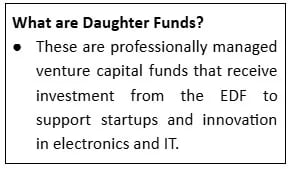
- Fund of Funds Model: EDF invests in Daughter Funds, which then invest in startups and innovation-driven enterprises, and it does not directly invest in startups.
- Fund Manager: The fund is managed by CANBANK Venture Capital Fund Ltd. (CVCFL).
Strategic Importance
- Reducing India’s dependence on imported electronics
- Encouraging domestic innovation in critical technologies like semiconductors, IoT, AI, and robotics
- Positioning India as a global hub for electronics design and manufacturing
Saalumarada Thimmakk
Syllabus: GS4/ Ethics; Environmental Ethics
In News
- India mourns the passing of Padma Shri awardee Saalumarada Thimmakka, one of the country’s most respected environmentalists and a global symbol of grassroots afforestation.
About
- Born in Gubbi taluk, Tumakuru district, and later settled in Hulikal, Thimmakka lived a life shaped by poverty and personal sorrow.

- Beginning in the 1950s, she and her husband Bikkala Chikkayya carried water daily for miles, protected the saplings from grazing cattle using thorny branches, and planted mostly in monsoon seasons to ensure the trees’ survival.
- Their persistent efforts resulted in a green corridor that provides shade, supports birdlife, and regulates the microclimate, serving as a living example of community-led afforestation.
- Her legacy also influenced Karnataka’s afforestation policies and inspired numerous tree-planting movements across India. The 385 trees she planted were saved from being cut down during a road widening project in 2019 after her appeal to the Chief Minister and Deputy Chief Minister.
Source: TH
Previous article
STEM Cell Therapy
Next article
National Press Day
