



Syllabus: GS3/Security
Context
- Recently, the Parliament of India has passed the ‘Promotion and Regulation of Online Gaming Act, 2025’, to regulate and prohibit certain gaming formats having social and economic concerns.
Key Highlights of the Act
- Three Segments of Online Games:
- E-sports: Recognised under the National Sports Governance Act, 2025, involving performance-based competitions with regulated prize money (e.g., Call of Duty, GTA).
- Social Gaming: Games for recreation or education, promoted by the government under Section 4 of the Act.
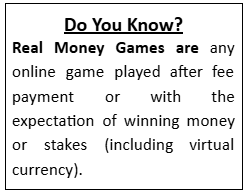
- Real Money Games (RMGs): Any game played with money, stakes, or convertible credits, regardless of skill or chance (includes Poker, Rummy, Fantasy Cricket, and Ludo).
- Ban on Real Money Games:
- The Act prohibits all forms of RMGs, regardless of whether they are based on skill, chance, or both. Advertising of RMGs is banned.
- Key Provisions on Regulation
- Punishments: Offering RMGs or facilitating related financial transactions attracts up to three years’ imprisonment, a fine of up to ₹1 crore, or both.
- Advertising such games is punishable with two years’ imprisonment or a fine of ₹50 lakh.
- Enforcement: CERT-IN aims to block apps offering banned services. Interpol may be engaged against offshore operators.
- Exemptions: No penal provisions exist for individual players.
- Regulatory Authority: The Centre is empowered to create a body to recognise, categorise, and register games.
- Punishments: Offering RMGs or facilitating related financial transactions attracts up to three years’ imprisonment, a fine of up to ₹1 crore, or both.
- The Act provides budgetary support for promoting social gaming but does not restrict minors’ access to e-sports or social games.
Rationale Behind the Act
- The government stated that the law responds to citizen complaints, citing evidence that online gaming algorithms prevent long-term net wins for users.
- Government reports highlight broader risks:
- Financial Crimes: A 2022 intelligence report flagged ₹2,000 crore in tax evasion by gaming firms.
- National Security: Portals like FIEWIN defrauded Indians of ₹400 crore, with links to terror financing.
- Tax Evasion: Authorities allege ₹30,000 crore in GST evasion by gaming companies.
- The Act thus frames RMGs as threats involving fraud, money laundering, and offshore jurisdictional challenges.
Government Justification
- Data shows Indians lose approximately ₹15,000 crore annually to Real Money Games (RMGs).
- The World Health Organization has linked RMGs to compulsive behavior, financial distress, and family disruption.
- Karnataka alone reported 32 suicides related to online gaming addiction over the past 31 months.
Implications
- No Distinction Between Skill and Chance: The Act overrides previous legal interpretations that distinguished games of skill from gambling, placing all RMGs under prohibition.
- Impact on Industry: Over 400 companies and more than two lakh jobs may be affected.
- Major platforms like Dream11, MPL, and PokerBaazi face existential threats to their business models.
- Swift Legislative Action: The Bill was passed in both Houses within 72 hours and received Presidential assent.
- It was enacted without industry consultation due to its prohibitory nature.
Judicial and Constitutional Issues
- Regulation of gambling falls within State jurisdiction under Entries 34 and 62 of the Constitution’s Seventh Schedule.
- States like Telangana (2017), Andhra Pradesh (2020), and Tamil Nadu (2022) had already enacted bans.
- On taxation, a 28% GST on gaming deposits was imposed in 2023, equating online gaming with betting and lotteries.
- It is argued that the Act fails to distinguish between games of skill and chance, eroding the legal precedent and potentially violating Article 19(1)(g), which protects the right to trade and occupation.
- If challenged, the SC may offer interim relief to the industry.
Conclusion
- The Promotion and Regulation of Online Gaming Act, 2025 marks a decisive shift in India’s online gaming policy, banning all forms of RMGs while promoting e-sports and social gaming.
- However, questions of federal jurisdiction, constitutional freedoms, and enforceability—especially against offshore platforms—remain unresolved.
- Its impact on jobs, taxation disputes, and ongoing court challenges will shape the future of India’s online gaming ecosystem.
| Daily Mains Practice Question [Q] Critically examine the implications of the Promotion and Regulation of Online Gaming Act, 2025 on India’s digital economy and youth behavior. Do you think the blanket ban on real money games strikes the right balance between regulation and innovation? |
Previous article
STEM Education & Students with Disabilities
Next article
Tourism in India: The Tariff-proof Sector
