

Syllabus: GS3/Agriculture
Context
- Bio-fortified potatoes, with added iron content, will soon be available in Indian markets, said the Director-General of the Peru-based International Potato Center (CIP).
About
- Bio-fortified sweet potatoes, with vitamin A added using technology developed by the CIP, are already available in Karnataka, Assam, West Bengal, and Odisha.
- The focus is on iron fortification in potatoes, the first variety has been released in Peru.
- Now it is under the evaluation of the ICAR, and it needs to be adapted to the Indian growing conditions.
| The CIP-South Asia Regional Centre (CSARC) – The CIP-South Asia Regional Centre (CSARC) is established in Agra, Uttar Pradesh. – It will not only serve farmers in potato-belt states like UP, Bihar and West Bengal but also cater to South Asian countries. – Objective: To increase food and nutrition security, farmers income, and job creation by improving potato and sweetpotato productivity, post-harvest management and value-addition. – Governance: By a coordination committee that comprises the Secretaries of Agriculture of India, Nepal, Bhutan, and Bangladesh. The International Potato Center (CIP) – The CIP was founded in 1971 as a research-for-development organization with a focus on potato, sweetpotato and Andean roots and tubers. – It delivers innovative science-based solutions to enhance access to affordable nutritious food, foster inclusive sustainable business and employment growth, and drive the climate resilience of root and tuber agri-food systems. – Headquartered: Lima, Peru. – CIP has a research presence in more than 20 countries in Africa, Asia and Latin America. |
Biofortified Crops
- Biofortified crops are those that have been specially bred to have higher levels of essential nutrients, such as vitamins, minerals, or amino acids, than their conventional counterparts.
- This is done through traditional breeding techniques, genetic modification, or modern biotechnological methods.
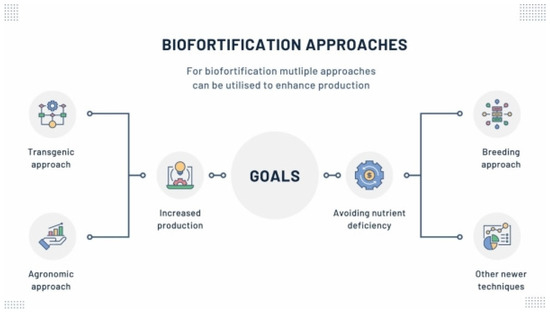
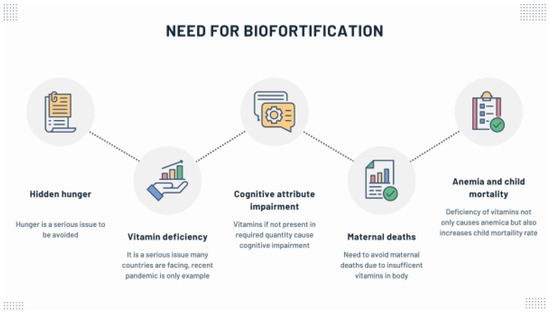
- Aim: To improve the nutritional value of crops, especially in regions where deficiencies in essential nutrients are widespread.
- Golden Rice has been genetically modified to produce higher levels of provitamin A (beta-carotene), aiming to reduce vitamin A deficiency.
Need for Biofortification
Significance of Biofortification
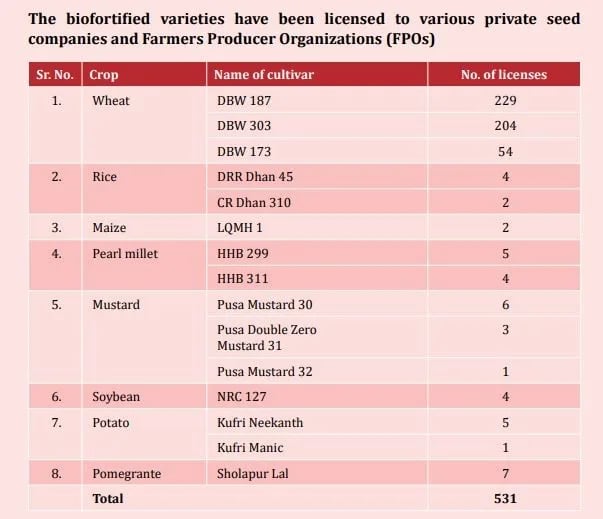
- It is regarded as the most sustainable approach to alleviate malnutrition.
- It provides nutrients in natural form.
- Biofortified food is affordable as it does not involve any additional price.
- ‘Biofortified varieties’ are as high yielding as ‘traditional varieties’, thus no loss is incurred to the farmers.
- It does not require elaborate infrastructure facilities as required in ‘food fortification’.
- Food fortification involves improving the nutritional content of food crops during the processing stage.
- It does not involve additional cost on preparing the enriched food grains.
Challenges
- Agronomic and Climatic Constraints: Biofortified varieties may not perform uniformly across different agro-climatic zones.
- Lack of Market incentives: Farmers may not get better prices for nutrient-rich crops, reducing motivation.
- Lack of demand: Without public awareness campaigns, market demand remains low.
- Weak integration with national nutrition schemes: Mid-Day Meal, ICDS, and PDS rarely include biofortified grains.
- Limited R&D investment: Compared to GM crops or hybrid seeds, biofortification receives less funding.
Way Ahead
- Strengthen seed distribution and farmer outreach.
- Integrate biofortified crops into government food schemes.
- Improve consumer awareness and market linkages.
- Invest in region-specific R&D and nutritional impact studies.
Source: TH
Previous article
Shifts in India’s Pesticide Market
Next article
POSH and Political Parties
