


Syllabus: GS3/ Infrastructure
In Context
- The Sagarmala Programme which was launched in 2015 by the Ministry of Ports has revolutionized India’s maritime sector.
About
- With a 7,500 km coastline, 14,500 km of potentially navigable waterways, and a strategic position on key global trade routes, India holds immense potential for port-led economic growth.
- The Sagarmala Programme is a key pillar of the Maritime Amrit Kaal Vision 2047 (MAKV), driving India’s ambition to become a global leader in maritime affairs. Building on Maritime India Vision 2030, MAKV sets ambitious targets, including 4 million Gross Registered Tonnage (GRT) of shipbuilding capacity and 10 billion metric tons of port handling annually, aiming to position India among the top five shipbuilding nations by 2047.
- MAKV outlines over 300 strategic initiatives to develop world-class ports, expand coastal and inland waterways, and promote a sustainable Blue Economy.
Sagarmala Programme
- Objectives: To streamline logistics, reduce costs, and enhance international trade competitiveness by shifting from traditional, infrastructure-heavy transport to efficient coastal and waterway networks.
- The program focuses on port modernization, industrial growth, job creation, and sustainable coastal development, ensuring minimal infrastructure investment while maximizing economic impact.
- Components:
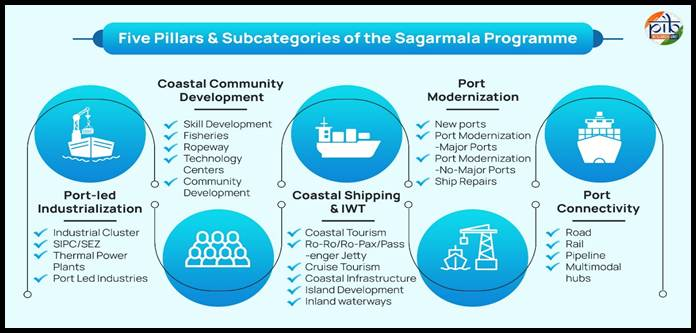
- The program consists of several key components aimed at transforming India’s maritime sector. The overall set of projects under the Sagarmala Programme are divided into 5 pillars.
- Implementation Mechanism:
- Major Ports, central ministries, State Governments, state maritime boards, and other relevant agencies execute projects.
- Projects are selected based on the Master Planning of Major Ports, meetings of the National and State Steering Committees.
- Funding Structure:
- Many projects are funded through the internal resources of MoPSW agencies, including Major Ports.
- Priority is given to private sector participation, with PPP models implemented wherever feasible.
- Sagarmala Development Company Limited (SDCL) was established to support project Special Purpose Vehicles (SPVs).
- Achievements:
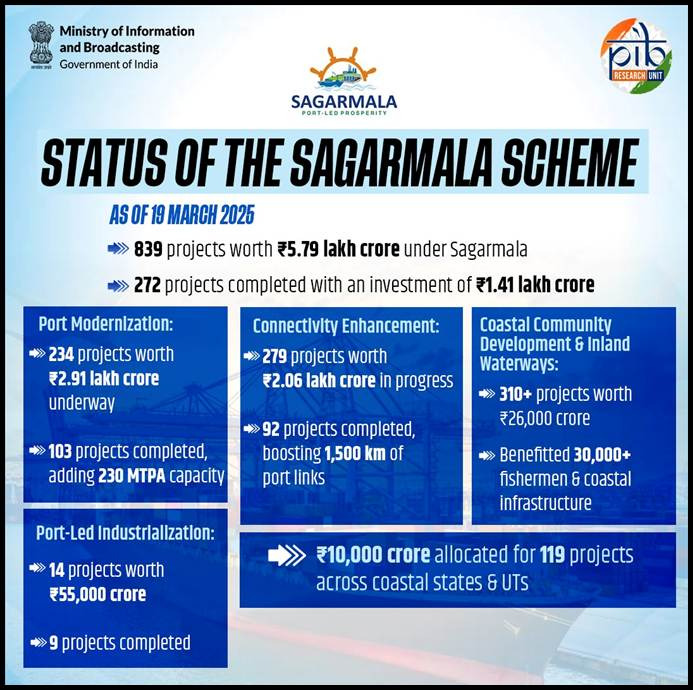
- Coastal shipping grew 118% in a decade, Ro-Pax ferries moved over 40 lakh passengers, and inland waterway cargo rose 700%.
- Nine Indian ports rank in the world’s top 100, with Vizag in the top 20 container ports.
Sagarmala 2.0
Sagarmala Startup Innovation Initiative (S2I2)
- Launched on March 19th 2025, it is a transformative program designed to foster innovation and entrepreneurship in India’s maritime sector.
- S2I2 supports startups in green shipping, smart ports, maritime logistics, shipbuilding technology, and sustainable coastal development by providing funding, mentorship, and industry partnerships.
- Anchored in the principles of RISE—Research, Innovation, Startups, and Entrepreneurship-S2I2 will drive technological advancements, enhance industry competitiveness, and accelerate economic growth.
Challenges
- Investment Mobilization and Budgetary Support: Securing timely investments and adequate budgetary allocations has been a persistent issue.
- Land Acquisition and Environmental Concerns: Acquiring land for infrastructure development, especially in coastal areas, involves complex legal and environmental considerations.
- Stakeholder Coordination: Effective implementation requires seamless coordination among central and state agencies, port authorities, and private sector participants.
- Connectivity Issues: Inadequate last-mile connectivity between ports and the hinterland affects the efficiency of cargo movement. Underutilization of domestic waterways and constrained rail infrastructure further exacerbate this problem.
- Community and Social Impacts: Port expansion and related industrial activities can lead to the displacement of local communities, particularly fishing populations.
Way Ahead
- Improve Inter-agency Coordination: Foster better collaboration between central, state, and local bodies for seamless execution.
- Focus on Sustainable Development: Ensure environmental safeguards, promote green ports, and support community livelihoods.
- Enhance Port-Hinterland Connectivity: Invest in multi-modal transport networks to improve last-mile cargo movement.
- Promote Indigenous Shipbuilding & Recycling: Support Make in India initiatives for maritime infrastructure and services.
Source: PIB
Previous article
The Medical Termination of Pregnancy (MTP) in India
Next article
Growth of India’s E-retail Market
