


Syllabus: GS 2/International Relations
In Context
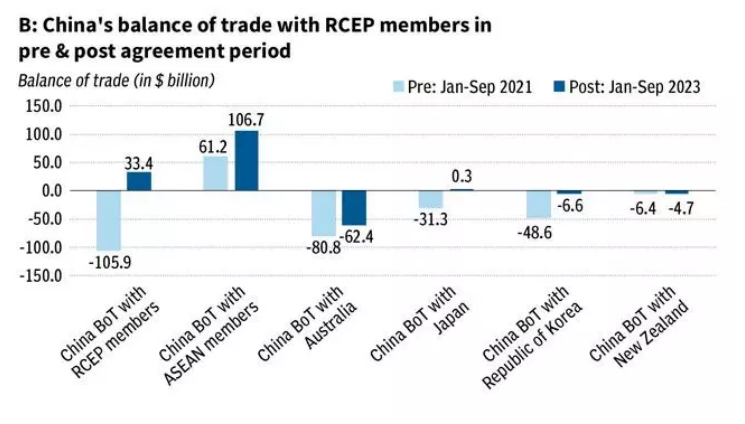
- Recently, it is observed that Regional Comprehensive Economic Partnership (RCEP) has brought significant benefits to China.
Key Points
- Following the implementation of RCEP, China saw notable enhancement in its trade surplus with nations where it previously maintained a positive trade balance.
- Simultaneously, there was a substantial reduction in the trade deficit with countries that previously exhibited a negative trade balance.
Regional Comprehensive Economic Partnership (RCEP)
- It is a free trade area (FTA) consisting of 10 ASEAN members (Brunei, Cambodia, Indonesia, Malaysia, Myanmar, Singapore, Thailand, the Philippines, Laos and Vietnam) and five of the bloc’s dialogue partners — China, Japan, South Korea, Australia and New Zealand.
- The landmark agreement was signed in November 2020 and It came into force in January 2022.
- Together, these RCEP participating countries account for about 30% of the global GDP and 30% of the world population.
- The purpose of RCEP was to make it easier for products and services of each of these countries to be available across this region.
India’s withdrawal from RCEP
- India was a founding member of the RCEP. In 2019, India decided to withdraw from the RCEP negotiations.
- Reasons : The fundamental reasons for India not joining RCEP was non-consideration of five key demands, namely,
- Amendments in tariff differentials,
- Alterations in the base rate of customs duty,
- Modifications to the most favoured nation (MFN) rule,
- Incorporation of certain exemptions into ratchet obligations within the agreement, and
- The recognition of India’s federal character in investment determinations.
China Factor
- The crucial factor behind India’s withdrawal from RCEP was the presence of China — a country with which India already has a substantial trade deficit even without a formal FTA.
- The fear was that India’s trade deficit could widen further if it opened its markets to cheaper Chinese goods without commensurate market access for Indian products in other RCEP countries.
- There was increased opposition from various industry segments and bodies, raising doubts about how RCEP would bring about a difference considering that comparable benefits hadn’t materialised from certain existing FTAs.
Analysis of withdrawal
- Analysing exclusively from the standpoint of BoT with China, initial data indicates that India’s decision to abstain appears to be one of foresight.
- Early trends indicate that this stance was crucial in safeguarding India’s domestic manufacturing base, especially the MSME sector.
- Opening up the Indian market to RCEP members, particularly China, could have had an adverse impact on the country’s manufacturing sector and some of the flagship initiatives of the government like the Production Linked Incentive (PLI) scheme.
- There is also a growing view that it would serve India’s interest to invest strongly in negotiating bilateral agreements with the US and the EU, both currently a work in progress.
- Now India along with some countries is getting into the U.S.-driven Indo-Pacific Economic Framework for Prosperity (IPEF)
Benefits of RCEP
- Promotes economic growth and regional stability.
- Encourages investments
- Enhances competitiveness and innovation
- Streamlines trade procedures and regulations.
Conclusion and Way Forward
- It must be noted that the impact of an FTA cannot be assessed relying solely on the movement of goods; services and investments must also be considered.
- Given the prevailing political tensions with China, it appears sensible for India to maintain a level of autonomy in its supply chains.
- Relying heavily on China, especially for crucial inputs, could potentially undermine our ability to assertively address any misconduct by that nation.
- Thus, by ensuring a degree of self-sufficiency, India can not only safeguards its economic interests but also take a firm stance in response to any unfavourable actions by China.
| Mains Practice Question [Q] What is behind India’s reasoning to stay out of RCEP? How much of a factor was the presence of China?Discuss its implications for India’s ‘Act East’ strategy. |
Previous article
MS Swaminathan: Indian Agriculture Lacks Today
Next article
Gender Gap in STEM Fields
