


Justice Surya Kant to take over as 53rd Chief Justice of India
Syllabus: GS2/Governance
In News
- Justice Surya Kant took over as 53rd Chief Justice of India and he will assume office on November 24, 2025, succeeding Chief Justice BR Gavai.
Appointment of Chief Justice of India
- The Chief Justice of India and the other judges of the Supreme Court are appointed by the President under clause (2) of Article 124 of the Indian Constitution.
- The Chief Justice of India is typically the senior-most Supreme Court judge deemed fit for the role.
- The Union Law Minister seeks the outgoing CJI’s recommendation, which is then forwarded to the Prime Minister, who advises the President for final appointment.
- For other judges, the collegium recommends candidates, with written opinions from senior judges.
Eligibility
- To be eligible, a person must be an Indian citizen and either:
- have been for at least five years a Judge of a High Court or of two or more such Courts in succession
- have been for at least ten years an advocate of a High Court or of two or more such Courts
- be deemed a distinguished jurist by the President.
| Do you know? – Article 217, which deals with the appointment of High Court judges, says the President should consult the CJI, Governor, and Chief Justice of the High Court concerned. 1. Further, the tenure of a CJI is until they attain the age of 65 years, while High Court judges retire at 62 years. |
Process
- India follows the collegium system for appointing judges, involving the five senior most Supreme Court judges.
- Though not mentioned in the Constitution, it evolved through key judgments like the First and Third Judges Cases, shifting appointment power from the executive to the judiciary.
- The government may conduct background checks and raise objections, but the collegium’s decision usually prevails.
- Seniority is the guiding norm, and the Law Minister forwards the collegium’s recommendation to the Prime Minister, who advises the President for final appointment.
Source :TH
Cyprus Ready to be part of IMEC
Syllabus: GS2/IR/GS1/Places
In News
- The Cyprus Foreign Minister visited India and expressed strong interest in joining the India-Middle East Economic Corridor (IMEC), citing Cyprus’s strategic location, EU membership, and robust shipping sector.
About Cyprus
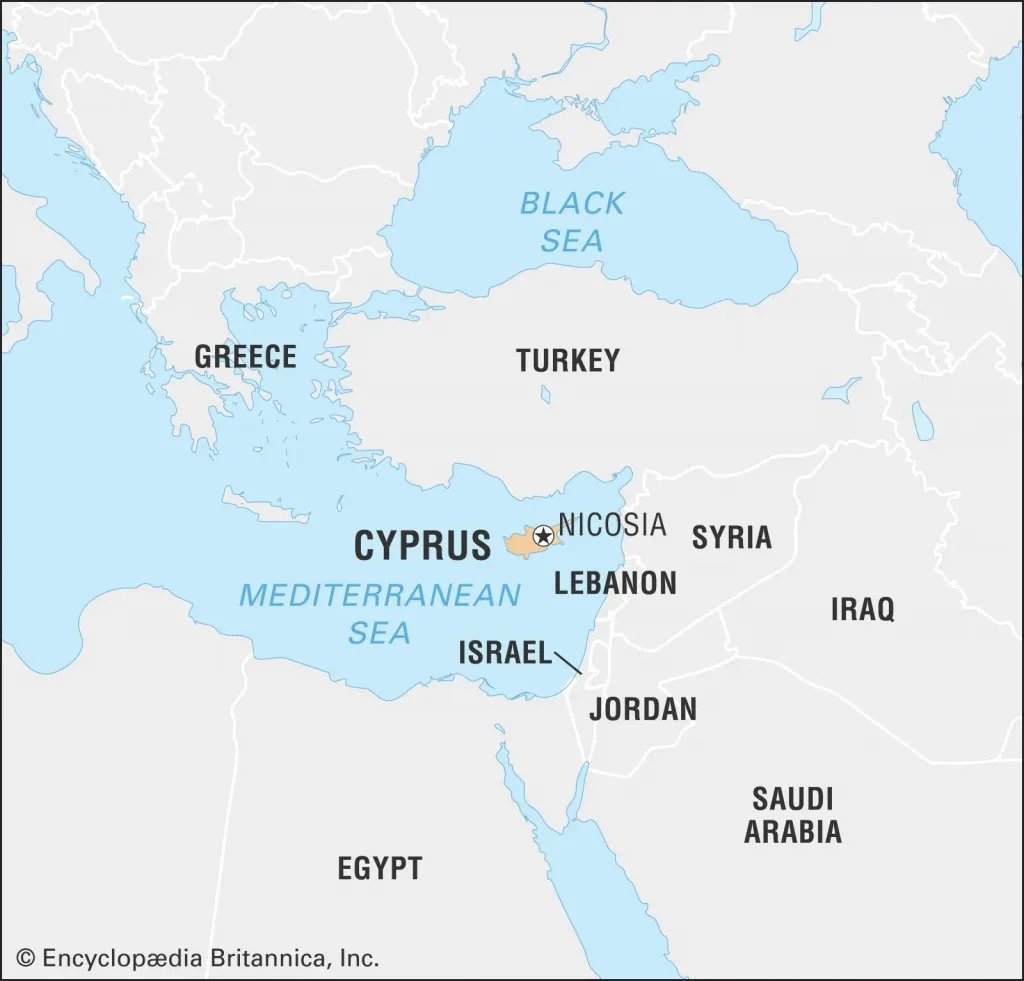
- It is an island nation in the eastern Mediterranean Sea, known for its rich history, natural beauty, and cultural diversity.
- It is located about 40 miles south of Turkey and 60 miles west of Syria.
- It gained independence from Britain in 1960, but tensions between Greek and Turkish Cypriots have led to a de facto partition since 1974.
Cooperation with India
- India and the Republic of Cyprus (RoC) share over six decades of strong bilateral relations based on friendship, mutual respect, and cooperation in international fora.
- Ties, established in 1962, have expanded across political, economic, and defence spheres.
- Both countries support each other in global organizations — India backs Cyprus’s reunification under UN resolutions, while Cyprus supports India’s UN Security Council bid and civil nuclear initiatives.
- Both sides reviewed the India-Cyprus Joint Action Plan (2025–2029) and discussed regional developments and multilateral cooperation, especially as Cyprus prepares to assume the EU Council Presidency in 2026.
- Cyprus also backed the India-EU Free Trade Agreement, highlighting its potential to unlock major economic opportunities.
India-Middle East Economic Corridor (IMEC)
- The IMEC was announced during the G20 Summit held in New Delhi in 2023 “to stimulate economic development through enhanced connectivity and economic integration between Asia, the Arabian Gulf, and Europe.”
- It is a proposed corridor spanning ship, ship-rail, and road networks to connect India to the Gulf region and the Gulf region to Europe.
Source :TH
US-China Sign Rare Earths Deal
Syllabus: GS3/Economy
In News
- US President Donald Trump and Chinese President Xi Jinping concluded their meeting in South Korea with an agreement to maintain the flow of China’s rare earth exports to the US.
What are rare earth elements?
- Overview: The term “rare” refers to their low concentration in extractable deposits, making mining and processing economically and environmentally challenging.
- Types: They are a group of 17 metallic elements, plus scandium and yttrium, known for their high density, melting points, conductivity, and thermal conductance.
- Source: They are mainly sourced from bastnasite, loparite, and monazite, and are classified into light (Cerium group) and heavy (Yttrium group) based on atomic numbers.
- Distribution: China dominates the global rare earth market, producing 60% of mine output and over 90% of refined products and magnets.
- Applications: They are essential in small quantities for a wide range of advanced technologies, including electronics, vehicles , defense systems, renewable energy, and medical devices.
- Environmental impact: Processing rare earths relies on toxic chemicals that can pollute soil, air, and water.
- Many ores also contain radioactive elements like thorium and uranium, requiring acid treatments that add health and safety risks.
- While cleaner extraction methods exist, they are expensive and not widely used, creating a conflict between meeting demand and reducing environmental damage.
- Many ores also contain radioactive elements like thorium and uranium, requiring acid treatments that add health and safety risks.
India’s Status and Steps
- India holds the world’s third-largest reserves of rare earth elements (REEs), estimated at 6.9 million metric tons, primarily in Andhra Pradesh, Karnataka, Odisha, and Kerala, with monazite sands in Kerala being especially rich.
- The government amended the Mines and Minerals Act in 2023 to classify REEs as critical minerals and launched the National Critical Mineral Mission in 2025.
Source :IE
Large Magellanic Cloud (LMC)
Syllabus: GS3/ Science and Technology
Context
- Using the James Webb Space Telescope (JWST), researchers identified five carbon-rich compounds surrounding a nascent star called ST6 in the Large Magellanic Cloud (LMC).
About the Large Magellanic Cloud (LMC)
- LMC is a dwarf irregular satellite galaxy of the Milky Way, located about 160,000 light-years from Earth in the constellation Dorado.
- Structure: It is known for its large, glowing nebulae, such as the Tarantula Nebula, which indicate active star birth.
- Star Content: It contains about 30 billion stars, with many young, star-forming regions.
- Composition:
- The LMC has fewer heavy elements like carbon, nitrogen, and oxygen than the Milky Way.
- Such metal-poor conditions mimic those of the early universe, providing a natural laboratory for studying primitive cosmic chemistry.
Source: IE
Nauradehi Sanctuary
Syllabus: GS3/ Environment
Context
- Nauradehi Wildlife Sanctuary is set to become the third home for cheetahs after Kuno National Park and Gandhi Sagar Sanctuary.
About Nauradehi Wildlife Sanctuary
- It is located on a plateau spanning Sagar and Damoh districts in the Bundelkhand region of Madhya Pradesh.
- It is characterised by deciduous forests of sal, teak, mahua, bamboo and bel trees.
- It contains extensive grasslands that support a substantial prey base including antelopes, wild boar, and other herbivores.
What is Project Cheetah?
- Project Cheetah is India’s cheetah relocation programme. It aims to bring back independent India’s only extinct large mammal.
- The cheetah was officially declared extinct by the Indian government in 1952.
- The first batch of eight cheetahs arrived in 2022 from Namibia and another batch of 12 cheetahs from South Africa arrived in 2023 in Kuno National Park.
- Two male cheetahs were moved from Kuno National Park to Gandhi Sagar Wildlife Sanctuary in 2025, making it the second home for cheetahs in India as part of Project Cheetah.
Source: THE PRINT
Exercise Trishul
Syllabus: GS3/Defence
Context
- India has launched Exercise Trishul 2025, a major tri-service military exercise across Gujarat and Rajasthan, involving the Army, Navy, and Air Force.
About the exercise
- Exercise Trishul 2025 is the largest tri-service exercise since the Operation Sindoor strikes six months ago.
- The Kutch region of Gujarat, near the Sir Creek border—a long-standing flashpoint with Pakistan—forms the core area of operations.
- More than 20,000 troops, supported by T-90S and Arjun tanks, attack helicopters, missile systems, Rafale and Sukhoi-30MKI fighters, as well as a fleet of frigates and destroyers, are conducting joint operations along the western front.
Source: IT
Previous article
India Targets Record 6 GW Wind Energy Addition by FY 2026
Next article
150 Years of Foundation of Arya Samaj
