


Syllabus: GS3/ Energy
Context
- The Union Minister for New and Renewable Energy (MNRE) announced that 6 gigawatts (GW) of new wind capacity is expected to be added by the end of financial year 2025–26.
Wind Energy in India
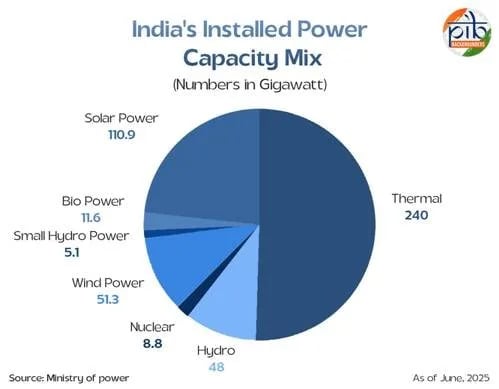
- India currently has the fourth highest wind installed capacity in the world with total installed capacity of 51.67 GW (as of August 12, 2025) of which 4.15 GW was added during FY 2024-25.
- Wind power generated 78.21 billion units of electricity during April 2024 to February 2025, contributing 4.69% of total electricity generated in the country.
- As per National Institute of Wind Energy, the estimated wind potential of the country is 1,164 GW at 150 meters above ground level.
Significance of Wind Energy
- Clean Energy Source: Wind energy produces zero greenhouse gas emissions during operation, contributing significantly to India’s Nationally Determined Contributions (NDCs) and Net Zero 2070 target.
- Rural and Coastal Development: Wind farms are largely located in rural or coastal areas, leading to infrastructure development, local employment, and community-level income.
- Sustainable Development: Support inclusive growth by providing electricity to remote areas.
- Encourage innovation and investment in clean technologies.
- Meet growing energy demand sustainably for a fast-developing nation.
| Renewable Energy Targets of India – As part of the updated NDC submitted to the UNFCCC (United Nations Framework Convention on Climate Change) in 2022: 1. India has committed to reducing its emissions intensity by 45% by 2030 (compared to 2005 levels), 2. achieving 50% of cumulative electric power capacity from non-fossil fuel sources by 2030, 3. and promoting a sustainable way of living through the ‘LIFE’ (Lifestyle for Environment) movement. 4. These targets also contribute to India’s long-term goal of reaching net-zero emissions by 2070. – The National Electricity Plan (NEP) envisions significant growth in renewable energy generation by 2032, with solar power expected to contribute 50% of that growth. |
Challenges in Wind Energy in India
- Site Constraints: High-wind potential sites are mostly concentrated in a few states, Tamil Nadu, Gujarat, Karnataka, and Maharashtra, limiting geographic spread.
- Land availability issues, forest clearances, and social resistance delay project timelines.
- Intermittency of wind generation challenges grid stability and requires investment in energy storage and forecasting systems.
- Policy Uncertainty: Frequent changes in bidding guidelines, offtake mechanisms, and RPO (Renewable Purchase Obligation) targets create uncertainty.
- Data Gaps: Wind resource data is still inadequate or outdated for many inland regions.
Government Initiatives
- National Wind Energy Mission: Focuses on the development and expansion of wind energy in India. The target for wind energy capacity is set at 140 GW by 2030.
- Domestic Manufacturing and Policy Push:
- Presently, India’s wind industry has 70% local content. Target to increase this to 85% by 2030 to strengthen domestic manufacturing.
- Tax Incentives: GST on wind equipment reduced from 12% to 5%, cutting turbine costs by approximately ₹25 lakh per MW.
- Global Manufacturing Ambition: With initiatives like the ALMM (Approved List of Models and Manufacturers)–Wind framework, India aims to meet 10% of global wind demand by 2030 and up to 20% by 2040, positioning itself as a global hub for turbines and components.
- The Union Cabinet approved a ₹7,453 crore Viability Gap Funding scheme for 1 GW of offshore wind projects (500 MW each off Gujarat and Tamil Nadu) and port upgrades.
Way Ahead
- Integrate energy storage systems (battery and pumped hydro) with wind farms for continuous and reliable supply.
- Establish Centres of Excellence for Wind Technology in partnership with institutions like NIWE to promote R&D in offshore, hybrid, and advanced turbine design.
- Promote hybrid tenders combining wind, solar, and storage to maximize grid efficiency and land utilization.
Source: TH
Previous article
US Waiver to India on Chahbahar Port
Next article
News in Short – 31 October, 2025
