


Syllabus: GS2/Polity & Governance
Context
- Recently, Justice Surya Kant was sworn in as the 53rd Chief Justice of India (CJI), succeeding Justice BR Gavai. The oath of office was administered by the President of India at Rashtrapati Bhavan.
| Justice Surya Kant: Career Highlights – Born: In Hisar, Haryana (1962) – Youngest Advocate General of Haryana (2000) – Elevated as a judge of the Punjab and Haryana High Court (2004) – Chief Justice of the Himachal Pradesh High Court (2018) – Judge at Supreme Court (2019) 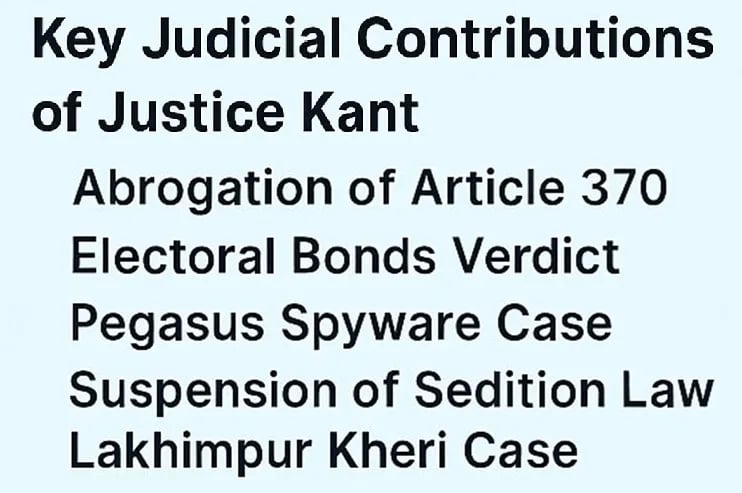 |
About the Chief Justice of India (CJI)
- Origins in Colonial Judiciary: The position of Chief Justice traces its lineage to the Supreme Court of Judicature at Fort William, established under the Regulating Act in 1774 by the British Parliament.
- It was headed by a Chief Justice, with Sir Elijah Impey as the first to hold the title in India.
- Over time, High Courts were established in Calcutta (1862), Bombay, and Madras, each led by a Chief Justice under the Indian High Courts Act, 1861.
- Post-Independence Constitutional Framework: The Constitution of India (1950) formally established the Supreme Court of India under Article 124, replacing the Federal Court of India (1937–1950).
- Justice Harilal Jekisundas Kania became the first Chief Justice of India on January 26, 1950, the day the Constitution came into effect.
Constitutional Mandates of the Chief Justice of India
- The Supreme Court of India is established under Part V, Chapter IV (Articles 124 to 147) of the Constitution of India. Key provisions include:
- Article 124: Establishment and constitution of the Supreme Court.
- Article 124 (1): There shall be a Supreme Court of India consisting of a Chief Justice of India and other Judges.
- Article 124 (2): Every Judge of the Supreme Court shall be appointed by the President of India by warrant under his hand and seal and shall hold office until he attains the age of sixty-five years.
- Article 145: It empowers the Supreme Court to make rules for regulating its practice and procedure, under the leadership of the CJI.
- Article 146: It grants the CJI authority over the appointment and service conditions of officers and servants of the Supreme Court.
- Article 147: It defines the term ‘Supreme Court’ to include the Chief Justice and other judges.
Judicial Independence and Safeguards
- Tenure Security: The CJI can be removed through impeachment under Article 124(4) and (5). The removal requires proven misbehavior or incapacity.
- Financial Autonomy: Salaries and allowances are charged on the Consolidated Fund of India (CFI).
- Post-Retirement Restrictions: The CJI cannot plead or act in any court or before any authority in India after retirement.
Key Responsibilities of the CJI
- Oath of President of India: Every President and every person acting as President or discharging the functions of the President shall, before entering upon his office, make and subscribe to an oath or affirmation in the presence of the Chief Justice of India or, in his absence, the senior-most Judge of the Supreme Court available.
- Judicial Leadership: Presides over Constitution Benches and allocates cases to other judges.
- Master of the Roster: The term refers to the CJI’s prerogative to decide which judge hears which case. It was reaffirmed by the Supreme Court in 2018, declaring the CJI as the ‘spokesperson of the court’ and the sole authority over bench composition.
- Administrative Head: Oversees the functioning of the Supreme Court and its registry.
- Collegium System: Heads the collegium responsible for recommending appointments and transfers of judges in the higher judiciary.
- Final Court of Appeal: The Supreme Court is the final court of appeal in civil, criminal, and constitutional matters.
- Article 32: It empowers the Court to enforce Fundamental Rights through writs like habeas corpus, mandamus, prohibition, quo warranto, and certiorari.
- Article 136: It grants the Court discretionary power to grant special leave to appeal from any judgment or order passed by any court or tribunal in India.
- Judicial Review and Guardian of the Constitution: The Supreme Court, under the leadership of the CJI, has the power to:
- Strike down unconstitutional laws and executive actions.
- Interpret constitutional provisions, especially in cases involving federal disputes, fundamental rights, and electoral laws.
- Ensure checks and balances among the three branches of government.
- Advisory Role: Plays a consultative role in matters such as the appointment of Election Commissioners and Lokpal members.
Challenges & Priorities For 53th CJI
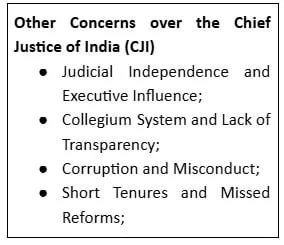
- Judicial Pendency and Backlog: Over 90,000 cases are pending in the Supreme Court alone, with millions more across lower courts.
- The rising trend of ‘miscellaneous applications’ and prolonged litigation has indicated judicial efficiency and procedural discipline.
- He is expected to streamline case listing, promote alternative dispute resolution (ADR), and enhance digital case management systems.
- SIR Case: A constitutional challenge involving sovereign infrastructure reallocation and federal fiscal powers.
