



Sree Narayana Guru
Syllabus: GS1/Modern History
Context
- The President of India inaugurated the observance of the Mahasamadhi centenary of Sree Narayana Guru at Sivagiri Mutt, Varkala, Kerala.
About
- Sree Narayana Guru was a philosopher, spiritual leader and social reformer in India.
- He led a reform movement against the injustice in the caste-ridden society of Kerala in order to promote spiritual enlightenment and social equality.
- He founded institutions like the Sarada Mutt at Sivagiri to promote education, spirituality, and social upliftment.
- His slogan, “One Caste, One Religion, One God for All,” is a cornerstone of his philosophy and a widely recognized saying in Kerala.
- Important work: Daiva Dasakam, Nivritti Panchakam, and Atmopadesa Satakam.
Legacy
- His teachings deeply influenced later social reformers and movements, including the Vaikom Satyagraha (1924–25) for temple entry rights.
- Recognized as a saint, philosopher, and social reformer who transformed Kerala’s caste-ridden society.
Source: PIB
Gyan Bharatam Mission
Syllabus: GS1/Culture
Context
- The Gyan Bharatam Mission on manuscripts under the Union Culture Ministry, signed Memorandums of Understanding with around 20 institutes for conservation, upkeep and digitisation of manuscripts.
Gyan Bharatam Mission
- National Mission for Manuscripts (NMM) is aimed to preserve, document, and disseminate India’s rich manuscript heritage.
- The Mission has been restructured with the nomenclature ‘Gyan Bharatam Mission’ as a Central Sector Scheme for the period 2024-31.
- The key objectives of the Mission include Survey and Documentation, conservation and preservation, publication and research etc.
- The Culture Ministry had earlier organised the first-ever international conference on Indian manuscripts titled “Reclaiming India’s Knowledge Legacy through Manuscript Heritage”.
Source: TH
Saudi Arabia Ends Kafala System
Syllabus: GS2/ International Relations
In News
- In a landmark labour reform, Saudi Arabia has officially scrapped the decades-old Kafala (sponsorship) system.
What was the Kafala system?
- The Kafala system required foreign workers to have a Saudi sponsor, usually their employer, who controlled their visa and legal status.
- This meant that workers couldn’t change jobs, leave the country, or even renew their residence permits without the sponsor’s consent.
Why did Saudi Arabia scrap the system?
- Human rights bodies long argued that this system often led to worker exploitation and abuse, as employees were left with little legal recourse if their employers withheld salaries or passports.
- The reform aligns with Saudi Crown Prince Mohammed bin Salman’s Vision 2030, which aims to modernise the economy, attract foreign investment, and reduce the kingdom’s reliance on oil.
How will this impact Indian workers in Saudi Arabia?
- Saudi Arabia currently has an estimated 1.34 crore foreign workers. They account for close to 42 per cent of the Kingdom’s population, a majority of the estimated 1.34 crore workers hail from Bangladesh, India, Nepal and the Philippines.
Source: HT
RBI Proposes Limits on Banks Capital Market Exposure and Acquisition Financing
Syllabus: GS3/ Economy
Context
- The Reserve Bank of India (RBI) has issued a draft circular proposing limits on banks exposure to capital markets and corporate acquisitions to manage risks while promoting credit growth.
What are the Key Proposals?
- Capital Market Exposure: Banks aggregate exposure, including direct and indirect (through funds, guarantees), should not exceed 40% of their Tier-1 capital.
- Tier-1 capital includes equity, retained earnings, and certain instruments capable of absorbing losses.
- Acquisition Financing (Loans for Buying Companies):
- Banks’ exposure to acquisition finance should be capped at 10% of Tier-1 capital.
- Banks may finance up to 70% of the acquisition deal value; the remaining 30% must come from the acquiring company.
- Only listed entities with satisfactory net worth and profitability for the last three years are eligible.
- Loans must be fully secured by the target company’s shares, so the bank can recover money if needed.
- It proposed revised risk-weight guidelines for non-banking financial companies’ infrastructure loans, a move that could lower capital requirements for lenders financing established projects.
Source: TH
Exercise Ocean Sky 2025
Syllabus: GS3/ Defence
Context
- The Indian Air Force (IAF) is participating in Exercise Ocean Sky 2025, a multinational air combat exercise hosted by the Spanish Air Force at Gando Air Base, Spain.
About
- The exercise aims to foster mutual learning, enhance interoperability, sharpen air combat skills, and strengthen defence cooperation with friendly nations.
- The exercise brings together more than 50 aircraft from Spain, Germany, Greece, Portugal, India, and the United States, including India’s Su-30MKI fighter jets.
Growing India–Spain Defence Ties
- In August 2025, India received the final delivery of 16 Airbus C-295 military transport aircraft at the Airbus Defence and Space facility in Seville, Spain.
- The C-295 project marks India’s first private sector venture in military aircraft production, under a partnership between Tata Advanced Systems Limited (TASL) and Airbus Spain.
- A Final Assembly Line is being set up in Vadodara, Gujarat, to manufacture the remaining 40 out of 56 aircraft in India.
Source: TH
Project Arunank
Syllabus: GS3/Defence
In News
- Project Arunank of the Border Roads Organisation (BRO) marked its 18th Raising Day in Naharlagun, Arunachal Pradesh.
Project Arunank
- It was established in 2008 and it has built over 696 km of roads and 1.18 km of major bridges, enhancing connectivity to remote areas and supporting Armed Forces operations.
- Notable achievements include the blacktopping of the 278 km Hapoli-Sarli-Huri Road and strategic links like the TCC-Maza and TCC-Taksing Roads.
- It has embraced sustainable technologies such as Steel Slag, Geo Cells, and GGBFS Concrete to improve infrastructure durability.
- Environmental efforts include planting 23,850 trees under the ‘Ek Ped Maa Ke Naam’ initiative, while welfare measures for Casual Paid Labourers have improved working conditions.
Future Plans
- BRO plans to expand road networks, build new bridges and tunnels, and enhance high-altitude connectivity using advanced technologies for safer, more sustainable infrastructure.
Source:PIB
ICGS Ajit and ICGS Aparajit
Syllabus: GS3/Defence
In News
- The Indian Coast Guard launched two advanced Fast Patrol Vessels—ICG Ship Ajit and ICGS Aparajit—at Goa Shipyard Limited (GSL).
ICGS Ajit and ICGS Aparajit.
- These vessels are the seventh and eighth in a series of eight indigenously built FPVs being constructed by Goa Shipyard Limited (GSL) for the ICG, underscoring India’s growing self-reliance in defence shipbuilding.
- The 52-metre-long vessels displace 320 tonnes and are equipped with Controllable Pitch Propellers (CPP) — the first of their kind in this class of ships in India — ensuring superior manoeuvrability and propulsion efficiency.
Importance and Roles
- The FPVs are designed for multi-mission roles such as fisheries protection, coastal patrol, anti-smuggling, anti-piracy, and search and rescue operations, especially around India’s island territories and Exclusive Economic Zone.
- This marks a key step in enhancing India’s coastal defense and maritime surveillance capabilities.
Source:PIB
Indo-Tibetan Border Police (ITBP) Raising Day
Syllabus: GS 3/Security Agencies
In News
- The 64th raising day of Indo-Tibetan Border Police (ITBP) was observed recently.
Indo-Tibetan Border Police (ITBP)
- It was raised on October 24, 1962 and it guards the 3,488 km-long India-China border, stretching from the Karakoram Pass in Ladakh to Jachep La in Arunachal Pradesh.
- It also plays a crucial role in internal security operations, including anti-Naxal duties in Chhattisgarh.
- Many of the ITBP’s Border Out Posts are located at altitudes between 9,000 and 18,800 feet, where temperatures can plummet to minus 45 degrees Celsius during winters.
Relevance
- It is recognised as a specialised armed police force.
- It trains its personnel in mountaineering, skiing, and tactical combat, in addition to maintaining readiness for disaster response and relief operations in the Himalayan region.
- It has conducted numerous rescue missions, providing timely assistance to citizens affected by natural calamities.
Source:PIB
Carabid Beetles
Syllabus: GS3/ Environment
Context
- Recent research in Italy has shown that carabid ground beetles can serve as potential bioindicators of microplastic pollution in soil.
About Carabid Beetles
- Carabid beetles, belonging to the family Carabidae, are nocturnal predators that inhabit nearly all terrestrial ecosystems worldwide.
- Species diversity: Around 34,000 species globally and over 1,000 species recorded in India.
- Physical traits: Flattened, elongated bodies (mostly dark or metallic-shiny), and prominent mandibles for predation.
- Ecological Role:
- Natural pest controllers: Feed on a variety of agricultural pests like caterpillars, slugs, aphids, weevils, and snails.
- Indicator of soil quality: High carabid diversity reflects low pesticide use, good organic matter, and balanced soil moisture.

Source: TH
Pilot Whales
Syllabus: GS3/Species in News
Context
- More than two dozen pilot whales have died after becoming stranded on a remote beach in New Zealand.
About
- Scientific name:
- Globicephala melas (Long-finned Pilot Whale).
- Globicephala macrorhynchus (Short-finned Pilot Whale).
- Family: Delphinidae (Oceanic dolphins).
- Despite their name, they are not true whales but large oceanic dolphins.
- They were named pilot whales because it was thought that each pod followed a ‘pilot’ in the group.
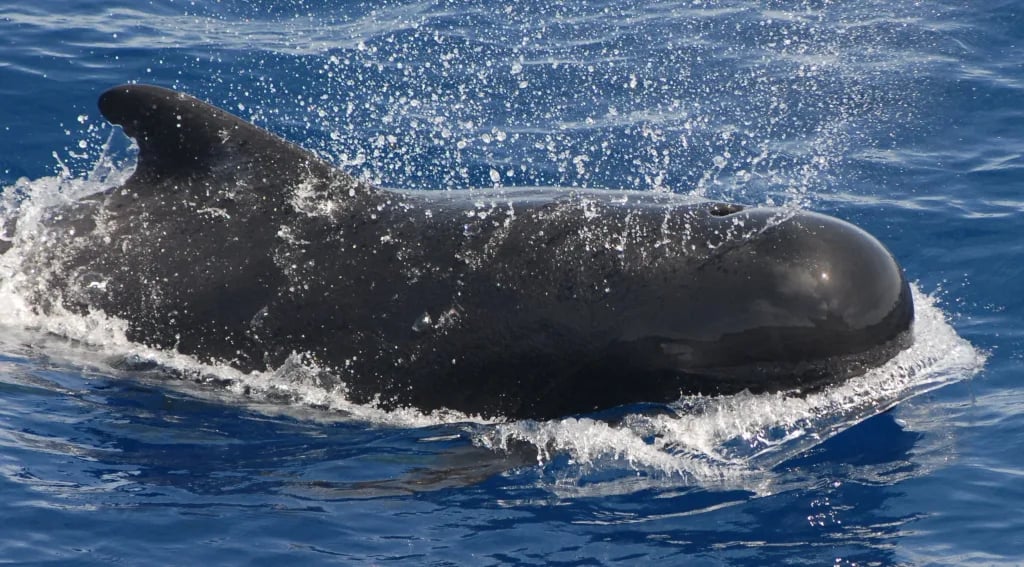
- Distinctive Appearance: Pilot whales have a distinctive appearance characterized by a bulbous forehead and a long, black body with a white or light-gray saddle patch behind the dorsal fin.
- Habitat & Distribution:Long-finned species prefer cooler waters (North Atlantic, Southern Ocean).
- Short-finned species prefer warmer tropical and subtropical waters, including parts of the Indian Ocean and Arabian Sea.
- Conservation Status:
- The IUCN Red List for short finned whales is Least Concern.
- The data is not sufficient for the long finned whales.
Source: DD
Previous article
Cloud Seeding
Next article
Classical Languages of India
