


Syllabus: GS2/IR
Context
- India and the United Kingdom signed a Comprehensive Economic Trade Agreement (CETA) during Prime Minister Narendra Modi’s visit to the U.K.
About
- This marks India’s first major FTA in over a decade and the UK’s fourth since its exit from the European Union (EU) in 2020.
- India and the UK finalized the trade pact following over three years of negotiations.
- Aim: Making trade easier and more beneficial between India and the United Kingdom.
- The bilateral trade between the two countries stands at nearly USD 56 billion, with a joint goal to double this figure by 2030.
- The agreement will come into effect once ratified by both countries.
- While the Union Cabinet in India has approved the deal, it still requires approval from the UK Parliament.
Key Highlights and Benefits
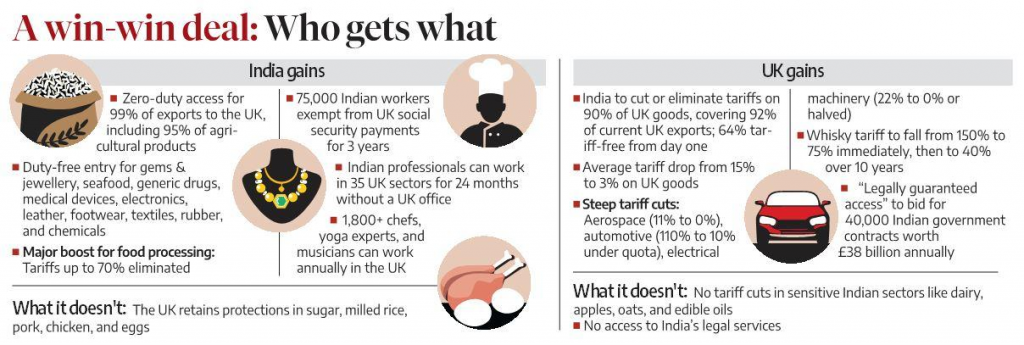
For India
- Duty-free access to the UK market for 99% of Indian products: This is a huge win for Indian exports, especially in labour-intensive sectors like textiles, footwear, gems and jewellery, and engineering goods, which previously faced duties of 4% to 16%.
- Easier entry for Indian professionals: The agreement provides assured temporary access to the UK market for Indian professionals like chefs, yoga instructors, and IT specialists.
- Exemption from social security contributions: Under the agreement on the Double Contribution Convention, Indian workers temporarily posted in the UK can be exempt from paying social security for up to three years, saving them and their employers significant money.
- Boost for Manufacturing: Sectors like electronics, pharmaceuticals, chemicals, food processing, and plastics are expected to see a boost in exports.
- Boost for Agriculture and Fisheries: Indian farmers and the fisheries sector will benefit from duty-free access for many agricultural and marine products, allowing them to compete better in the UK market.
For the UK
- Reduced tariffs on nearly 90% of UK goods entering India: This will make British products more affordable in India.
- Big cuts on duties for British whisky and gin: Tariffs on popular British products like whisky and gin will drop significantly, from 150% to 75% immediately and then gradually to 40% within ten years. This gives UK distillers a significant advantage in the large Indian market.
- Lower tariffs on certain UK-made automobiles: Car duties will be reduced, improving the competitiveness of British car manufacturers in India.
- Access to Indian federal government procurement tenders: UK firms can bid for government contracts in India worth over a certain amount, opening up a large market.
- Benefits for financial and professional services: The agreement includes commitments that benefit UK companies in IT, financial services, and professional services like consulting and engineering.
| UK-India Vision 2035 Roadmap – Increased ambition: Since elevating the relationship to a Comprehensive Strategic Partnership, India and the UK have catalysed significant partnerships and growth across all sectors. The new vision builds on this momentum, setting ambitious goals to deepen and diversify bilateral cooperation. – Strategic Vision: The India-UK Vision 2035 sets clear strategic goals and milestones, tracking a path for sustained future collaboration and innovation. |
Source: IE
Previous article
National Sports Governance Bill, 2025
Next article
ICJ Ruling on Climate Change
