


Syllabus: GS2/ Vulnerable Sections, Government Policies & Interventions
Context
- Recently, the Centre for Legal Action and Behaviour Change (C-LAB), in partnership with the Just Rights for Children (JRC) network, released a report related to child labour rescues in 2024–25.
Key Findings of Report
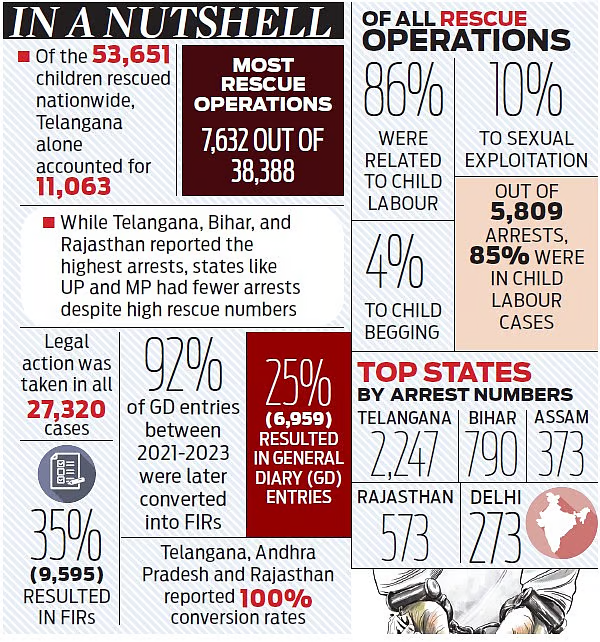
- Over 53,000 children were rescued across 24 states and union territories (Between April 2024 and March 2025).
- Telangana topped the list with 11,063 rescues, followed by Bihar (3,974), Rajasthan (3,847), Uttar Pradesh (3,804), and Delhi (2,588)
- Alarming Trends: The report reveals that nearly 90% of rescued children aged 10 to 14 were found working in sectors classified as the worst forms of child labour — including spas, massage parlours, and orchestras.
- Legal Action and Enforcement: A total of 38,388 FIRs were registered and 5,809 arrests made, with 85% of arrests directly related to child labour.
- Telangana, Bihar, and Rajasthan led in enforcement.
- States like Uttar Pradesh and Madhya Pradesh showed high rescue numbers but fewer arrests.
- Policy Recommendations: The report calls for the launch of a National Mission to End Child Labour, the formation of district-level Child Labour Task Forces, and better coordination between NGOs and law enforcement to ensure prosecution and rehabilitation.
| Definition of Child – United Nations Convention on the Rights of the Child (UNHRC): A child as an individual who has not attained the age of 18 years.India has been a signatory to the UNHRC since 1992. – International Labour Organization (ILO): Child is any person under 18. 1. Child Labour (as per the ILO) refers to work that deprives children of their childhood, their potential and their dignity, and that is harmful to their physical and/or mental development. Constitutional Provisions Related To Child 1. Article 15(3) (Protective Discrimination): It empowers the State to make special provisions for children, recognizing their need for additional safeguards and support. 2. Article 21A (Right to Education): It guarantees free and compulsory education for all children aged 6 to 14 years. 1. This provision, added by the 86th Constitutional Amendment (2002), is central to preventing child labour by ensuring access to schooling.Article 24 (Prohibition of Child Labour): It explicitly prohibits the employment of children below the age of 14 in factories, mines, or any other hazardous employment. This is a direct constitutional safeguard against exploitative labour.Article 39(e) and 39(f):Children are not forced by economic necessity to enter vocations unsuited to their age or strength.Childhood and youth are protected against exploitation and moral and material abandonment.Article 45 (Early Childhood Care and Education): It directs the State to provide early childhood care and education for all children below the age of six, laying the foundation for long-term development and protection.Legal ProtectionMinimum Wages Act, 1948 (amended in 1986): A ‘child’ is a person who has not completed his fourteenth year of age.Child Labour (Prohibition and Regulation) Amendment Act, 2016: It prohibits “the engagement of children in all occupations and of adolescents in hazardous occupations and processes” wherein adolescents refers to those under 18 years; children to those under 14. The Act also imposes a fine on anyone who employs or permits adolescents to work.Do You Know?Gurupadswamy Committee (1979) observed poverty is main factor for the child labour. It recommended that a multiple policy approach was required in dealing with the problems of working children.The Child Labour (Prohibition & Regulation) Act was enacted in 1986 based on the recommendations of Gurupadaswamy Committee. |
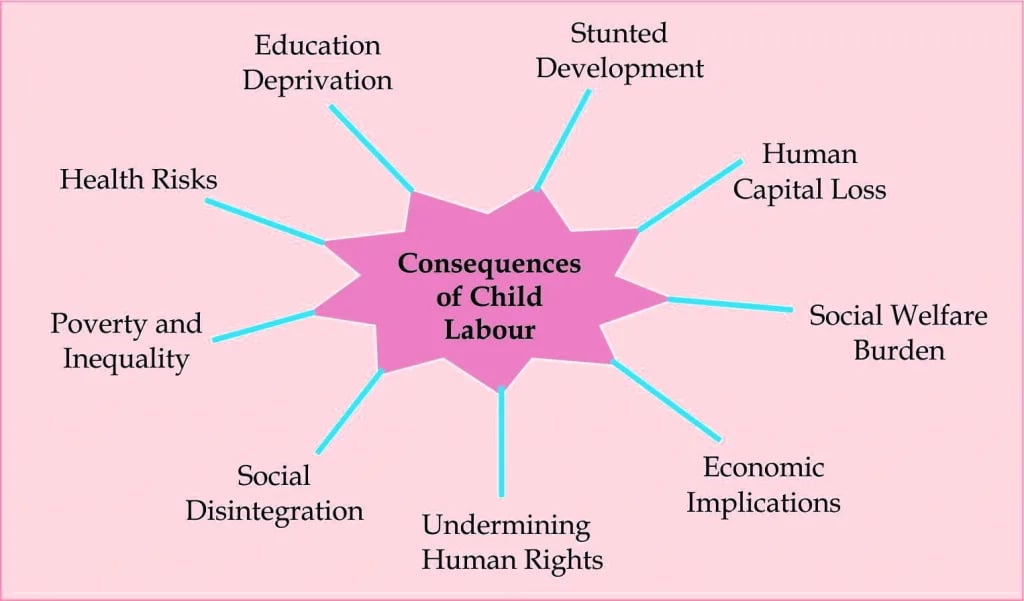
Reasons Behind Child Labour in India
- Poverty and Economic Compulsion: According to the Ministry of Labour & Employment, poverty remains the primary driver of child labour.
- Families struggling to meet basic needs often rely on children to supplement household income, especially in rural and informal sectors.
- Lack of Access to Quality Education: Many children drop out of school due to poor infrastructure, teacher shortages, or financial constraints.
- Once out of school, they are more likely to enter the workforce.
- Illiteracy and Low Awareness: Parents with limited education may not fully understand the long-term value of schooling or the legal protections against child labour.
- It perpetuates a cycle of exploitation.
- Demand for Cheap Labour: Industries such as beedi-making, carpet weaving, and fireworks often prefer child workers for their nimble fingers and lower wages.
- Cultural and Social Norms: In some communities, child labour is normalized or even seen as a rite of passage.
- Girls, in particular, may be pulled into domestic work or caregiving roles at a young age.
- Migration and Trafficking: Children from marginalized communities are often trafficked or migrate with families to urban areas, where they end up in exploitative jobs without legal safeguards.
Model State Action Plans
- The Ministry of Labour & Employment has circulated model plans to guide states in enforcement, rescue, and rehabilitation efforts.
- Support for Action Against Child Labour (SAFAL): It aimed at strengthening enforcement and community-based monitoring.
- National Policy on Child Labour (1987):
- Focus on rehabilitating children in hazardous occupations.
- Convergence of welfare schemes to support families of child labourers.
- Launch of project-based interventions in high-incidence areas.
- National Child Labour Project (NCLP): Implemented in districts with high child labour prevalence. It provides:
- Special training centres for rescued children
- Bridge education, vocational training, mid-day meals, and stipends
- Support for mainstreaming into formal schools
- Now integrated into the Samagra Shiksha Abhiyan.
Success Stories
- Velpur Mandal in Telangana as a model for eradicating child labour through community engagement, school retention, and strict enforcement — a testament to what’s possible with sustained local action.
Previous article
News In Short-23-06-2025
