


Israel’s Parliament Gives Initial Nod to Occupied West Bank Annexation
Syllabus: GS2/ International Relations
Context
- Israel’s Parliament, the Knesset, has given preliminary approval to the bill titled “Application of Israeli Sovereignty in Judea and Samaria, 2025,” aimed at applying Israeli law to the occupied West Bank.
About West bank
- The West Bank is a landlocked territory in the Middle East that is a central part of the Israeli-Palestinian conflict.
- It lies to the west of the Jordan River and is bordered by Israel to the west, north, and south, and by Jordan and the Dead Sea to the east.
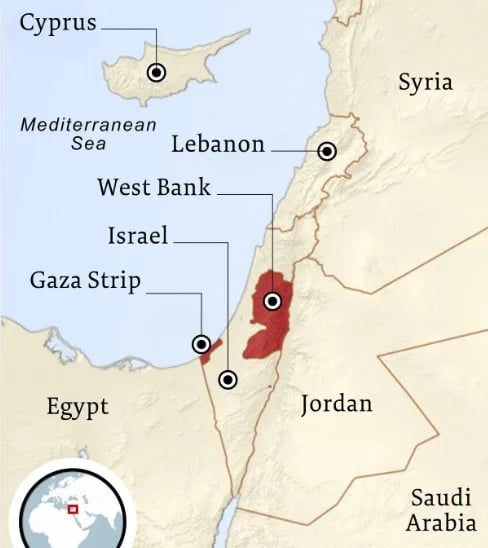
History and political status
- British Mandate: From 1920 to 1947, the area was part of the British-mandated territory of Palestine.
- 1948–1967: After the 1948 Arab-Israeli War, the West Bank was occupied and later annexed by Jordan. This annexation was not widely recognized internationally.
- 1967 Six-Day War: Israel captured the West Bank during the 1967 Six-Day War and argues that the area is “disputed” rather than “occupied.”
- Oslo Accords: Beginning with the 1993 Oslo Accords, parts of the West Bank were put under varying degrees of Palestinian self-rule through the Palestinian Authority (PA).
- International status: The international community overwhelmingly considers the West Bank to be occupied territory.
- The International Court of Justice (ICJ) and the United Nations have ruled that Israeli settlements in the West Bank are illegal under international law.
Source: DD News
Ladakh Delegates Offered Terms of Article 371
Syllabus: GS2/Polity and Governance
Context
- Ladakh’s two key socio-political amalgams, Leh Apex Body (LAB) and Kargil Democratic Alliance (KDA) decided to resume talks with the Ministry of Home Affairs (MHA) on Statehood and Sixth Schedule.
- The Centre has reportedly proposed special provisions under Article 371 of the Constitution as a potential alternative to Sixth Schedule status.
Background
- In 2019, the former State of Jammu & Kashmir was bifurcated into two Union Territories — Jammu & Kashmir, and Ladakh, the latter without a Legislative Assembly.
- After its special status was removed, several political groups in Ladakh have been demanding that land, employment, and the cultural identity of Ladakh, should be protected under the Sixth Schedule.
- In 2019, the National Commission for Scheduled Tribes recommended the inclusion of Ladakh under the Sixth Schedule.
Sixth Schedule
- The Sixth Schedule under Article 244 provides for the formation of autonomous administrative divisions — Autonomous District Councils (ADCs) — that have some legislative, judicial, and administrative autonomy within a state.
- This Schedule contains provisions regarding the administration of tribal areas in the states of Assam, Meghalaya, Tripura and Mizoram.
- The Schedule also gives ARCs and ADCs the power to collect land revenue, impose taxes, regulate money lending and trading, collect royalties from licenses or leases for the extraction of minerals in their areas, and establish public facilities such as schools, markets, and roads.
Protections offered under Article 371
- Articles 371 and 371-A through J provide “special provisions” for specific states, often to give representation to certain religious and social groups and to allow these groups to exercise autonomy over their affairs without interference from the state and central governments.
- Special provisions under Article 371 would allow protections to be extended to the local population of Ladakh.
Source: TH
Scientists use ‘Atomic Stencils’ to make Designer Nanoparticles
Syllabus: GS3/Science and Technology
Context
- Researchers have developed a method to precisely create patchy nanoparticles with atomic-level control called atomic stencilling.
About
- Atomic Stencilling allows scientists to selectively “paint” polymers onto gold nanoparticles to form distinct surface patterns.
- Nanoparticles are tiny particles, serving as the building blocks for revolutionary technologies in medicine, electronics, and energy.
- However, to create truly complex and functional materials, scientists need nanoparticles with different surface domains that can guide how they connect together and organise particular patterns.
- Creating these patchy nanoparticles with precision and in large quantities has been a major hurdle.
- Using the stencilling technique, the team successfully created more than 20 types of patchy nanoparticles with unique patterns.
Significance
- This new level of control over nanoparticle design is a crucial step toward creating metamaterials, which are engineered materials with unique properties not found in nature, such as the ability to manipulate light and sound in new ways.
- The applications are vast, potentially leading to advances in targeted drug delivery, ultra-efficient catalysts, next-generation electronics, and new classes of smart materials.
Source: TH
Iran Ratifies UN Convention Against Terror Financing
Syllabus: GS2/ International Relations, GS3/ Security
Context
- Iran has ratified a law to join the United Nations International Convention for the Suppression of the Financing of Terrorism (CFT) in a bid to align with global financial norms.
About
- FATF status: As of October 2025, Iran remains on the FATF blacklist for its failure to adopt sufficient anti-money laundering (AML) and counter-terrorist financing (CFT) standards.
- The ratification is seen as a first step toward potential re-evaluation by the FATF.
About the CFT
- The CFT was adopted by the United Nations General Assembly on 9 December 1999 (Resolution 54/109).
- Objective: To criminalize the financing of terrorism and establish international cooperation mechanisms to prevent, investigate, and prosecute such offences.
- It requires countries to strengthen financial oversight, share intelligence, and cooperate in law enforcement.
- International Legal Framework: Complements other UN instruments such as the UN Security Council Resolution 1373 (2001) and the UN Convention against Transnational Organized Crime (2000).
- India has ratified the CFT and has incorporated its provisions through:
- Unlawful Activities (Prevention) Act (UAPA), 1967
- Prevention of Money Laundering Act (PMLA), 2002.
| Financial Action Task Force (FATF) – The Financial Action Task Force (FATF) is an intergovernmental organization which leads global action to tackle money laundering, terrorist and proliferation financing. – History: FATF was established in 1989 by the G7 to examine and develop measures to combat money laundering. It originally included the G7 countries, the European Commission and eight other countries. 1. In 2001, the FATF expanded its mandate to also combat terrorist financing. – Members: FATF has 40 members including India. – FATF has the authority to issue warnings and sanctions against countries that fail to comply with its standards, such as suspension of membership and blacklisting. FATF ‘Grey list’ and ‘Blacklist’ – Black List: Countries known as Non-Cooperative Countries or Territories (NCCTs) are put on the Blacklist. These countries support terror funding and money laundering activities. – Grey List: Countries that are considered a safe haven for supporting terror funding and money laundering are put in the FATF Grey list. |
Source: TH
Prof Eknath Chitnis: Veteran scientist who pioneered India’s space programme
Syllabus: GS3/Achievements of Indian in Science and Technology
In News
- Renowned Indian space scientist Eknath Vasant Chitnis passes away.
Major Roles and Contributions
- He was one of the last surviving associates of Dr. Vikram Sarabhai, the father of India’s space programme.
- He is also credited for guiding the then budding scientist Dr APJ Abdul Kalam.
- He played a crucial role in the early years of the Indian National Committee for Space Research (INCOSPAR) which later transformed into the Indian Space Research Organisation (ISRO).
- He also played a crucial role in selecting the site for India’s first rocket launch at Thumba in Kerala.
- He directed the Satellite Instructional Television Experiment (SITE) in 1975–76, which broadcast educational content to 2,400 villages using NASA’s ATS-6 satellite — a milestone in India’s digital revolution.
- From 1981 to 1985, he served as the second director of ISRO’s Space Applications Centre (SAC) in Ahmedabad.
Honours
- He was awarded the Padma Bhushan in 1985 for his contributions to science and technology.
Source:TH
2025 Sakharov Prize
Syllabus: Miscellaneous
Context
- Two imprisoned journalists Andrzej Poczobut in Belarus and Mzia Amaghlobeli in Georgia—have won the 2025 Sakharov Prize.
About the Prize
- The Sakharov Prize for Freedom of Thought is the European Union’s highest human rights award, established in 1988 and named after Soviet dissident and Nobel Peace laureate Andrei Sakharov.
- It honours individuals or groups defending human rights and fundamental freedoms.
- The final winner or winners of the Sakharov Prize are chosen by the Conference of Presidents, a European Parliament body led by the president, which includes the leaders of all the political groups represented in the Parliament, making the choice of laureates a truly European choice.
- The award carries an endowment of €50,000 and is presented at the European Parliament in Strasbourg (France) each December.
Do you know?
- Several Sakharov laureates, including Nelson Mandela, Malala Yousafzai, Denis Mukwege, and Nadia Murad, later went on to win the Nobel Peace Prize.
- Interestingly, Venezuelan opposition leader María Corina Machado, who won the 2025 Nobel Peace Prize earlier this month, received the Sakharov Prize last year.
Source: TH
Previous article
India Moves up to 9th Position Globally in Forest Area
