


Syllabus: GS3/ Environment
Context
- India has moved up to the 9th position in terms of total forest area globally, as per the Global Forest Resources Assessment (GFRA) 2025, released by the Food and Agriculture Organization (FAO) in Bali.
- The GFRA is published every five years.
Key Findings
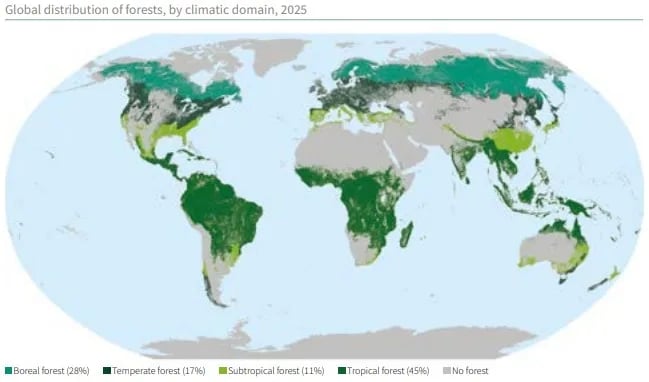
- Globally, forests cover 4.14 billion hectares, accounting for about 32% of total land area, translating to 0.5 hectares of forest per person.
- Russia has the largest forest cover followed by Brazil, Canada, the USA, China, Congo, Australia, Indonesia, India and Peru.
- The report highlights that global deforestation has slowed in the past decade.
- However the world continues to lose 10.9 million hectares of forest every year (2015–2025), a rate still considered alarmingly high.
- India’s Forest Cover Status:
- India’s forest cover stands at 72.7 million hectares, representing about 2% of global forest area.
- India has maintained its third position worldwide after China and Russia In terms of annual forest gain.
- India and Indonesia together represent over 70% of global agroforestry areas, indicating strong integration of trees in farmlands.
Significance of India’s Achievement
- Climate Change Mitigation: Expanding forest area enhances carbon sequestration, aiding India’s Nationally Determined Contributions (NDCs) under the Paris Agreement.
- Biodiversity Conservation: Forests serve as habitats for a wide range of flora and fauna, supporting India’s rich biodiversity.
- Livelihood Support: Over 275 million people in India depend on forests for livelihood, making their sustainable management socio-economically crucial.
- Land and Water Security: Forests prevent soil erosion, regulate water cycles, and help maintain ecological balance in fragile ecosystems.
- International Commitments: Aligns with India’s targets under the UN Decade on Ecosystem Restoration (2021–2030) and SDG 15 (Life on Land).
Government Initiatives toward forest conservation
- The ‘Ek Ped Maa Ke Naam’ campaign has been instrumental in encouraging citizens to plant trees and enhance environmental consciousness.
- National Mission for a Green India (GIM): A mission under the National Action Plan on Climate Change (NAPCC) that aims to increase forest cover and improve existing forest quality to combat climate change.
- Compensatory Afforestation Fund Act (2016): An act that ensures funds for afforestation and related activities by requiring users of forest land for non-forest purposes to pay compensatory levies.
- Eco-Sensitive Zones (ESZs): Areas designated around Protected Areas (National Parks and Wildlife Sanctuaries) to act as a buffer and minimize the negative impact of certain human activities on fragile ecosystems.
- Joint Forest Management (JFM): A program that fosters partnerships between state forest departments and local communities to protect, and regenerate forest resources.
What are the Challenges?
- Development Projects: Forest diversion for mining, roads, and urban expansion continues to threaten ecological stability.
- Forest Degradation: Over-extraction and encroachment affect forest health and connectivity.
- Climate Extremes: Rising temperatures and altered rainfall patterns affect forest regeneration and species composition.
- Conservation and Livelihoods: Ensuring local community welfare while maintaining conservation priorities remains a challenge.
Concluding remarks
- India’s progress in global forest rankings reaffirms the country’s commitment to environmental sustainability and green growth.
- Continued focus on scientific forest management, local participation, and climate-resilient ecosystem restoration will be essential to sustain and enhance this momentum in the years ahead.
Source: PIB
Previous article
Atlas: The Rise of AI-Powered Browsers
Next article
News in Short – 23 October, 2025
