


Syllabus: GS3/Economy; Population
Context
- Nobel laureate Amartya Sen recently stressed that migration has been a major source of global progress, enabling exchange of knowledge, culture, and values.
About Migration
- Migration is the movement of people across borders or within countries — is a defining feature of the interconnected world.
- It is driven by opportunity, necessity, or aspiration, and influences economies, cultures, and governance on a global scale.
- Types:
- Internal Migration: Within a country (rural–urban, inter-state, intra-state).
- International Migration: Movement across countries.
- Voluntary vs Forced: Choice-based (jobs, education) vs distress-driven (conflict, climate change, persecution).
- Seasonal/Circular Migration: Short-term, often linked to agriculture, construction, or informal work.
- The migration that is safe, orderly, and humane, aligning with the UN’s Sustainable Development Goals (SDG Target 10.7).
Trend in Migration
- Global Migration: According to the World Migration Report 2024, there were approximately 281 million international migrants in 2020 — about 3.6% of the global population — a steady rise from 2.8% in 2000.
- Migration corridors have evolved, with the Mexico–USA, Syria–Türkiye, and India–UAE routes among the largest.
- India, Mexico, and China are among the top countries of origin, while the U.S. remains the largest destination and remittance-sending country.
- Migration in India: India is the largest country of origin for international migrants, with over 18 million Indians living abroad.
- The 78th Round of NSSO reveals:
- Marriage is the leading reason for migration (68.2%), followed by employment (22%).
- Uttar Pradesh to Maharashtra is the most significant internal migration corridor.
- Suburban Mumbai, Pune, and Thane host the highest number of migrants.
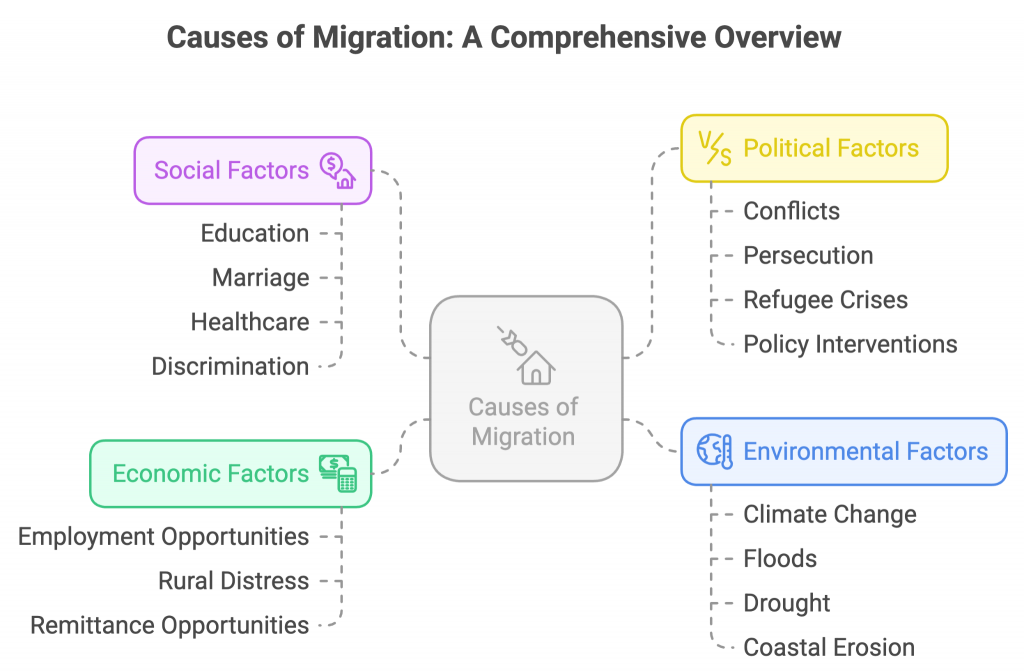
Importance of Migration & How It Fuels Globalisation?
- Economic Integration & Labor Mobility: Migrants fill critical labor gaps in aging economies, especially in sectors like healthcare, construction, and technology.
- The International Organization for Migration (IOM) reports that migrants contribute disproportionately to economic growth. For example, Latin American immigrants in Chile made up just 3.5% of the workforce but contributed 11.5% to GDP growth between 2009–2017.
- Migration enables rapid deployment of talent, essential for innovation and competitiveness in global markets.
- Remittances & Capital Flow: Remittances from migrants reached $831 billion globally in 2022, a 650% increase since 2000.
- India alone received over $111 billion, making it the top remittance recipient worldwide.
- These financial flows often exceed foreign direct investment, boosting local economies and reducing poverty in origin countries.
- Knowledge Transfer & Innovation: Migrants bring diverse perspectives and expertise, fostering innovation in host countries.
- Migration facilitates the exchange of scientific ideas, cultural practices, and entrepreneurial models.
- Cultural Diversity & Social Enrichment: Migration enhances cultural pluralism, introducing new languages, cuisines, art forms, and traditions.
- Diverse societies tend to be more resilient, creative, and globally connected.
Related Challenges & Misconceptions
- Irregular & Unsafe Migration Pathways: Many migrants move without legal documentation, exposing them to exploitation, trafficking, and abuse.
- According to the UN, over 43 million people were forcibly displaced in 2024, including refugees and asylum seekers.
- International Organization for Migration (IOM) highlights the need for regular migration pathways to reduce vulnerability and ensure access to rights.
- Precarious Working Conditions: Migrant workers often face lower wages, poor safety standards, and limited access to healthcare.
- Globally, ILO data shows migrants earn 25% less than local workers on average.
- Policy Gaps & Governance Failures: India struggles with implementation of migration-related agreements, despite signing multiple MoUs with destination countries.
- The absence of a robust Emigration Act and lack of coordination between central and state governments hinder effective migration management.
- Gender & Child Vulnerabilities: Women and children migrants face heightened risks of abuse, trafficking, and marginalization.
- Climate-Induced Displacement: Droughts, floods, and extreme weather events are driving migration in vulnerable regions.
- In Odisha, India, distress migration is often a survival strategy in drought-prone areas.
- Illegal Immigration & National Security: Countries face challenges balancing humanitarian obligations with border control.
- India’s northeastern states grapple with undocumented migration from neighboring countries, sparking debates over identity and citizenship.
Way Ahead
- Humane & Inclusive Policies: Recognise migration as a right and opportunity, not a threat.
- Safeguard voting rights (Amartya Sen’s concern on SIR).
- Strengthen Social Protection: Universal portability of PDS, health, education.
- Legal protection for informal workers.
- Balanced Regional Development: Invest in rural infrastructure, agro-processing, small towns to reduce distress migration.
- Urban Planning: Affordable housing, sanitation, transport to absorb migrant influx sustainably.
