


Syllabus: GS3/ Environment
Context
- A UN-backed treaty on biodiversity in international waters, formally known as the Biodiversity Beyond National Jurisdiction (BBNJ) Treaty, has entered into force, creating the first legally binding global framework to conserve and sustainably use the high seas.
What are the High Seas?
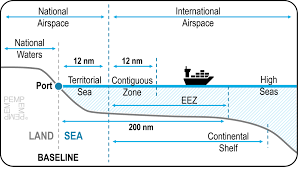
- High seas refer to ocean areas beyond national jurisdiction, i.e., beyond 200 nautical miles (Exclusive Economic Zones – EEZs).
- They cover nearly two-thirds of the global ocean and about half of the Earth’s surface.
- Earlier governed mainly by general principles under UNCLOS, with limited biodiversity-specific regulation.
About the Biodiversity Beyond National Jurisdiction (BBNJ) Treaty
- Adoption & Background: The Biodiversity Beyond National Jurisdiction (BBNJ) Agreement was adopted in 2023 by an Intergovernmental Conference on Marine Biodiversity of Areas Beyond National Jurisdiction, convened under the auspices of the United Nations.
- Legal Status under UNCLOS: It is the third implementing agreement under the United Nations Convention on the Law of the Sea (UNCLOS), after:
- 1994 Part XI Implementation Agreement (Deep Seabed Mining)
- 1995 UN Fish Stocks Agreement.
- Objective: To ensure the conservation and sustainable use of marine biological diversity in Areas Beyond National Jurisdiction (ABNJ), commonly known as the high seas.
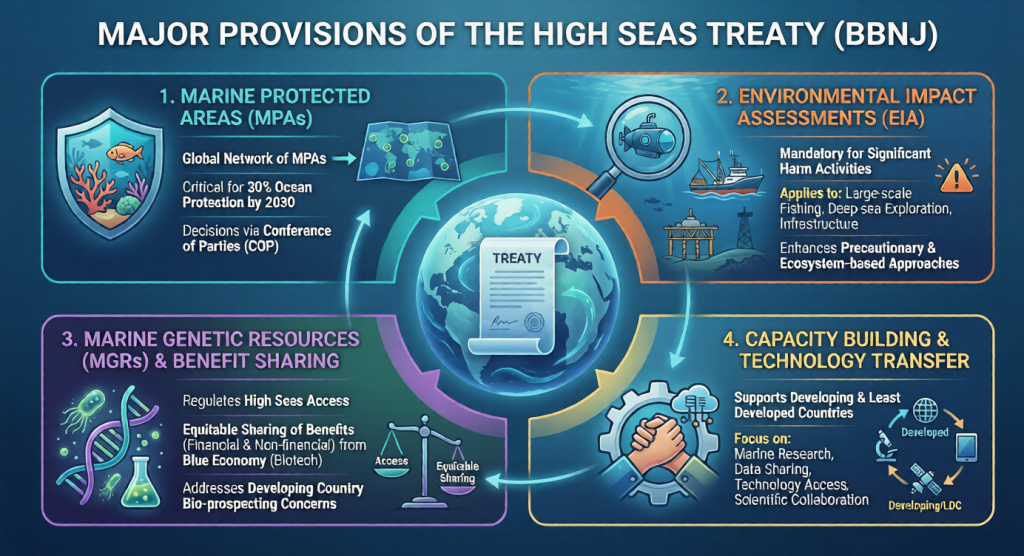
- Institutional & Financial Mechanisms: Establishes a Conference of the Parties (COP) as the decision-making body.
- Creates a Clearing-House Mechanism for data, knowledge, and cooperation.
- Sets up a Secretariat and a dedicated funding mechanism to support implementation.
- Membership Status: 83 countries have ratified the treaty so far & India has signed but not yet ratified the BBNJ Agreement.
Significance of the BBNJ Treaty
- Governance of the Global Commons: The treaty provides the first comprehensive legal framework for biodiversity protection in Areas Beyond National Jurisdiction (ABNJ), which constitute nearly two-thirds of the global ocean.
- Earlier, high seas fishing faced weak regulation, enabling overfishing of migratory species like tuna; BBNJ allows ecosystem-based management.
- Advancement of the “30×30” Target: Supports the global goal of protecting 30% of oceans by 2030 through Marine Protected Areas (MPAs) in the high seas.
- Mandatory Environmental Impact Assessments (EIAs): Requires prior EIAs for activities that may cause significant harm to marine ecosystems.
- Equity through Marine Genetic Resources (MGRs): Introduces fair and equitable benefit-sharing from marine genetic resources used in pharmaceuticals, cosmetics, and biotechnology.
- Capacity Building for Developing Countries: Promotes technology transfer, scientific cooperation, and funding support.
- Strengthening Multilateralism: Reinforces faith in rules-based global order under the United Nations, especially at a time of fragmented global governance.
Concerns and Limitations of the BBNJ Treat
- Deep-Sea Mining Excluded: The treaty does not regulate seabed mining, which remains under the International Seabed Authority (ISA).
- Implementation Challenges: Monitoring and enforcement in vast high seas is technically and financially demanding. Like developing countries may struggle to conduct EIAs or participate effectively in COP processes.
- Non-Universal Ratification: The United States has signed but not ratified, limiting compliance by major maritime powers.
- Soft Compliance Mechanisms: The treaty relies more on cooperation than coercive enforcement, raising concerns over compliance.
- Example: Illegal, Unreported, and Unregulated (IUU) fishing may persist despite new norms.
Source: Firstpost
Previous article
18th Japan-India Foreign Ministers’ Strategic Dialogue
Next article
Seed Act 2026 and Its Impact on Farmers
