


Syllabus: GS3/Environment
Context
- A new study published in Current Biology explains the cellular adaptations that enable mangrove species to tolerate extreme salt stress, offering insights for developing salt-tolerant crops in the future.
Key Highlights of the Study
- Key cellular traits (not stomata-based): Mangroves do not rely on smaller or more numerous stomata to increase photosynthesis.
- Instead, they exhibit: unusually small leaf epidermal pavement cells and thicker cell walls, which together give them more mechanical strength to tolerate low osmotic potentials.
- Salt management strategies
- Salt exclusion: Some mangroves have waxy root layers that filter out salt before water enters the plant.
- Salt secretion: Other species absorb salt but secrete it through specialised leaf tissues.
Mangroves
- A mangrove is a small tree or shrub that grows along coastlines, taking root in salty sediments, often underwater.
- Mangroves are flowering trees, belonging to the families Rhizophoraceae, Acanthaceae, Lythraceae, Combretaceae, and Arecaceae.
- Features:
- Saline Environment: A speciality of mangroves is that they can survive under extreme hostile environments such as high salt and low oxygen conditions.
- The roots filter out 90% of the salt they come into contact with within the saline and brackish water.
- Low oxygen: Underground tissue of any plant needs oxygen for respiration. The mangrove root system absorbs oxygen from the atmosphere.
- Store Freshwater: Mangroves, like desert plants, store fresh water in thick succulent leaves.
- Mangroves are viviparous: Their seeds germinate while still attached to the parent tree. Once germinated, the seedling grows into a propagule.
- Saline Environment: A speciality of mangroves is that they can survive under extreme hostile environments such as high salt and low oxygen conditions.
- The Sundarbans in West Bengal are the largest mangrove region in the world and a UNESCO World Heritage Site.
- The second largest mangrove forest in India is Bhitarkanika (Ramsar site) in Odisha created by the two river deltas of Rivers Brahmani and Baitarani.
Importance of Mangroves
- Natural Coastal Defence: A mature mangrove belt (50 years old and 100–1,000 m wide) can reduce wave energy by 7–55%, significantly lowering the impact of cyclones, storm surges and coastal flooding compared to non-mangrove coastlines.
- Biodiversity Hotspots: India’s mangroves support about 4,011 species, including 920 plant species and 3,091 animal species.
- Climate Change Mitigation (Blue Carbon): Mangroves store 7.5–10 times more carbon per acre than tropical forests.
- Livelihood and Economic Security: Mangrove ecosystems support millions of livelihoods globally through fisheries, aquaculture, eco-tourism and restoration activities, providing income security for vulnerable coastal communities.
- Cost-effective Nature-based Solutions: By combining disaster risk reduction, biodiversity conservation and carbon sequestration, mangroves offer a low-cost, high-impact solution compared to engineered coastal defences.
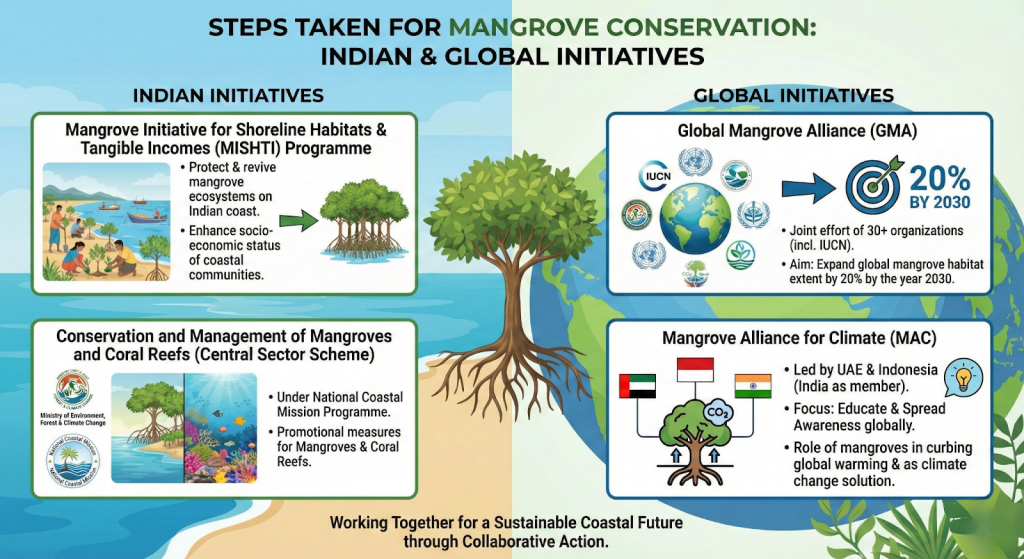
Source:PIB
Previous article
Siliserh Lake and Kopra Jalashay Designated as New Ramsar Sites
Next article
News In Short 16-12-2025
