


Syllabus: GS1/ Social Issue
In News
- The Supreme Court issued systemic directions to strengthen enforcement of anti-dowry laws.
- SC observed that dowry is a deep-rooted social evil cutting across communities and requires institutional accountability, not merely penal provisions.
SC Directions
- Judicial Monitoring: High Courts must monitor pending cases under IPC Sections 304-B (dowry death) and 498-A (cruelty) for expeditious disposal, with the judgment circulated for compliance review.
- Administrative Enforcement: States must appoint and resource Dowry Prohibition Officers (DPOs) under Section 9 of the Dowry Prohibition Act, 1961, disseminating their contact details widely.
- Capacity Building & Sensitisation: Police and judicial officers require periodic training on case sensitivity, distinguishing genuine claims from frivolous ones, while district administrations and Legal Services Authorities run grassroots awareness campaigns.
Dowry Cases In India
- NCRB’s Crime in India 2023 report confirms a 14% rise in cases under the Dowry Prohibition Act, 1961, reaching 15,489 from 13,479 in 2022, alongside 6,156 dowry deaths nationwide.
- Uttar Pradesh topped with 7,151 cases and 2,122 deaths, followed by Bihar, Karnataka, and Madhya Pradesh.
- Of 83,000+ pending dowry-related cases, conviction rates hovered at 11-17%, with 833 murders explicitly motivated by dowry; under-reporting persists due to social stigma and family pressures.
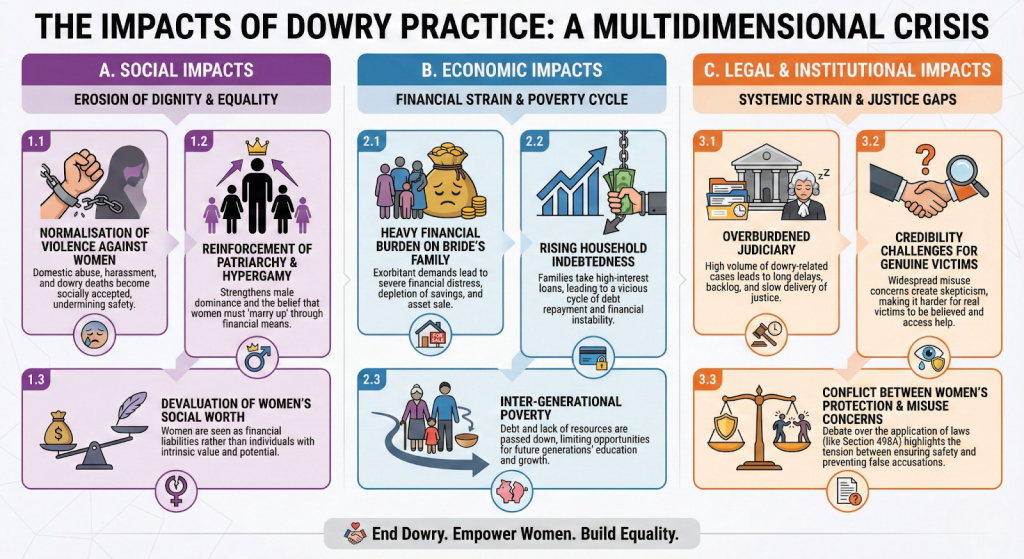
Related Laws and Constitutional Basis
- Dowry is prohibited under the Dowry Prohibition Act, 1961, which criminalises the giving, taking and demanding of dowry and provides for the appointment of Dowry Prohibition Officers.
- The current legal law reinforces this framework through Section 498-A (Sections 85 and 86 of BNS), addressing cruelty against married women, and Section 304-B (Section 80 of BNS), which deals with dowry deaths occurring within seven years of marriage.
- Constitutionally, the fight against dowry draws legitimacy from Articles 14 and 15, which guarantee equality and prohibit discrimination, Article 21, which ensures the right to life with dignity, and Article 51A(e), which places a fundamental duty on citizens to renounce practices derogatory to the dignity of women.
Source: BS
