


How Stupas Found in Zehanpora Highlight Kashmir’s Rich Buddhist Past?
Syllabus: GS1/Ancient History
Context
- Archaeologists have unearthed ancient Buddhist stupas and settlements at Zehanpora based on a century-old photograph discovered in a French museum.
About
- The mounds are located along an ancient Silk Route leading to Kandahar and beyond.
- Zehanpora has yielded Buddhist stupas, an urban settlement complex (could be chaityas and viharas), Kushan-era pottery shards, copper artefacts and walls, with more finds expected in subsequent excavation phases.
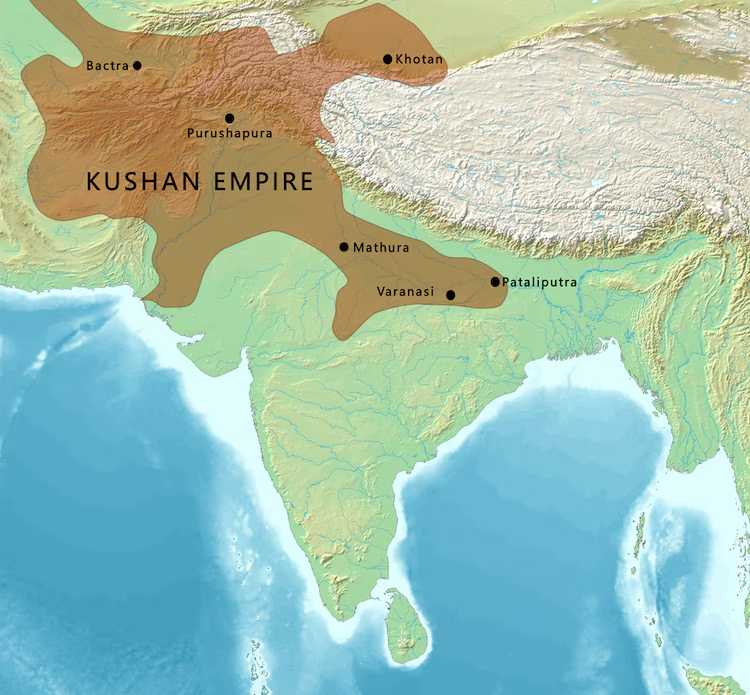
- The Kushans were a powerful ancient Indo-Greek dynasty dynasty that ruled large parts of north India and Central Asia between the 1st and 3rd centuries CE.
- They played a major role in promoting trade, urban centres and the spread of Buddhism in India and beyond.
- Significance:
- The Zehanpora discovery places Kashmir within the 2,000-year-old Gandhara Buddhist network.
- It bolsters claims that Kashmir was a central hub of Buddhist learning and monastic activities.
- The northern part of Kashmir has many known sites with Buddhist affiliations, like Kanispora, Ushkur, Zehanpora, and Parihaspora, while Harwan represents a major Buddhist complex in Srinagar in central Kashmir.
- South Kashmir is dotted with archaeological sites like Semthan, Hutmur, Hoinar and Kutbal with strong Buddhist affiliations.
- These sites collectively represent Kashmir’s Buddhist heritage in the form of structural and artistic evidence.
| Core Teachings of the Buddha – The Four Noble Truths a. Dukkha: Life is suffering or unsatisfactory. b. Samudaya: Suffering is caused by craving and attachment (tanhā). c. Magga: The path to the cessation of suffering is the Eightfold Path. d. The Noble Eightfold Path: Grouped into three categories: wisdom, ethical conduct, and mental discipline. – The Three Marks of Existence a. Anicca (Impermanence): All things are in constant change. b. Dukkha (Suffering): Existence is filled with dissatisfaction. c. Anattā (Non-self): There is no permanent, unchanging self. – The Goal: Nirvana (Nibbāna) a. A state beyond suffering and rebirth. b. Achieved through wisdom, ethical living, and mental discipline. c. Nirvana is the ultimate liberation and peace. |
Source: IE
Western Disturbance
Syllabus: GS1/ Physical Geography
In News
- Inadequate precipitation in the Himalayas is primarily due to the weakened state of Western Disturbance patterns.
About Western Disturbance
- It is an extra-tropical storm that originates in the Mediterranean region.
- The disturbance travels from the “western” to the eastern direction and gradually travels across the middle-east from Iran, Afghanistan and Pakistan to enter the Indian subcontinent.
- Disturbance means an area of “disturbed” or reduced air pressure. Equilibrium exists in nature due to which the air in a region tries to normalize its pressure.
- In the term “extra-tropical storm”, the storm refers to low pressure.
- “Extra-tropical” means outside the tropics (as WD originates outside the tropical region).
- The disturbance travels from the “western” to the eastern direction and gradually travels across the middle-east from Iran, Afghanistan and Pakistan to enter the Indian subcontinent.
Impacts
- It brings rainfall, snowfall, and fog to northern India.
- WD is important for the agriculture of the Rabi crop in the Northern subcontinent.
- The WD is not always the harbinger of good weather and sometimes, they can cause extreme weather events like floods, flash floods, landslides, dust storms, hail storms and cold waves killing people, destroying infrastructure and impacting livelihoods.
- WD brings winter and pre-monsoon rain and is important for the development of the Rabi crop in the Northern subcontinent.
Source: TOI
HPV Vaccination
Syllabus: GS2/ Health
Context
- A large population-based study has shown that high HPV (Human Papillomavirus) vaccination coverage can reduce precancerous cervical lesions even among unvaccinated women, highlighting a strong herd-protective effect.
About Human papillomavirus (HPV)
- HPV is a common sexually transmitted infection. Most infections are asymptomatic and self-limiting.
- Nature: HPV is a DNA virus from the Papillomaviridae family.
- Diseases Caused by HPV:
- Cervical cancer (over 95% of cases linked to HPV).
- Other cancers: anal, vaginal, vulvar, penile and oropharyngeal cancers.
- Genital warts (non-cancerous).
- HPV vaccination: It prevents infection from the most dangerous HPV types. Most effective when given before sexual debut (ages 9–14 years).
Source: IE
Centre seeks access to phone source codes
Syllabus: GS2/Governance
In News
- The government is planning strict smartphone security rules under the Indian Telecom Security Assurance Requirements
Indian Telecom Security Assurance Requirements
- The 2023-drafted smartphone security standards are under review for potential legal enforcement, with the IT ministry set to meet tech executives for further discussions.
- Key measures include
- Requiring manufacturers to share source code for government analysis.
- Allowing pre-installed apps to be uninstalled.
- Blocking apps from using cameras and microphones in the background to prevent misuse.
- Meeting 83 security standards and alerting the government to major software updates.
Objectives
- It is part of Prime Minister Narendra Modi’s efforts to boost security of user data as online fraud and data breaches increase in the world’s second-largest smartphone market, with nearly 750 million phones.
Concerns raised
- Tech companies like Apple, Samsung, Google, and Xiaomi oppose the proposals, citing lack of global precedent and risks to proprietary information.
- Previous government rules, such as a mandatory state-run cyber safety app, faced pushback, though some security measures, like testing for Chinese-made cameras, were enforced. In India, Xiaomi, Samsung, and Apple hold 19%, 15%, and 5% of the market, respectively.
Source :IE
Exercise Sanjha Shakti
Syllabus: GS3/ Defence
In News
- The Indian Army conducted Exercise Sanjha Shakti, a Military–Civil Fusion exercise, at the Dighi Hills Range under the aegis of the Southern Command, specifically the Maharashtra, Gujarat and Goa Area.
About
- The exercise aimed to strengthen civil–military coordination, enhance rapid response capabilities, and ensure public safety in rear areas, especially during disasters, internal security challenges, and other emergency situations in the hinterland.
- More than 350 personnel participated, involving the Indian Army and 16 civilian agencies, including Maharashtra Police, Force One, and fire and emergency services, highlighting the importance of integrated planning and joint execution.
- Exercise Sanjha Shakti underlined that rear area security is a key responsibility of the armed forces and requires close cooperation with civilian institutions during both peace-time emergencies and security contingencies.
Source: TOI
Bhairav Battalions to Debut in Army Day Parade
Syllabus: GS3/Defence
In News
- The Army’s newly raised Bhairav Battalions will participate in the Army Day Parade in Jaipur for the first time.
Bhairav Battalions
- They are raised by Army headquarters by drawing lessons from global conflicts as well as India’s own operational experience, including the recent Operation Sindoor.
- They are designed as high-speed, offensive units capable of executing Special Forces’ tasks at multiple levels, depending on operational requirements, the officer added.
- They are intended to bridge the gap between Para Special Forces and regular infantry units, enabling them to conduct special operations from tactical to operational depth.
- They focus on modern warfare, including drone operations.
- The Army plans a pool of over 1 lakh drone operatives.
- Currently, 15 Bhairav Battalions exist, with plans to raise 25 in total.
Other Related Developments
- The Army has also formed Rudra Brigades, combining infantry, mechanised units, tanks, artillery, special forces, drones, and support elements.
- Artillery, mechanised infantry, and armoured corps are being upgraded with modern battlefield systems for enhanced operational effectiveness.
Source : TH
Param Shakti
Syllabus: GS3/Science and Technology
Context
- The Ministry of Electronics and Information Technology (MeitY) has launched ‘PARAM SHAKTI’, a supercomputing facility hosting the indigenous PARAM RUDRA system, at the IIT Madras.
About
- The system has been developed and implemented by the Centre for Development of Advanced Computing (C-DAC) under the National Supercomputing Mission (NSM).
- PARAM SHAKTI is powered by the PARAM RUDRA supercomputing cluster, built using C-DAC’s indigenous RUDRA series of servers.
- The system delivers a peak computing capacity of 3.1 petaflops, meaning it can perform over 3.1 quadrillion calculations per second.
- The facility has been fully developed and manufactured in India and runs on open-source software.
- Significance: The system enables large-scale simulations that reduce dependence on prolonged experimental trials and accelerate research timelines.
| National Supercomputing Mission – The National Supercomputing Mission was launched in 2015 with the aim of building supercomputing capabilities in the country, both in terms of manufacturing and usage. – The NSM planned to install 37 supercomputers across the country’s educational institutions, like IITs, NITs, IISER, and IISc for use by researchers. – PARAM Shakti in IIT Madras marked the 37th supercomputer installed. – Currently, the strongest supercomputer in the country is the PARAM Siddhi AI, which has a capacity of 5.2 petaflops and is housed inC-DAC, Pune. a. However, the computer is a global design and not entirely indigenous. |
Source: IE
NV Centres in Diamonds
Syllabus: GS3/Science and Technology
In News
- Researchers have discovered that tiny defects in diamonds, called nitrogen-vacancy (NV) centres can be harnessed for powerful quantum technologies.
Nitrogen-vacancy (NV) centres
- All diamonds are made of a rigid grid of carbon atoms.
- Nitrogen-vacancy (NV) centres occur when a carbon atom in a diamond is replaced by nitrogen, leaving an adjacent vacancy.
- These “perfect defects” act like single atoms trapped in a solid cage, retaining quantum spin coherence.
- NV centres are highly sensitive to magnetic and electric fields, making them precise quantum sensors.
- They can operate at room temperature, unlike most quantum systems requiring extreme cooling.
Latest Developments
- Researchers from Austria and Japan have demonstrated that by using around 9 trillion nitrogen-vacancy (NV) centres in a superconducting microwave cavity could generate a continuous microwave beam, creating a diamond maser—a microwave equivalent of a laser.
- The process relies on a “bucket brigade” mechanism, where energy is transferred between interacting spins through magnetic dipole-dipole interactions, sustaining continuous emission.
- This discovery shows that spin interactions, previously seen as disruptive, can be harnessed to develop quantum devices and enhance understanding of collective emission in many-body solid-state systems.
Potential applications
- Potential applications include highly stable superradiant masers with narrow linewidths, efficient narrow-band microwave amplifiers, ultra-stable frequency sources for quantum technologies and precision sensing, and enhanced quantum sensors, benefiting fields such as medical imaging, materials science, and environmental monitoring.
Source: TH
Previous article
National Youth Day 2026
