


Syllabus: GS2/IR
Context
- India and Malaysia vowed to expand their ties in the high-priority sectors of trade and investment, defence, energy, advanced manufacturing and semiconductors.
Key Outcomes
- The two sides inked a total of 11 agreements and documents to expand cooperation in a range of key areas.
- Audio-Visual Co-production Agreement to boost cultural and media collaboration, and a MoU on Disaster Management Cooperation aimed at improving joint preparedness for emergencies.
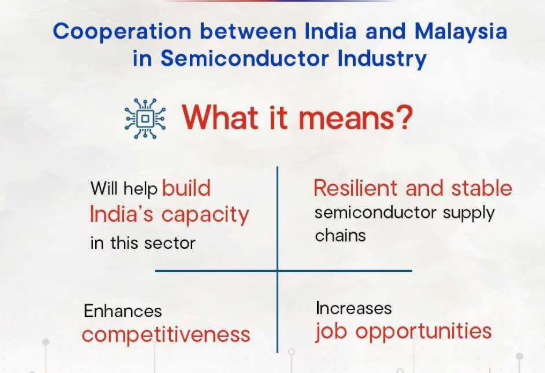
- In the technology and industrial domain, the governments exchanged an Exchange of Notes on Cooperation in Semiconductors, underlining mutual interest in strengthening capabilities and supply chains in this critical sector.
- A Framework Agreement on the International Big Cats Alliance (IBCA) was also finalised, reflecting shared commitment to biodiversity and sustainable development.
- Social Welfare: Both signed a MoU between the Employees’ State Insurance Corporation of India and the Social Security Organisation of Malaysia to enhance social security programmes for Indian citizens working in Malaysia.
- Agreements on Vocational Education and Training and Security Cooperation between the two national security councils were also exchanged, signalling broader institutional linkages.
- Both sides also received the report of the 10th Malaysia-India CEO Forum, highlighting private sector perspectives on trade, investment and future collaboration.
Overview of India and Malaysia Relations
- Diplomatic Relations: The two countries established diplomatic relations in 1957, and this was elevated to a Comprehensive Strategic Partnership (CSP) in 2024.
- Both countries are members of various international organizations, such as the United Nations, ASEAN (Association of Southeast Asian Nations), and the Non-Aligned Movement.
- Trade and Economic Relations: Malaysia is the 13th largest trading partner for India while India stands amongst the 10 largest trading partners globally.
- Furthermore, Malaysia has emerged as the third largest trading partner for India from the ASEAN region and India is the largest trading partner for Malaysia among the countries of the Southeast Asian region.
- Malaysia stands as an important trade partner, as both countries have engaged in various economic agreements such as the India-Malaysia Comprehensive Economic Cooperation Agreement (CECA).
- Both countries have agreed to conduct trade settlements in Indian rupees, reflecting an intention to bolster trade relations.
- Defense and Security: The defense ties have steadily expanded, marked by the signing of a defense cooperation memorandum in 1993, regular defense cooperation meetings, and joint military exercises.
- Strategic Partnership: India and Malaysia have aimed to strengthen their strategic partnership through various initiatives, including high-level visits, joint commissions, and dialogues.
- Both countries have expressed interests in enhancing cooperation in areas such as defense, counter-terrorism, maritime security, and cultural exchanges.
- ASEAN Centrality: Malaysia holds a crucial position in expanding India’s trade with ASEAN, aligning with India’s Act East Policy, advancing maritime connectivity in the Strait of Malacca and South China Sea, and supporting ASEAN’s Indo-Pacific Perspective (AOIP) and the Indo-Pacific Initiative (IPOI).
- Tourism and diaspora: India is the 5th largest source country for inbound tourism to Malaysia.
- A bilateral agreement on employment and workers’ welfare in 2009, and a revised air services agreement in 2017, have significantly contributed to the growth of tourism between the nations.
- Indian Community: Malaysia has the third largest Indian diaspora in the world (2.9 million).
- The number of Persons of Indian Origin is around 2.75 million (about 6.8% of Malaysia’s population).
- Cultural Ties: Indian influence in Malaysia can be seen in various aspects of Malaysian culture, including language, religion (Hinduism and Buddhism), architecture, cuisine, and festivals.
Challenges
- Trade Disputes and Imbalances: Issues related to tariffs, non-tariff barriers, and trade restrictions have occasionally strained economic ties between the two countries.
- Geopolitical Considerations: Both countries have diverse foreign policy priorities and engagements with other nations, which lead to differences in strategic perspectives.
- Indo-Pacific & China Factor: Malaysia’s economic dependence on China constrains deeper strategic alignment with India.
- Differing approaches within ASEAN on South China Sea issues also impact the relations.
- Connectivity Constraints: Underutilisation of maritime and logistics connectivity despite geographical proximity.
- Limited direct shipping and integrated supply chains.
- Defence & Strategic Limitations: Defence cooperation remains below potential, largely limited to training and exercises.
- Lack of joint defence production or technology transfer.
- Diaspora Issues: Concerns related to welfare, employment conditions and political representation of the Indian-origin community.
Conclusion
- India and Malaysia completed 65 years of modern diplomatic relations in 2022.
- The relations between India and Malaysia have grown from a Strategic Partnership to an Enhanced Strategic Partnership and to a comprehensive partnership now, with new cooperation in cultural diplomacy, digital economy, and agricultural commodities forthcoming.
Source: TH
Previous article
News In Short 07-02-2026
Next article
Strengthening India’s Astronomy Infrastructure
