


Syllabus: GS1/ Culture, GS2/ Governance
Context
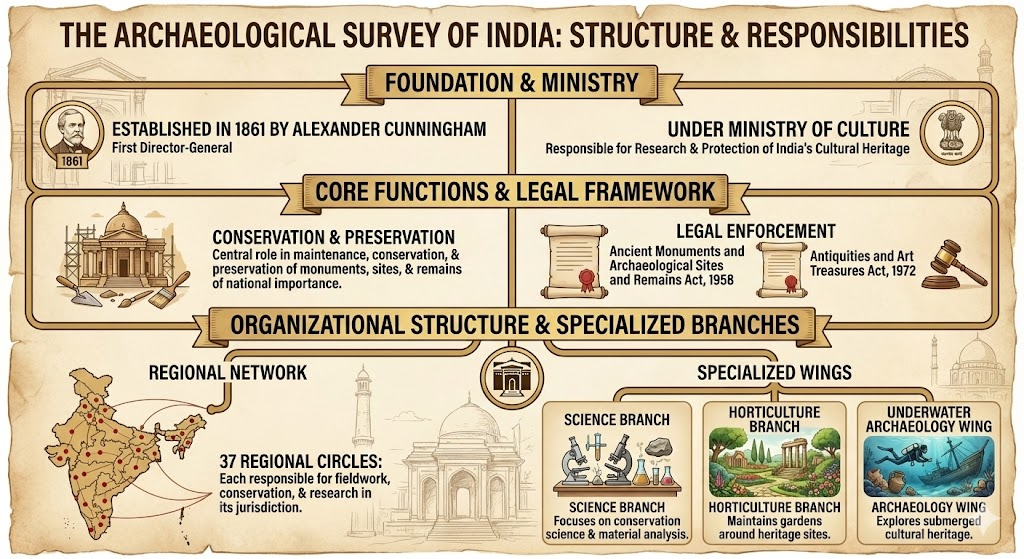
- The Union Ministry of Culture is set to allow private agencies to undertake core conservation work at centrally protected monuments, ending the Archaeological Survey of India’s (ASI) exclusive mandate in this domain.
Rationale Behind the Decision
- Capacity Augmentation: Address human resource and expertise limitations of ASI.
- Time-bound Execution: Private participation enables adherence to strict project timelines.
- Creation of a National Talent Pool: Encourages professionalisation of heritage conservation.
- Efficient Fund Utilisation: Reduces delays in deploying CSR and donor funds.
- Global Best Practices: Many countries use regulated private conservation firms under state oversight.
New Public-Private Partnership Model
- The new initiative aims to introduce a public-private partnership (PPP) model in heritage conservation. The move seeks to:
- Enhance capacity for conservation work.
- Accelerate project timelines that have historically been slow under ASI’s single-agency approach.
- Encourage private participation while maintaining professional and regulatory oversight.
- All conservation projects will continue to be supervised by the ASI and must comply with the National Policy for Conservation (2014).
Checks, Balances, and Eligibility
- Only qualified conservation architects with proven track records will be empanelled.
- Implementing agencies need to demonstrate prior experience in restoring structures over 100 years old.
- Initially, a list of 250 monuments needing urgent conservation will be published.
- Donors may choose from this list or request specific sites based on regional or thematic interests.
Framework and Implementation
- Role of the National Culture Fund (NCF): Funds for all projects will be routed through the NCF, established in 1996 with a government corpus of ₹20 crore.
- The NCF’s structure allows donors to contribute funds directly for conservation projects while receiving 100% tax exemptions under CSR initiatives.
- Empanelment of Conservation Architects: The Union Ministry of Culture aims to issue a Request for Proposal (RFP) to empanel more than a dozen conservation architects across India, as the first step.
- Donors will select from this panel to guide their conservation projects.
- The architect and donor will jointly hire external implementing agencies with experience in heritage conservation.
- The Detailed Project Report (DPR) for each project needs to be approved by the ASI.
- It effectively means that while the ASI retains its supervisory role, private players can now become implementing agencies.
| Comparison with ‘Adopt a Heritage’ Scheme – Earlier, the government’s ‘Adopt a Heritage’ initiative allowed corporate bodies to act as monument mitras, focusing on developing tourist amenities such as cafes, ticket counters, and restrooms. – The new plan, however, goes further, allowing private participation in core conservation work, marking a major policy shift in heritage management. |
Global parallels
- The United Kingdom has set up the Churches Conservation Trust, managing historic buildings with robust private involvement.
- The United States also involves private sector funding and organisations in protecting cultural and natural heritage.
- Germany and the Netherlands have also established various foundations to manage historic buildings, supported by private funding.
| Safeguarding Jurisdictions: Constitutional Mandates – Union (Entry 67): The Union has exclusive jurisdiction over ancient and historical monuments and archaeological sites and remains declared by Parliament to be of national importance. – State (Entry 12): States have jurisdiction over ancient and historical monuments not declared to be of national importance by Parliament. – Concurrent List (Entry 40): Both the Union and States have concurrent powers over archaeological sites and remains other than those declared of national importance. – Article 253: Empowers Parliament to legislate for implementing international treaties, conventions, or agreements, even on subjects in the State List, overriding federal distribution when required for international obligations (e.g., UNESCO conventions). |
Source: IE
Previous article
EAM Visit to Europe
Next article
Pravasi Bharatiya Divas (PBD)
