


Syllabus: GS3/Economy
Context
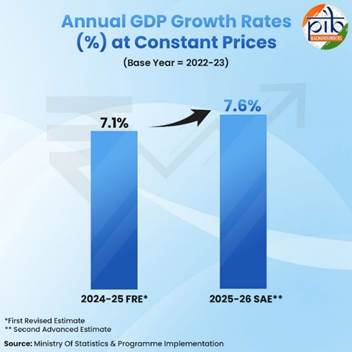
- According to the new series, the gross domestic product (GDP) is estimated to grow at 7.6% during the current fiscal.
About
- The new series has revised downward the growth for 2023-24 to 7.2% from the 9.2% estimated in the old series, and has revised upward the growth for 2024-25 to 7.1% from the earlier estimate of 6.5%.
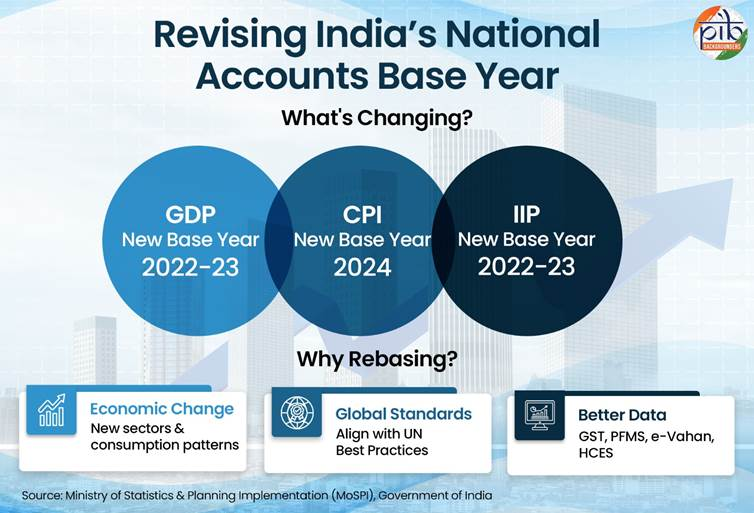
- The base year for GDP Estimates has been revised from 2011–12 to 2022–23 to better reflect India’s evolving economic structure.
- The revised GDP series strengthens estimation by integrating new, improved data sources.
How GDP is Calculated?
- India’s GDP is calculated using two methods: the factor cost method and the expenditure method.
- The factor cost method evaluates performance across eight industries, including agriculture, manufacturing, and financial services.
- The expenditure method examines spending in areas like household consumption and government costs to assess economic performance.
- The Central Statistics Office under India’s Ministry of Statistics and Program Implementation manages GDP data collection.
- India’s GDP data is released quarterly with a two-month lag and annually on May 31.
- Contribution of Sectors: The largest contributor to India’s GDP is the services sector, which accounts for 61.5% of GDP.
- The next largest contributor was the industrial sector (23%) and then the agriculture sector (15.4%).
What is Base Year?
- A base year is a benchmark year used for comparison in economic and statistical calculations.
- It provides a reference point against which current values of indicators like GDP, CPI, and IIP are measured to track real changes over time.
- Significance:
- It allows us to remove the effect of inflation and see real growth.
- Ensures that the data reflects the current structure of the economy, consumption patterns, and prices.
Economic Datasets for Calculation of GDP
- Gross Domestic Product (GDP): GDP is the total monetary value of all final goods and services produced within a country’s domestic territory during a specific period (usually a quarter or a year).
- It is calculated by adding up all the expenditures made in the economy, including expenditures by Indians in their individual capacity, expenditures by governments, expenditures by private businesses, etc.
- This provides a picture of the demand side of the economy.
- Released By: National Statistical Office (NSO), Ministry of Statistics and Programme Implementation (MoSPI).
- Index of Industrial Production (IIP): IIP measures the volume of production in the industrial sector, including mining, manufacturing, and electricity.
- It is a volume-based index, not value-based like GDP.
- Indicates industrial activity, helping assess the short-term economic momentum.
- Released By: NSO, MoSPI.
- Consumer Price Index (CPI): CPI measures the average change in prices paid by consumers for a basket of goods and services over time i.e., it tracks retail inflation.
- Tracks cost of living and purchasing power.
- Includes items like food, housing, clothing, transport, etc.
- Released By: NSO, MoSPI.
Concerns with India’s Statistical Architecture
- GDP Methodology System: India’s GDP calculation method is globally accepted but the real problem is weak and outdated supporting statistical systems.
- Manufacturing Data Distortion: Corporate manufacturing is measured well and is performing strongly but Informal manufacturing is poorly measured causing discrepancy in data.
- Growing GDP Discrepancies: The gap between production-side and expenditure-side data in GDP is widening. It is caused by uneven data quality and outdated weights.
- Gap in GVA and IIP: IIP tracks physical output, not value added; this divergence reflects measurement limits, not economic slowdown.
- IMF Rating Paradox: India scores well on GDP methods but poorly on overall statistical quality. It shows the gap between good methodology and weak data ecosystem.
- Need for Statistical Modernisation: The economy has evolved faster than its statistical tools, the current system cannot fully capture structural change.
2026 Base-Year Revision as an Opportunity
- Shift away from commodity-flow approach: It will move away from the commodity-flow method for estimating consumption across most items.
- Under the earlier framework, fixed ratios derived from a 2011–12 study were used to allocate commodities between intermediate consumption, final consumption and other uses.
- The revised system instead uses dynamic rates and ratios, allowing estimates to evolve over time as consumption patterns change.
- Elimination of ‘Discrepancies’: MoSPI plans to integrate Supply and Use Tables (SUTs) directly into annual GDP compilation.
- Supply and use tables show how different goods and services are supplied by domestic industries and imports and how they are distributed between different intermediate or final uses, including exports.
- This approach aims to limit discrepancies in early estimates and fully eliminate them in final estimates.
- Use of Digital and Administrative Data: Increased reliance on datasets such as;
- e-Vahan (vehicle registrations).
- GST and other administrative records.
- Updated Surveys as Data Backbone: Key surveys feeding into the new series include;
- Household Consumption Expenditure Survey (HCES) 2022–23 and 2023–24.
- Updated surveys of formal and informal enterprises.
- These are expected to offer more granular insights into consumption behaviour and production activity than earlier benchmarks.
- Sectoral Coverage of Revised Framework: The revised quarterly compilation framework has been aligned more closely with the Annual National Accounts methodology in terms of sectoral classification, deflation strategies, and estimation practices.
- Inclusion of Hired Domestic Workers in GDP Estimation.
- The new series includes unincorporated enterprises, self-employed individuals and informal workers.
Do You Know?
- India compiles its GDP estimates in line with the 2008 System of National Accounts (SNA 2008).
- It is the internationally accepted statistical framework.
- With the United Nations Statistical Divisiontransitioning to SNA 2025- expected to be adopted globally around 2029–30- India intends to align with the updated standard in its next base year revision.
Way Ahead
- The revision of the GDP base year to 2022–23 marks a significant step in aligning India’s national accounts with the realities of a rapidly transforming economy.
- The new series provides a more accurate, consistent and comprehensive measure of economic activity.
- By updating the base year, and eliminating discrepancies the new framework is better aligned with the realities of a rapidly formalising and digitising economy.
Source: TH
Previous article
News In Short 27-02-2026
Next article
Casebook on AI and Gender Empowerment
