

Syllabus: GS2/Governance; GS3/Skill Development
Context
- NITI Aayog launched a policy report titled “Revitalizing Apprenticeship Ecosystem: Insights, Challenges, Recommendations and Best Practices.”
About
- The report presents a comprehensive analysis of India’s apprenticeship landscape.
- It provides critical insights, identifies challenges, and outlines actionable recommendations to strengthen the apprenticeship system as a cornerstone of India’s skilling and employment strategy.
Apprenticeship
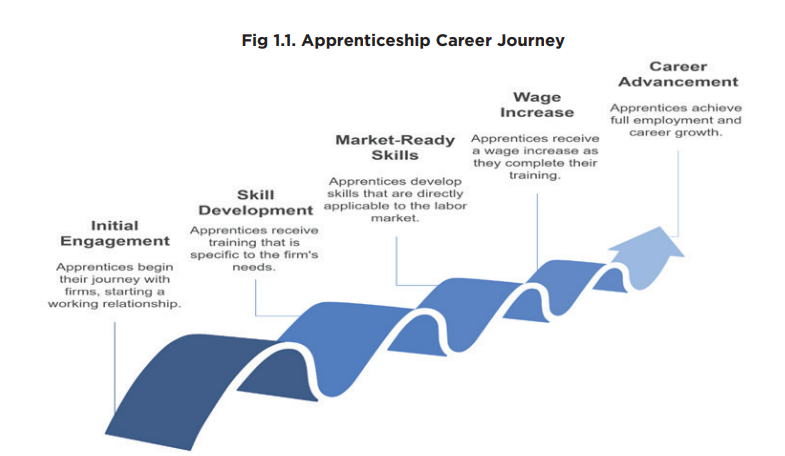
- Apprenticeship training serves as a critical conduit between formal education and employment, enabling youth to acquire job-relevant skills through structured, work-based learning.
- Apprenticeships boost productivity and innovation for businesses by giving them access to a pool of talented people specifically matched to their requirements.
Need for Apprenticeship
- The youth aged 15–29 years constituted 27.2% of the population in 2021 and in absolute terms, India will continue to have a youth population of approximately 345 million by 2036, the largest in the world.
- To translate this youth bulge into a demographic dividend, India must ensure that its young population is equipped with the necessary skills, education, and employment opportunities.
- At the heart of this transformation lies the imperative to strengthen the skilling ecosystem.
Current Landscape
- Gap in Registration and Engagement: In 2024-25, there were 1.31 million registrations for apprenticeships, but only 985,000 people engaged and 251,000 people actually completed their training.
- Drop in Registration: There is a marginal drop in registrations in recent years, and a need to continuously monitor drop-out rates between registration, engagement, and completion.
- Contribution of Establishments: While medium and large enterprises account for less than 30% of active establishments (AEs), they account for over 70% of total apprenticeship engagement. There is low participation by MSMEs, start-ups and informal sectors.
- Gender Gap in Participation: The male participants have a consistently higher share of both registrations and engagements over the years.
- There is insufficient targeted support for women and marginalised groups.
- Regional & Institutional Disparities: Top 10 states account for 79–84% of engagement; North East and UTs contribute very little. Performance within states varies significantly across districts.
NITI Aayog Recommendations
- Policy Reforms: It recommends creating a National Apprenticeship Mission and a unified National Apprenticeship Portal to streamline governance.
- It also calls for targeted incentives to promote apprenticeship engagement among aspirational districts, North East states, and women apprentices.
- Regulatory Framework: Establishing an Apprenticeship Engagement Index to benchmark and enhance apprenticeship efforts of States and Union Territories.
- It also calls for robust evaluation of apprenticeship programmes and apprentice competencies.
- State and District level interventions: It calls for state- and district-level interventions, suggesting targeted support for “high-potential, yet low-performing special districts”.
- Introduce recognition/reward initiative for top 25 districts based on apprenticeship growth metrics.
- Participation by Establishments: It seeks deeper participation by micro, small, and medium enterprises (MSME) through cluster-based approaches, integration with the start-up ecosystem, and aligning apprenticeships with the gig and platform economy.
- Stronger Support for Marginalised Section and Women : It calls for stronger apprentice support including travel and accommodation assistance for marginalised candidates, expanded insurance coverage, structured career counselling, international mobility pathways, and specific measures to enhance women’s inclusion.
Initiatives
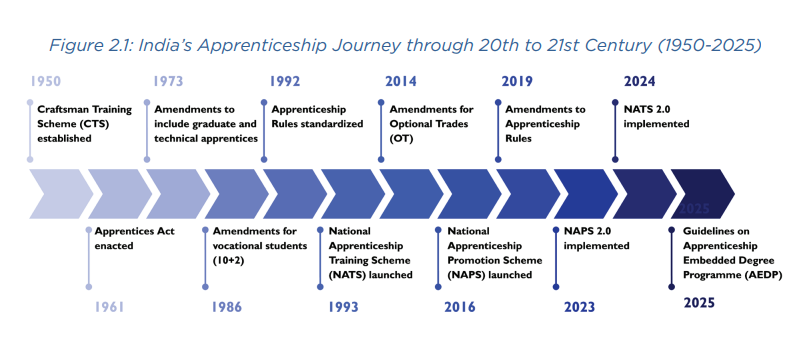
- National Apprenticeship Promotion Scheme (NAPS) 2016: Launched by the Ministry of Skill Development and Entrepreneurship, NAPS aims to provide on-the-job training to candidates between 14 and 35 years of age across sectors.
- NAPS incentivized employers to engage apprentices by sharing up to 25% of prescribed stipends (up to ₹1,500/month).
- It also reimbursed basic training costs for designated trades, fostering greater participation in apprenticeship programmes.
- National Apprenticeship Training Scheme (NATS): It is administered by the Ministry of Education, which focuses on graduate and diploma holders and offers six months to one year of structured on-the-job training.
Source: PIB
Previous article
News In Short 20-02-2026
Next article
International Mother Language Day
