


Syllabus: GS3/Environment & Climate Change
Context
- According to a study titled ‘Ocean Heat Content Sets Another Record in 2025’, found that the oceans absorbed more heat in 2025 than in any year since modern measurements began in the 1960s.
- It focused on the top 2,000 meters of the ocean, where most heat is stored.
Key Findings of Study
- Record-Breaking Ocean Heat Content (OHC): The Earth’s oceans absorbed 23 Zettajoules (ZJ) of additional heat in 2025, surpassing all previous records since the 1960s.
- It marks a 44% increase compared to 2024, when oceans absorbed 16 ZJ.
- Rising Global Sea-Surface Temperatures (SSTs): Global average SSTs in 2025 were the third highest on record, roughly 0.5°C above the 1981–2010 baseline.
- The South Atlantic, North Pacific, and Southern Ocean were identified as the fastest-warming regions.
- Oceans Absorb 90% of Anthropogenic Heat: Nearly 90% of the excess heat trapped by greenhouse gases (GHGs) since the industrial era has been absorbed by the oceans.
- This has led to steady, long-term warming even during years when atmospheric temperature rise slows temporarily.
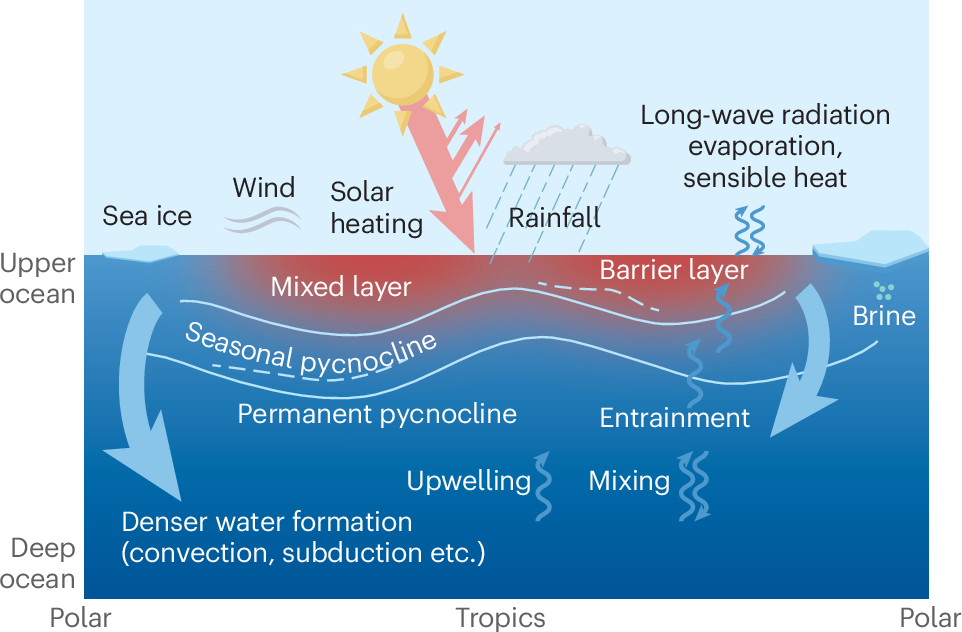
- Increased Ocean Stratification: Rising heat content has intensified ocean stratification like separating warm, light, nutrient-poor surface waters from cooler, denser, nutrient-rich deep waters.
- It reduces vertical mixing, meaning:
- Less CO₂ absorbed by oceans.
- Oxygen depletion in deeper waters.
- Nutrient scarcity for marine life near the surface.
- It reduces vertical mixing, meaning:
- Threats to Marine Ecosystems: Stratification and warming together threaten phytoplankton populations, which form the base of marine food webs.
- Decline in phytoplankton affects zooplankton, fish, crustaceans, and corals, increasing the risk of ecosystem collapse.
- Marine Heat Waves (MHWs) Intensifying: Marine heat waves (defined as ocean regions 3–4°C above average for ≥5 days) are becoming more frequent, longer, and more intense.
- According to the IPCC (2021), MHW frequency has doubled between 1982 and 2016.
- MHWs drive coral bleaching, reduce coral reproduction, and alter fish migration patterns.
- Stronger and More Destructive Storms: Warmer oceans are fueling more powerful tropical storms, cyclones, and hurricanes.
- Increased evaporation and heat transfer intensify storms, leading to stronger winds, heavier rainfall, and worse flooding upon landfall.
| Oceans Warming – Ocean warming is primarily driven by human-induced climate change, with greenhouse gas emissions, thermal expansion, and altered ocean-atmosphere interactions. – According to the World Meteorological Organization (WMO) and the IPCC, over 90% of excess heat trapped by greenhouse gases since the 1970s has been absorbed by the oceans.It affects global weather patterns, marine ecosystems, and coastal communities. Causes of Ocean Warming – Increased GHGs concentrations, especially carbon dioxide (CO₂), methane (CH₄), and nitrous oxide (N₂O), trapping heat in the Earth’s atmosphere. – Deforestation and industrial emissions reduce natural carbon sinks. – Changes in ocean circulation, influenced by atmospheric warming. Impact on Marine Life and Ecosystems – Coral bleaching is increasing, with up to 70–90% of coral reefs expected to be lost if global warming exceeds 1.5°C. – Fish migration patterns are shifting toward cooler waters, impacting global fisheries. – Deoxygenation and acidification further stress marine ecosystems. Ocean Warming and Climate Feedback Loops – As water warms, it expands (thermal expansion), contributing to sea level rise, alters the density and circulation of ocean currents. – Warming oceans amplify climate change through feedback mechanisms: Reduced CO₂ absorption capacity of warmer waters. Melting polar ice leads to further heat absorption (albedo effect). Altered weather systems such as stronger El Niño events. -The UN Environment Programme (UNEP) notes that these feedbacks could accelerate warming beyond current projections. Regional Focus: Indian Ocean -Data from the Ministry of Earth Sciences (MoES) and INCOIS show that: The Indian Ocean has warmed by 1.2°C since 1950, faster than the global average. – It contributes to intense monsoons, cyclone variability, and coastal flooding. – The Arabian Sea is particularly affected, witnessing a rise in severe cyclonic storms. – The India Meteorological Department (IMD) warns that increasing ocean heat content is linked to sea-level rise along India’s coastline, affecting coastal ecosystems and communities. Mitigation and Global Action – The UN Decade of Ocean Science for Sustainable Development (2021–2030) emphasizes: – Enhanced marine observation networks. – Reducing emissions through renewable energy transition. – Blue carbon initiatives like mangrove and seagrass restoration. India’s National Centre for Coastal Research (NCCR) and MoES have initiated long-term ocean observation programs under the Deep Ocean Mission, aimed at understanding and mitigating ocean warming effects. |
Previous article
Article 6 of the Paris Agreement and India
Next article
First Fully Organic Village of Rajasthan
