

Syllabus: GS3/ Environment
In Context
- At COP29, carbon markets under Article 6 (A6) of the Paris Agreement were made fully operational to improve the delivery and efficiency of climate finance.
- Earlier, India took a major step by signing the Joint Crediting Mechanism (JCM), effectively operationalising Article 6.2 and marking India’s formal entry into international carbon market cooperation.
What is Article 6 of the Paris Agreement?
- Article 6 creates a framework that allows countries to cooperate voluntarily to achieve their Nationally Determined Contributions (NDCs) through two main routes:
- Article 6.2: Enables bilateral or plurilateral cooperation through the trading of emission reductions, called Internationally Transferred Mitigation Outcomes (ITMOs).
- Article 6.4: Establishes a centralized Paris Agreement Crediting Mechanism (PACM), evolved from the earlier Clean Development Mechanism (CDM), to validate and verify projects generating carbon credits.
- Both mechanisms are backed by strong accounting rules to avoid double counting and ensure transparency and environmental integrity.
India and the Joint Crediting Mechanism
- India’s entry into Article 6 through its JCM partnership with Japan represents the operationalisation of Article 6.2. The JCM framework will facilitate the adoption of low-carbon and advanced industrial technologies, offering mutual benefits—emissions reduction for Japan and technology transfer and finance for India.
- The Indian government has identified 13 eligible activities under A6, focusing on high-impact, emerging technologies such as:
- Renewable energy with storage and offshore wind
- Green hydrogen and compressed bio-gas
- Sustainable aviation fuel and fuel-cell mobility
- High-end energy efficiency applications
- Carbon capture, utilisation, and storage (CCUS)
- These reflect a strategic alignment between India’s growth priorities and long-term decarbonisation goals, particularly for industries like steel, cement, and power generation.
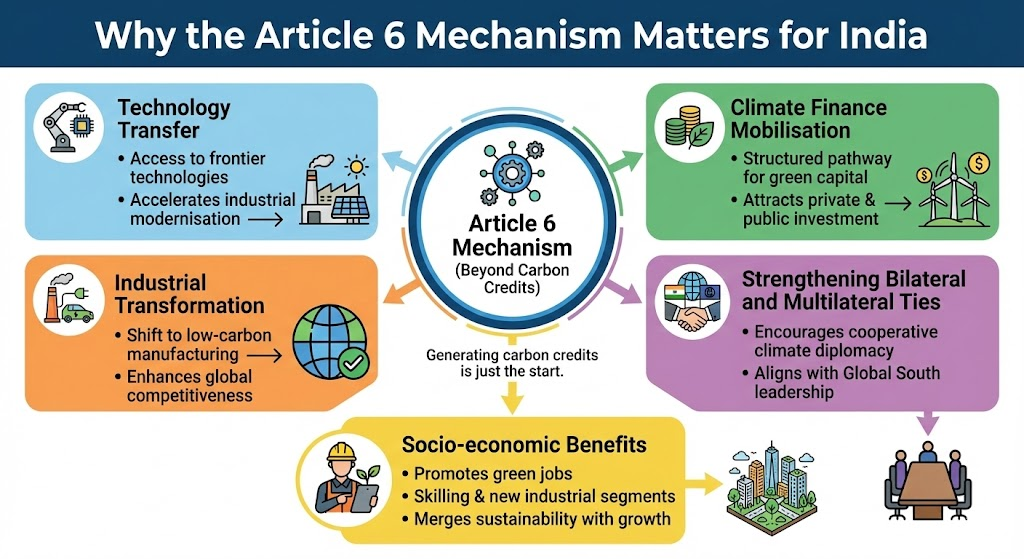
Key Policy Priorities
- Strengthen the Domestic Carbon Governance Framework: India’s Designated National Authority (DNA) must define clear procedures for:
- Issuing Letters of Authorisation (LoAs) for A6 projects.
- Managing corresponding adjustments to prevent double counting.
- Establishing a robust legal and regulatory architecture for carbon trading.
- Streamline Project Approvals: A Cabinet-level steering committee and single-window clearance system can drastically cut approval timelines. Current voluntary carbon projects take over 1,600 days to register—four times slower than regional peers.
- Develop a Domestic Carbon Removals Market: With rising global demand, India can position itself as a key supplier of high-quality removal credits through biochar, enhanced rock weathering, and afforestation-based projects.
- Promote South–South Collaboration: India’s leadership in institutions like ISA, CEM, and BASIC can catalyze shared platforms for knowledge exchange and co-investment among developing economies.
Source: TH
Previous article
India Germany Sign Pact to Shore Up Defence Industrial Cooperation
Next article
Warming of Earth’s Oceans
