


Syllabus: GS2/IR; GS3/Economy
Context
- India’s maritime policy has undergone significant evolution, intricately linked to its historical and geographical context, as explored in ‘The Routledge Handbook of Maritime India’.
About
- The handbook delves into India’s rich maritime history and strategic relationships across the Indian Ocean.
- It comprises five essays by different scholars, traces the historical evolution of India’s outward reach, focusing on the Cholas, the Marathas, Europeans and Indo-Arab maritime trade.
Maritime History of India
- Early Days: The beginning of India’s maritime history dates back to 3000 BC. During this time, the inhabitants of the Indus Valley Civilisation had maritime trade links with Mesopotamia.
- The Southern Dynasties: The Cholas, Cheras, and Pandyas were powerful peninsular Indian dynasties with strong maritime trade links to Sumatra, Java, the Malay Peninsula, and China.
- Arabs: By the 8th Century AD, Arabs began to come to India by sea in great numbers as traders. Over the time, many parts of modern-day West Asia became nodal points for business between Europe, Southeast Asia and India.
- Arrival of Europeans: Arrival of the Portuguese explorer Vasco da Gama at Calicut in 1498, opened a new and direct sea route from Europe to India.
- Maritime Prowess of the Marathas: The Marathas gave the strongest resistance to British control along the Indian coasts.
- Chhatrapati Shivaji Maharaj was the first to recognize the need for a powerful navy, building coastal forts like Vijaydurg and Sindhudurg and strengthening defences against the Siddis and Portuguese.
- Under his leadership, the Maratha navy grew to over 500 ships, holding off both the Portuguese and British for over 40 years.
- Post Independence: On 22 April 1958, Vice Admiral R.D. Katari became the first Indian Chief of Naval Staff.
- Following India’s Republic status on 26 January 1950, the Navy dropped the “Royal” prefix and was renamed the Indian Navy.
India’s Maritime Zone
- India’s maritime zone refers to the maritime boundaries and areas under its jurisdiction in the surrounding seas and oceans.
- India’s coastline stretches over 11,000 kilometers including island territories.
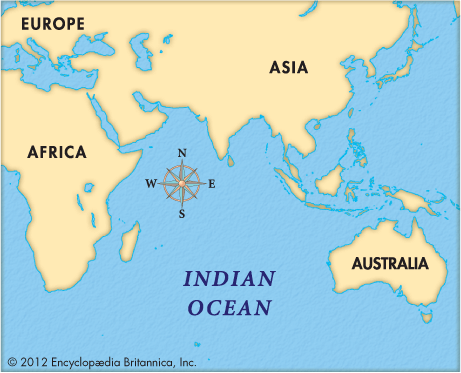
- Indian Ocean Region: The Indian Ocean covers approximately one-fifth of the total ocean area of the world.
- The Indian Ocean is bounded by Iran, Pakistan, India, and Bangladesh to the north; the Malay Peninsula, the Sunda Islands of Indonesia, and Australia to the east; the Southern Ocean to the south; and Africa and the Arabian Peninsula to the west.
- Maritime Security: It involves protecting the nation’s sovereignty from threats arising from the oceans and seas.
- Threats include protecting coastal areas, safeguarding the available ocean resources such as fish, offshore oil and gas wells, port facilities, etc.
Significance of the Indian Ocean Region (IOR)
- Geostrategic Importance: The Indian Ocean is the third largest ocean, linking the Middle East, Africa, South Asia, and Southeast Asia.
- It is home to crucial maritime chokepoints — Strait of Hormuz, Bab-el-Mandeb, Malacca Strait, Lombok Strait — which together handle a bulk of global energy and trade flows.
- The IOR acts as a bridge between the East and the West, making it a central theatre for power competition among India, China, the U.S., and other major players.
- Economic Significance: The region carries nearly 50% of global container traffic and 80% of seaborne oil trade.
- It is a hub of blue economy activities: shipping, fisheries, seabed mining, and tourism.
- Energy Security: The IOR is the lifeline of global energy flows: oil and gas from West Asia transit to East Asia via its sea lanes.
- Countries like India, China, Japan, and South Korea are energy-import dependent, making stability of the IOR vital.
- Blue Economy Potential: The IOR offers opportunities in fisheries, seabed minerals, renewable energy, and tourism—requiring secure seas for sustainable exploitation.
Need to Strengthen Maritime Security in IOR
- Indo-Pacific Construct: The Indo-Pacific combines the Indian and Pacific Oceans into one strategic theatre and highlights the centrality of IOR in shaping new global maritime order.
- This geographical reimagination enhances IOR’s visibility in global diplomacy and security.
- Implications for Global Order: Control over the IOR can shape:
- Trade flows (especially oil & gas),
- Strategic maritime chokepoints (like the Strait of Hormuz, Malacca, Bab el-Mandeb),
- Military posturing and base logistics.
- Geopolitical contestation: Major-power activity (notably China’s expanding presence and infrastructure investments) alters the strategic balance.
- Fragmented maritime governance: Many littoral states lack capacity for surveillance, law enforcement, and HADR (humanitarian & disaster response).
- Diverse asymmetric threats: Illegal, unregulated and unreported (IUU) fishing, trafficking, piracy resurgence and attacks on commercial shipping complicate security.
Challenges in IOR
- Expansion of Chinese Naval Power in IOR: Increased naval vessel deployments in the region in terms of both number and duration.
- Deployment of Chinese research and survey vessels to gather sensitive oceanographic and marine data under the guise of scientific research.
- Piracy hotspots near the Horn of Africa and in the Malacca Strait threaten shipping.
- Terrorism, arms smuggling, and trafficking networks exploit porous maritime borders.
- Strategic Port Development Near India: China is actively involved in developing ports and infrastructure in littoral states of the IOR, including those close to India’s maritime boundaries.
- The objective aligns with China’s long-term goal of becoming a maritime power.
Government Initiatives
- Sagarmala Programme: Focuses on leveraging India’s coastline and of navigable waterways.
- Supports port infrastructure, coastal development, and connectivity.
- Financial aid for projects like coastal berths, rail/road connectivity, fish harbours, cruise terminals.
- Maritime India Vision 2030 (MIV 2030): Aiming for India to become a top 10 shipbuilding nation by 2030 and create a world-class, efficient, and sustainable maritime ecosystem.
- Sagarmanthan Dialogue: An annual maritime strategic dialogue to position India as a global center for maritime conversations.
- Maritime Development Fund: ₹25,000 crore fund for long-term financing to modernize ports and shipping infrastructure, encouraging private investment.
- Launch of MAHASAGAR (Mutual and Holistic Advancement for Security and Growth for All in the Region) reflects India’s strategic rebranding in the IOR.
- Naval Modernisation and Indigenous Development: India is modernising naval capabilities:
- Commissioning indigenous warships (e.g., INS Vikrant, INS Visakhapatnam).
- Boosting maritime domain awareness and power projection.
- This strengthens India’s force posture and maritime deterrence in the IOR.
- India’s Response and Regional Diplomacy: India is working with regional partners to raise awareness about the long-term implications of Chinese infrastructure projects.
- Emphasize the risks to internal and regional security from China’s military use of these assets.
- India on Militarisation of the IOR: India asserts that Militarisation of the Indian Ocean Region is not desirable and will adversely impact security in the Indian Ocean and the wider Indo-Pacific.
- This reflects India’s stance against military usage of Chinese-funded infrastructure in the IOR.
Conclusion
- India’s maritime security initiatives reflect a blend of military capability, infrastructure readiness, regional partnerships, and legal-institutional frameworks.
- Initiatives such as Act East Policy, Indo-Pacific Vision, and Blue Economy strategy reinforce India’s centrality in the IOR.
Source: TH
