


Syllabus: GS3/Economy
Context
- Many challenges were flagged by exporters in a meeting of the Board of Trade (BoT) chaired by the Union Commerce and Industry Minister.
About
- The BoT meeting happened in the backdrop of slowing exports due to the steep US tariffs of 50% as both countries failed to conclude a trade deal.
- In the Board of Trade meeting, representatives from states and the industry, as well as key Central ministries, provide the Commerce Ministry with specific inputs to boost exports and trade.
- Concerns Raised by Exporters:
- Costlier raw materials, shortage of testing facilities to ensure products meet global quality standards, and lack of adequate shipping containers are all leading to loss of competitiveness of goods exports.
- The steep US tariffs have dampened exports, and have triggered cancellations in orders and delayed payment.
- There are also worries that these could result in orders moving to its competitors such as Bangladesh, Vietnam and China.
| Board of Trade – Board of Trade (BOT) has been constituted by merging Council for Trade Development and Promotion with Board of Trade in 2019. – It provides a platform to state governments and UTs for articulating state-oriented perspectives on Trade Policy. – Functions: It advises the Government on policy measures connected with the Foreign Trade Policy in order to achieve the objectives of boosting India’s trade. a. It is an important mechanism for deliberations on trade related issues with industry bodies, associations, export promotion councils, and state and UT governments. – It is chaired by the Union Minister for Commerce and Industry. |
Exports by India
- Exports account for nearly 21% of GDP and robust foreign exchange inflows for India.
- Over 45 million people being directly and indirectly employed under the export oriented industries, the MSMEs contribute nearly 45% of total exports.
- Key export drivers during April-September 2025 include Electronic Goods (41.94%), Engineering Goods (5.35%), Drugs and Pharmaceuticals (6.46%), Marine products (17.40%) and Rice (10.02%).
- Major export destinations include the USA (13.34%), United Arab Emirates (9.34%), China (21.85%), Spain (40.30%), and Hong Kong (23.53%).
- Such sustained export growth has been instrumental in supporting India’s current account balance and macroeconomic stability.
Government Initiatives to Curb these Challenges
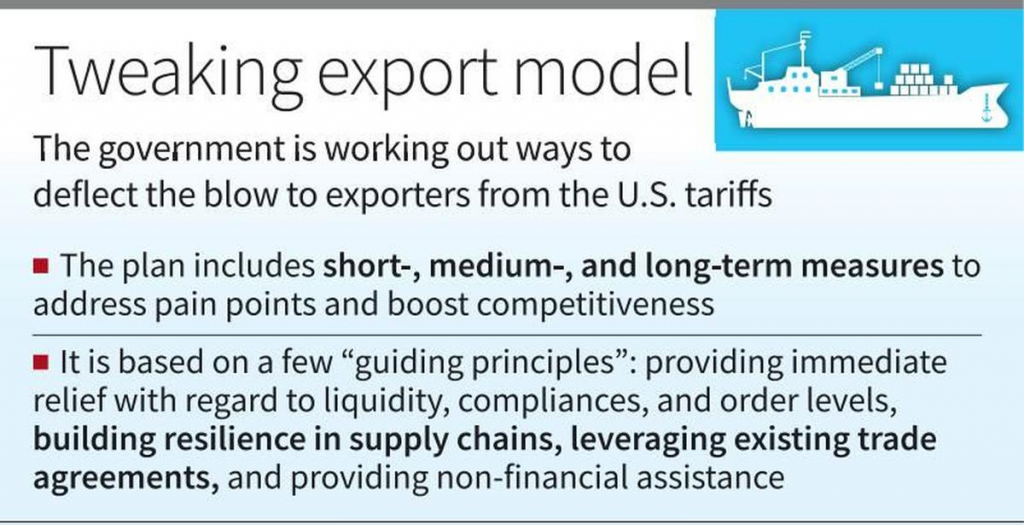
- Export Promotion Mission: In the Union Budget for 2025-26, the Finance Minister announced an Export Promotion Mission.
- It would facilitate easy access to export credit, cross-border factoring support, and support to MSMEs to tackle non-tariff measures in overseas markets.
- EPM will span six years covering FY 2025-26 to FY 2030-31.
- Under EPM, priority support will be extended to sectors impacted by recent global tariff escalations, such as textiles, leather, gems & jewellery, engineering goods, and marine products.
- Export Support Package: The government announced a Rs 7,295-crore export support package, comprising a Rs 5,181-crore interest subvention scheme along with a Rs 2,114-crore collateral support, to improve exporters’ access to credit.
- Free Trade Agreements (FTA) Negotiations: India is aggressively pushing for newer markets and has signed as many as three free trade agreements, with Oman, New Zealand and the UK, in 2025.
- Digital Transformation: The Department of Commerce has advanced its Digital Transformation agenda to strengthen trade facilitation and intelligence through data-driven solutions.
- Initiatives such as Trade eConnect and Trade Intelligence & Analytics (TIA) portal lay a strong foundation for evidence-based decision-making.
Conclusion
- The Indian government’s comprehensive strategy aims to reinforce the resilience of its exporters amid challenging global trade dynamics.
- Sustained efforts will be essential to protect traditional export sectors and ensure long-term competitiveness against both US tariffs and Chinese market strategies.
Source: IE
Previous article
Urban Wastewater Management (UWM)
Next article
Land Acquisition Policy of India
