


Syllabus: GS2/Governance/GS3/Economy
In News
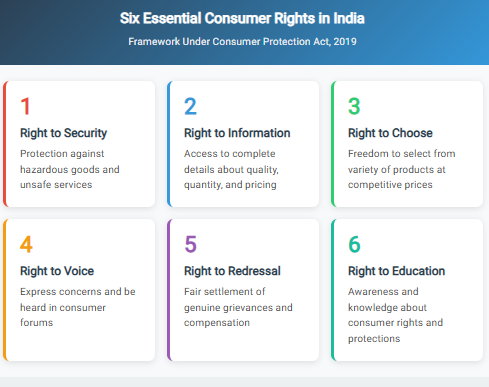
- Recently, National Consumer Day was observed in India to highlight the significance of consumer rights and the broader framework of consumer protection.
National Consumer Rights Day and Consumer Protection Act
- It was established in India to commemorate the enactment of the Consumer Protection Act of 1986, which was approved by the President of India on December 24, 1986.
- Since then, 24th December has been celebrated as National Consumer Day.
- The Consumer Protection Act, 2019 replaced the Consumer Protection Act, 1986.
- It was enacted to protect consumer rights, address grievances related to goods and services, and ensure fair treatment and access to justice for consumers.
Key Features
- The Section 2(28) of the Consumer Protection Act, 2019 defines “misleading advertisement” in relation to any product or service which is falsely describes a product or service, gives false guarantees or misleads consumers about its nature or quality, makes deceptive implied claims amounting to unfair trade practice, or deliberately hides important information.
- Section 21 of the Consumer Protection Act empowers the CCPA to act against false or misleading advertisements by directing traders, manufacturers, endorsers, advertisers or publishers to discontinue or modify such advertisements if they are found harmful to consumers or violative of consumer rights.
| Central Consumer Protection Authority (CCPA) – It is India’s apex consumer watchdog. It was established under Section 10(1) of the Consumer Protection Act, 2019, and became operational on 24th July 2020. – It is tasked with regulating matters related to the violation of consumer rights, unfair trade practices, and false or misleading advertisements that are prejudicial to the interests of consumers as a class and the public at large. – It can penalise manufacturers or endorsers of false or misleading advertisements with fines up to ₹10 lakh and imprisonment up to two years, which may increase to ₹50 lakh and five years for repeat offences, and can also ban endorsers from future promotions for up to one year, extendable to three years for subsequent violations. |
Other related steps
- The Department of Consumer Affairs in India has strengthened consumer protection through multiple initiatives:
- Consumer Welfare Fund – Provides financial support to States/UTs to promote consumer protection, with funding through corpus interest. Rs.38.68 crore released in 2024–25.
- e-Jagriti Platform – Launched in January 2025, it integrates multiple grievance systems for filing, tracking, and resolving complaints digitally. Over 1.35 lakh cases filed and 1.31 lakh disposed, benefiting domestic and NRI consumers.
- National Consumer Helpline 2.0 – AI-enabled, multilingual platform handling over 12 lakh complaints annually, resolving many within 21 days, with digital channels accounting for 65% of filings.
- Jago Grahak Jago Portal & Apps – Digital tools to detect dark patterns, provide verified e-commerce information, and allow consumers to report suspicious websites.
- Bureau of Indian Standards (BIS) – Ensures product safety and quality through standards, certification, and hallmark verification via the BIS Care app.
- National Test House (NTH) – Provides testing, calibration, and quality control services; modernising operations with digital systems and mobile apps; tested 45,926 samples in 2024–25.
- Legal Metrology Amendments (2025) – Strengthens rules related to medical device labelling and packaging, mandates country-of-origin disclosure on e-commerce platforms, and tightens pricing norms for pan masala, with the objective of improving regulatory clarity, transparency, and consumer protection.
Source :PIB
Previous article
External Affairs Minister S Jaishankar Visit Sri Lanka
Next article
Concentrated of India’s Exports in Few States
