



Syllabus: GS2/International Relations
Context
- The Prime Minister of India’s visits to Ethiopia, Namibia and Ghana in 2025 have renewed focus on India–Africa economic relations.
- In the 21st century, this partnership is moving beyond historical solidarity to a strategic, economy-driven engagement, shaped by Africa’s demographic rise and India’s global economic ambitions.
India-Africa Relations
- Overview: As Africa emerges as one of the fastest-growing regions, with its population projected to reach 1.7 billion and consumer spending valued at USD 6.7 trillion by 2030, India’s engagement with the continent has become increasingly strategic and multidimensional.
- India and Africa share a unique partnership rooted in a common history, mutual development aspirations, and demographic dynamism within this transformation.
- Economic Ties: India is now Africa’s fourth-largest trading partner, with bilateral trade approaching $100 billion, marking a 17% year-on-year increase.
- India exported goods worth $38.17 billion in FY24, primarily to Nigeria, South Africa, and Tanzania. Key exports included petroleum products, engineering goods, pharmaceuticals, rice, and textiles.
- However, China’s trade with Africa exceeds $200 billion, accounting for 21% of Africa’s total imports in 2024.
- From Commodity Trade to Strategic Engagement: Historically, India-Africa trade was shaped by Africa’s exports of raw materials and India’s exports of pharmaceuticals, textiles, and automobiles.
- They now aim to transition from commodity-driven trade to strategic engagement in manufacturing, digital services, and skills development.
- The African Continental Free Trade Area (AfCFTA), launched in 2021, offers a powerful framework to deepen this integration by enhancing intra-African trade and opening new corridors for Indian investment and industrial collaboration.
- Development Partnership:
- Capacity Building: Over 40,000 African professionals and students trained through Lines of Credit (LoCs) and ITEC.
- Digital Outreach: e-Vidya Bharti and e-Arogya Bharti have benefited 15,000 learners across 22 countries.
- Agriculture: Indian investments in irrigation, food processing and farm technologies support productivity and food security.
- Healthcare: Indian pharma hubs in Nigeria, Kenya and South Africa; vaccine and medical supplies to 32 African countries strengthened India’s image as a reliable health partner.
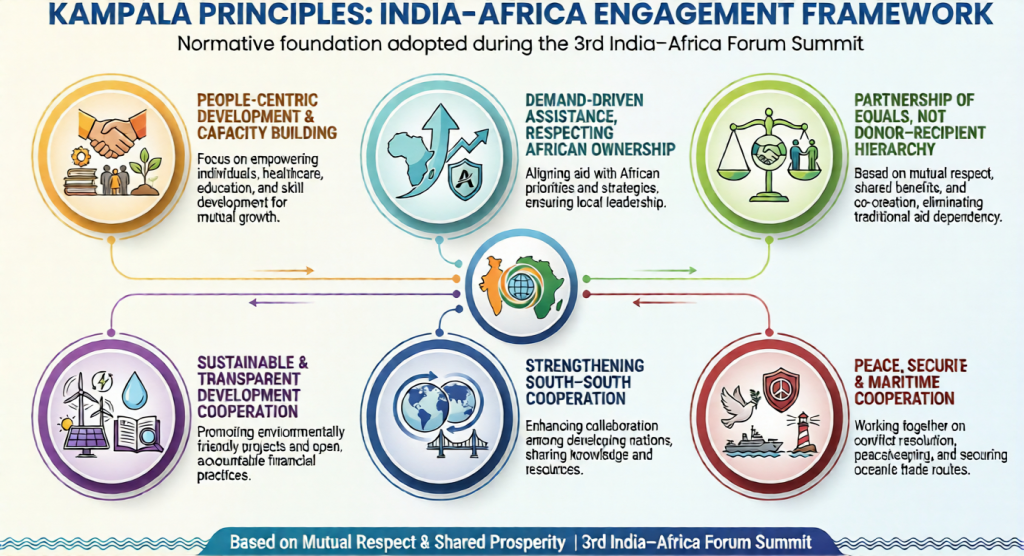
Challenges and Concerns
- Economic & Trade Challenges: Trade remains commodity-heavy with limited value addition.
- Indian firms face competition from China’s scale, financing capacity and infrastructure presence.
- Limited Preferential Trade Agreements (PTAs) with African blocs.
- Financial & MSME Constraints: Indian MSMEs face:
- Lack of affordable trade finance
- High political and commercial risks
- Inadequate insurance and credit guarantees
- Connectivity & Logistics: High freight and logistics costs due to:
- Underdeveloped ports and hinterland connectivity
- Absence of dedicated India–Africa maritime corridors
- Security Concerns: Piracy, terrorism and illegal exploitation in the Indian Ocean Region (IOR).
- Red Sea disruptions (Houthi attacks) caused a 90% drop in container traffic, increasing global freight costs and affecting Indian exports.
Way Forward For India’s Africa Strategy
- Trade Facilitation and Market Access: India needs to negotiate Preferential Trade Agreements (PTAs) and Comprehensive Economic Partnership Agreements (CEPAs) with African regional blocs and key economies.
- Removing tariff and non-tariff barriers will be essential to expanding market reach and improving trade efficiency.
- Transition to Value-Added Manufacturing: India’s current engagement is heavily commodity-driven. A shift toward value-added, two-way manufacturing and cross-border joint ventures is vital.
- Establishing manufacturing bases in Africa allows Indian firms to benefit from US preferential tariffs via African supply chains, and tap into Africa’s growing consumer base.
- Strengthening engagement with the African Continental Free Trade Area (AfCFTA) can unlock vast new opportunities for Indian exporters.
- Empowering MSMEs and Expanding Trade Finance: The African market offers fertile ground for India’s MSMEs, a segment often constrained in Western markets. Scaling up Lines of Credit and ensuring accessible trade finance are crucial.
- Further measures include promoting local currency trade, and establishing a joint insurance pool to mitigate political and commercial risks for small and medium enterprises.
- Reducing Logistics and Connectivity Costs: India needs to invest in port modernization, hinterland connectivity, and the development of India–Africa maritime corridors to reduce freight costs and facilitate smoother trade flows.
- Scaling Services and Digital Partnerships: India should leverage its global strengths in Information Technology, healthcare, education, and skill development to enhance services trade.
- Digital cooperation and people-to-people ties can serve as force multipliers for economic and cultural integration.
- Securing Supply Chains and Maritime Corridors: Piracy, terrorism, and illegal resource exploitation in the Indian Ocean Region (IOR) threaten maritime routes.
- Recent disruptions, such as Houthi attacks in the Red Sea, caused a 90% drop in container traffic and significant global freight inflation, impacting Indian exporters.
- However, India has expanded its maritime cooperation through the SAGARvision into Mutual and Holistic Advancement for Security and Growth Across Regions (MAHASAGAR) to counter these risks. Key initiatives include:
- AIKEYME 2025: A multilateral naval exercise in Dar-es-Salaam promoting interoperability and anti-piracy operations.
- IOS SAGAR Deployment: Indian Navy missions to East African ports to strengthen maritime security and cooperation.
| Daily Mains Practice Question [Q] Examine the evolving relationship between India and Africa. How can both regions build a sustainable and mutually beneficial partnership in the 21st century? |
