


Gavri of the Mewar Bhils
Syllabus: GS1/ Culture
In Context
- The Gavri is a 40-day annual ritual and folk festival performed by the Bhil community of the Mewar region in Rajasthan.
About the Gavri Festival
- The festival is typically performed during the Hindu months of Shravana and Bhadrapad (July to September), coinciding with the monsoon and harvest season.
- The ritual is performed mainly by male members of the Bhil tribe, who enact various roles including gods, goddesses, demons, and other mythological characters.
- The play enacts mythological tales related to the goddess Gauri, battles between good and evil.
About the Bhil Community
- The Bhils are one of the largest tribal (Adivasi) communities in India, primarily concentrated in Rajasthan, Gujarat, Madhya Pradesh, and Maharashtra.
- They have a distinct cultural identity with unique customs, language (Bhili), and traditional practices tied closely to nature and animist beliefs blended with Hinduism.
- The Bhils consider themselves descendants of Lord Shiva and his consort Parvati (Gauri).
Source: IE
Paithani Sarees
Syllabus: GS1/ Culture
In News
- Prime Minister in the monthly radio programme ‘Mann Ki Baat’ praised the traditional craftsmanship of Paithani sarees.
About Paithani Sarees
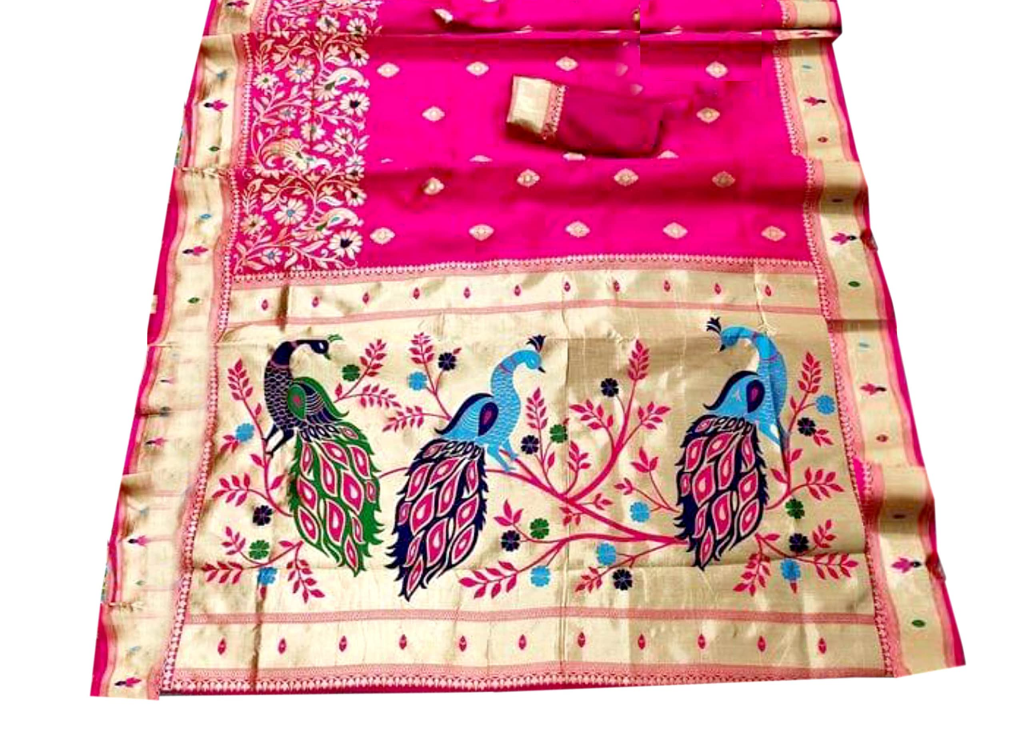
- Origin and History: Paithani sarees originated over 2000 years ago in Paithan, a town near Aurangabad in Maharashtra, on the banks of the Godavari River.
- The weaving tradition can be traced back to the Satavahana dynasty (2nd century BCE).
- Royal Patronage: Paithani sarees were woven for and worn by royalty and aristocrats, including the Satavahanas, the Peshwas of Pune, the Nizams of Hyderabad, and Mughal rulers.
- Material and Craftsmanship: Traditionally made from fine silk with pure gold and silver zari (metallic thread), Paithani sarees are handwoven using the tapestry weaving technique. They are renowned for their intricate floral and peacock motifs.
- GI Tagging: Paithani sarees have been granted the Geographical Indication (GI) tag in 2010.
Source: AIR
Majuli Island
Syllabus: GS1/Geography
Context
- Locals of Pathorichuk village of Majuli, Assam are combating riverbank erosion by planting Kanchan trees along the Brahmaputra’s banks.
About the Majuli Island
- Majuli is the world’s largest river island.
- It lies in the Brahmaputra River in Assam and became India’s first river island district in 2016.
- The island is bounded by:
- Northwest: River Subansiri and its tributaries Ranganadi, Dikrong, Dubla, Chici, and Tuni etc.
- Northeast: Kherkatia Suli (a spill channel of the Brahmaputra)
- South and Southwest: Main Brahmaputra River
- Majuli is home to indigenous tribes such as the Mising, Deori, and Sonowal Kachari, and it is a centre for Assamese neo-Vaishnavite culture.
Do you know?
- Umananda Island, located in the Brahmaputra at Guwahati, Assam, is the world’s smallest river island. The British called it Peacock Island because of its shape.
Source: TOI
Noon River
Syllabus :GS1/Geography
In News
- The Noon River is undergoing restoration through community-led desilting efforts.
Noon river
- The Noon River originates in Satah village, which is part of the Koch development block in the Bundelkhand region of Uttar Pradesh.
- The revival of the river seeks to address farmland submergence and water shortages.
- A major section of the river has been restored due to community involvement and administrative backing.
- It offers the potential to irrigate thousands of hectares and enhance water availability for many villages.
Source: IE
Mera Gaon Mera Dharohar Programme
Syllabus: GS2/ Governance
In News
- Over 4.7 lakh villages have been mapped so far, with their cultural portfolios available on the Mera Gaon Mera Dharohar web portal.
Mera Gaon Meri Dharohar Programme
- About: Launched in June 2023 under the National Mission on Cultural Mapping (NMCM).
- Implementing Agency: Indira Gandhi National Centre for the Arts (IGNCA) under the Ministry of Culture.
- Objective: To map, document, and digitally preserve the intangible cultural heritage of all 6.5 lakh villages across India, providing a comprehensive cultural portfolio for each village.
- Thematic Categories: 7 main types, including crafts, ecology, history, epics, architecture.
- Significance: Heritage preservation, rural development, inclusive documentation.
About National Mission on Cultural Mapping (NMCM)
- It is a flagship scheme of the Ministry of Culture, Government of India, launched in 2017 to comprehensively document, preserve, and promote India’s vast and diverse cultural heritage—particularly at the village level.
- Major Components:
- Mera Gaon Meri Dharohar (MGMD): Maps and documents village-wise intangible and tangible cultural assets.
- Sanskritik Pratibha Khoj: Talent discovery campaigns, revitalization of folk/tribal art, and cultural awareness.
- National Cultural Workplace (NCWP): A web platform and mobile app to create a database of artists, art practices, and act as a cultural services platform.
Source: PIB
Revised SHAKTI Policy 2025
Syllabus: GS2/Government Policy & Intervention
Context
- Recently, the Government has unveiled the Revised SHAKTI Policy 2025 — a transformative update to the Scheme for Harnessing and Allocating Koyala (Coal) Transparently in India.
About SHAKTI Policy
- It is India’s flagship framework, launched in 2017 by the Ministry of Coal, for transparent coal allocation to the power sector.
- It replaced the earlier Letter of Assurance (LoA)–Fuel Supply Agreement (FSA) regime (nomination-based system) with a more structured, auction-based system to ensure fairness, efficiency, and affordability in coal distribution.
- Revised SHAKTI Policy 2025 introduces Window I & II for coal allocation:
- Window-I (Coal at Notified Price): Coal supplied at fixed notified prices is allocated to government-owned thermal power plants including central and state-owned companies, joint ventures, and subsidiaries.
- Window-II (Coal at Premium above Notified Price): Any domestic coal-based power producer, including independent power producers (IPPs) and imported coal-based power plants, can bid for coal through auction at a premium over the notified price for periods ranging from short-term (up to 12 months) to long-term contracts (up to 25 years).
Other Reforms in Coal Sector
- Commercial coal mining was opened to private entities starting with auctions in 2020 under the Coal Mines (Special Provisions) Act, 2015.
- 100% Foreign Direct Investment (FDI) is allowed under the automatic route for coal mining and related activities.
- Draft legislation is underway to establish a Coal Trading Exchange (CTE) for online coal trading, clearing, and settlement, promoting market efficiency and transparency.
- Push for cleaner coal technologies like coal gasification, targeting 100 million tonnes of coal gasification by 2030, for producing chemicals, synthetic natural gas, and fertilizers.
- Introduction of the National Coal Index (NCI) to reflect prices from all sales channels and encourage fair pricing.
India’s First PPP Airport Bets on a Future-Ready Plan
Syllabus: GS3/Infrastructure
Context
- Cochin International Airport Limited (CIAL), the first Indian airport set up under a Public-Private Partnership (PPP) model, is embarking on a major expansion drive focused on green energy, smart tech and integrated growth.
About Cochin International Airport Limited (CIAL)
- It is situated in Nedumbassery, near Kochi, Kerala, and serves as a major gateway to southern India, and positioned to become a hub for international cargo and passenger traffic.
- It runs entirely on solar energy, generating over 250 million units of power, which has helped avoid 160,000 metric tons of CO₂ emissions.
- It is the world’s first fully solar-powered airport, aligning its operations with global carbon neutrality goals.
- CIAL is building the world’s first airport-based green hydrogen production plant, in partnership with Bharat Petroleum Corporation Ltd (BPCL), scheduled for inauguration by August 2025.
Grassland Bird Census in Kaziranga National Park
Syllabus: GS3/ Environment
In News
- The first-ever Grassland Bird Census in Kaziranga National Park was conducted between March 18 and May 25, 2025, involving forest officials, scientists, and conservationists.
- Kaziranga is a UNESCO World Heritage Site located in the Golaghat and Nagaon districts of Assam. It has the largest population of Indian one-horned rhinoceros worldwide.
Key points about the census
- Methodology: Traditional bird counting methods are ineffective for many small, camouflaged grassland birds. The recordings were analyzed using spectrograms and machine learning software called Birdnet to identify species.
- Species Surveyed: The survey focused on 10 priority species that are either endemic to the Brahmaputra floodplains or globally threatened, among these were the Bengal Florican, Swamp Francolin, Finn’s Weaver, and Black-breasted Parrotbill. A breeding colony of over 85 nests of the endangered Finn’s Weaver was discovered.
- Ecological Importance: Grassland birds are indicators of ecosystem health. Their presence shows the habitats are balanced and thriving. The census helps authorities understand biodiversity status and plan targeted conservation strategies.
Source: IE
Environment Protection (Management of Contaminated Sites) Rules, 2025
Syllabus :GS3/Environment
In News
- The Union Environment Ministry has introduced the Environment Protection (Management of Contaminated Sites) Rules, 2025.
Environment Protection (Management of Contaminated Sites) Rules, 2025.
- They are introduced under the Environment Protection Act, 1986 to legally address chemically contaminated sites under the Environment Protection Act.
- These sites, often landfills or chemical storage areas, were polluted due to unregulated hazardous waste dumping in the past.
- Features: District administrations must submit half-yearly reports on “suspected contaminated sites.
- A State Pollution Control Board or designated reference organisation will conduct a preliminary assessment within 90 days.
- Complete a detailed survey within another 90 days to confirm contamination.
- A remediation plan will be developed by expert bodies.
- The polluter will be held financially responsible; if they cannot pay, the Centre and State will bear the clean-up cost.
- Criminal liability, if proven (especially in cases of death or damage), will be dealt with under the Bharatiya Nyaya Sanhita (2023).
| Do you know? – The Environment (Protection) Act of 1986 was created to protect and improve the environment, giving the Central Government authority to set up bodies to prevent pollution and address region-specific environmental issues. – In 2023, its penal provisions were amended under the Jan Vishwas Act to decriminalize and streamline offences, aiming to promote trust-based governance and make living and doing business easier. – The Supreme Court earlier emphasized that citizens have a fundamental right under Article 21 to live in a pollution-free environment. |
Source :TH
Operation Mahadev
Syllabus: GS3/ Defence
In News
- Under Operation Mahadev, Indian security forces have successfully neutralized three terrorists linked to the recent Pahalgam attack .
About
- It is an anti-terror operation carried out jointly by the Indian Army, CRPF, and Jammu & Kashmir Police.
- It was carried out in Lidwas area near Dara & Harwan, close to Dachigam National Park, Srinagar, J&K.
- This would reinforce India’s resolve against cross-border terrorism and boost morale of security forces amid ongoing Operation Sindoor debate.
Source: TOI
FIDE Women’s World Cup 2025
Syllabus: Miscellaneous
In News
- Divya Deshmukh became the first Indian woman to win the FIDE Women’s Chess World Cup, defeating seasoned compatriot Koneru Humpy in the 2025 final held in Batumi, Georgia.
About
- The FIDE Women’s World Cup is typically held every two years.
- FIDE 2025 was the third edition of the Women’s Chess World Cup and featured 107 players from 46 federations.
- The tournament employs a single-elimination (knockout) format. Players are directly eliminated upon losing a match.
- Match Structure in Each Round:
- Classical Games: Each match begins with two classical time control games, played over two days. Players are typically allotted 90 minutes for the first 40 moves, with an additional 30 minutes for the rest of the game, and a 30-second increment per move from move one.
- Tie-breaks (if needed): If the classical games are tied, tie-break games are played on the third day, with progressively shorter time controls:
- First Tie-breaker: Two rapid games (e.g., 15 minutes + 10-second increment per move).
- Second Tie-breaker (if still tied): Two quicker rapid games (e.g., 10 minutes + 10-second increment).
- Blitz Games (if still tied): Two blitz games (e.g., 5 minutes + 3-second increment).
- Armageddon Game (if still tied): A final, high-pressure decider where White gets more time (e.g., 3 minutes) but Black wins if the game is a draw (e.g., 2 minutes, with a 2-second increment from move 61).
- Qualification for Candidates: The top three finishers in the Women’s World Cup typically qualify for the next Women’s Candidates Tournament.
Source: IE
Golden Jackals
Syllabus: GS3/Species in News
Context
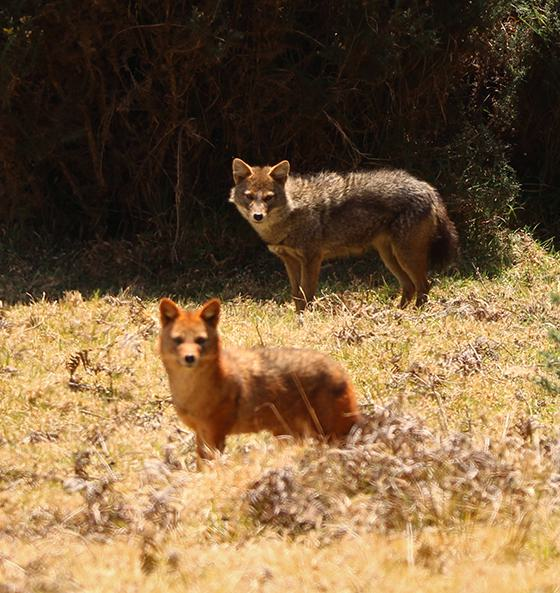
- Research undertaken by NGO Aranyakam Nature Foundation estimates that Kerala is home to 20,000–30,000 golden jackals.
About Golden Jackal (Canis aureus)
- Appearance: Also known as the common jackal, it is smaller than a wolf but larger than a fox. It has a golden to pale gold or brown-tipped coat, which can vary seasonally and regionally.
- Behaviour: Primarily nocturnal, active mostly at night.
- Habitat & Distribution: Found across Europe, Southwest, Central, South, and Southeast Asia.
- In India, golden jackals are found in states like Kerala, Maharashtra, Rajasthan, and Haryana.
- Diet: Omnivores in nature, they feed on small mammals, insects, hares, fish, birds and fruits and often venture into human habitats in search of the same.
- Legal protection:
- IUCN Red List: Least Concern
- CITES: Appendix III
Source: TH
Previous article
Layoffs Across IT Services Industry
Next article
Girl Child Trafficking in India
